Collaborative filtering recommends items from patterns in user behavior. Content-based filtering recommends items from their attributes and a user's interests. Hybrid recommendation combines both signals to compensate for their limitations. None is automatically the best choice: the right algorithm depends on interaction density, item metadata, freshness, and the outcome your application needs.
How Do the Three Recommendation Algorithms Compare?
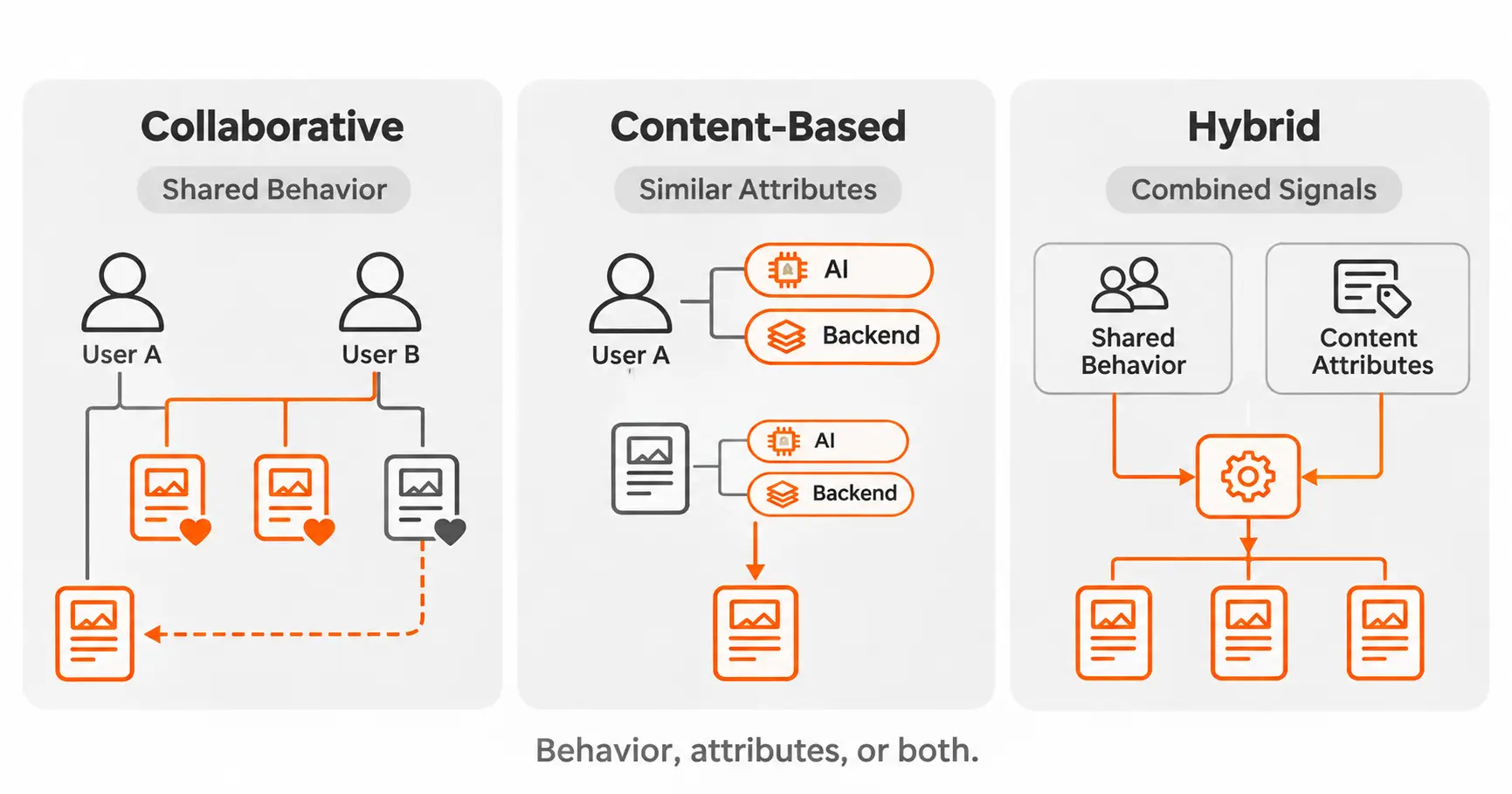
Google's candidate-generation documentation describes collaborative and content-based methods as complementary ways to select items for further scoring. They need not be competing end-to-end systems.
How Does Collaborative Filtering Work?
Collaborative filtering learns relationships from actions across many users and items. If two readers repeatedly save similar articles, an article saved by one may be worth recommending to the other, even when its topic looks different.
The input is typically a user-item interaction matrix. Rows represent users, columns represent items, and observed entries represent ratings, saves, views, or purchases. Missing entries do not necessarily mean dislike: an item may never have been shown.
Google's collaborative-filtering explanation describes learning user and item embeddings that capture these relationships without requiring engineers to hand-author every item characteristic.
User-based, item-based, and model-based methods
User-based filtering searches for people with similar histories. Item-based filtering identifies items commonly engaged with by overlapping audiences. Both can be useful baselines but become expensive or sparse at scale.
Model-based approaches, including matrix factorization, learn compact latent representations. A predicted affinity can be approximated by the dot product of user and item vectors. Collaborative filtering excels when meaningful interaction patterns exist. It is much weaker when an app has few users, few repeated interactions, or rapidly changing inventory.
How Does Content-Based Filtering Work?
Content-based filtering represents items using their characteristics and matches them against user preferences. A job platform can compare required skills and seniority with a candidate's interests; a creator app can match topics, language, and content semantics.
A simple approach uses tags or weighted categories. More advanced systems encode titles, descriptions, images, or other features as embeddings and retrieve nearby items.
In Google's content-based filtering tutorial, user and item attributes are mapped into a shared feature space, and a similarity score identifies matching items.
For example, someone following backend engineering topics could receive a newly published database article immediately because its metadata is informative. The weakness is overspecialization. When a user's history emphasizes one topic, the system may continually suggest nearly identical material. Sparse or inaccurate metadata also makes the similarities unreliable.
What Makes a Recommendation System Hybrid?
A hybrid recommender combines multiple recommendation signals, commonly collaborative interaction patterns and content similarity. It can use content metadata when behavioral coverage is weak and collaborative information as meaningful interactions accumulate.
A 2026 Journal of Big Data survey reviews these established recommendation families and their challenges, including sparsity and cold start. Hybridization is an architectural choice, not a guarantee of higher accuracy.
There are several useful designs:
For most production teams, mixed retrieval followed by common scoring offers a straightforward service boundary.
How Would These Methods Recommend the Same Items?
Consider a fictional creator marketplace. User U follows database engineering and has saved technical posts. Another group of users with overlapping behavior also frequently saves a creator's distributed-systems article.
A content-based generator may recommend a new SQL tutorial because its topics closely match U's interests. A collaborative generator may instead surface that distributed-systems article because similar users engaged with it.
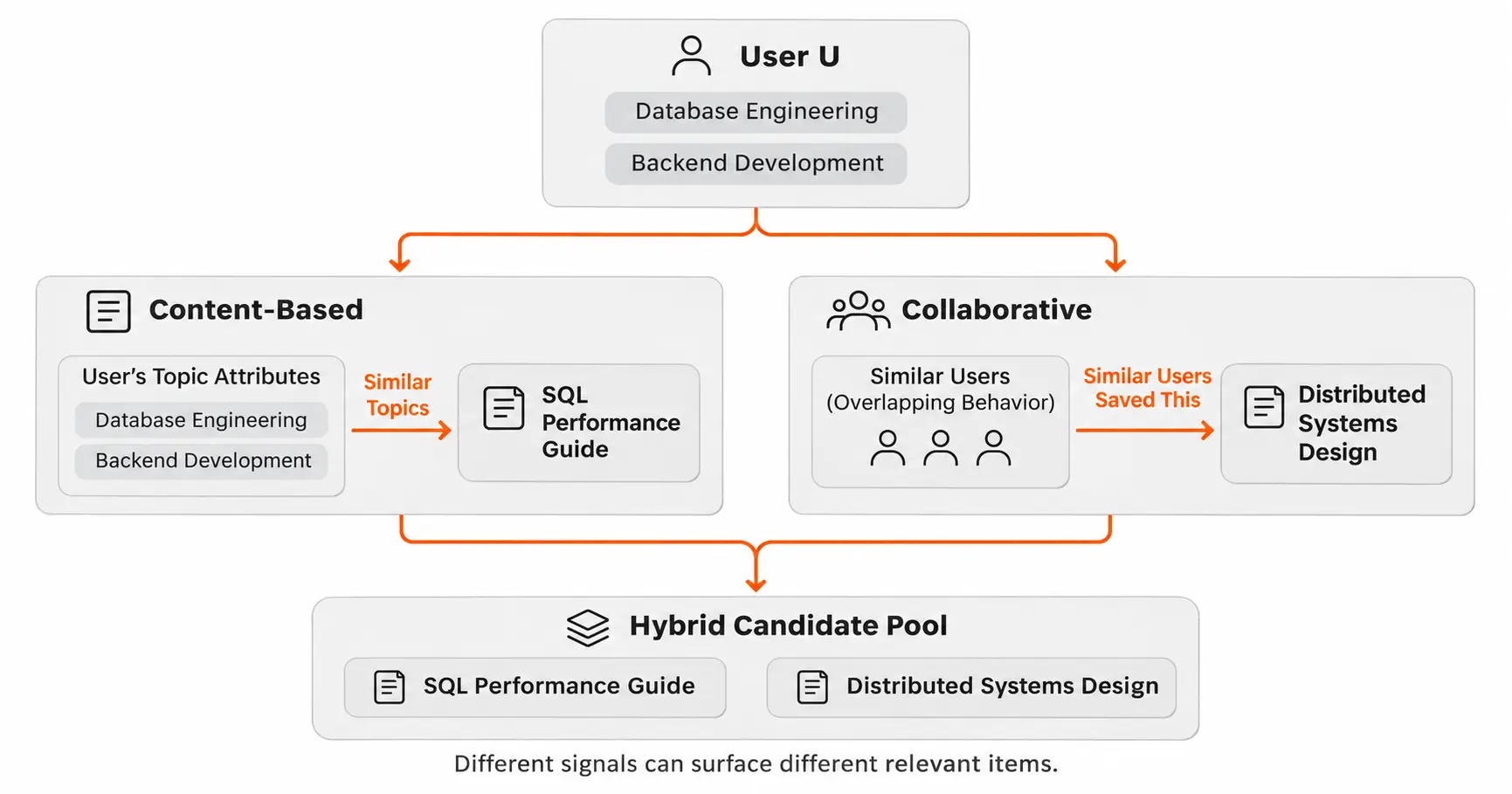
A hybrid pool can include both, deduplicate overlapping results, then apply a common score for relevance, freshness, and quality. Final diversity rules can prevent several nearly identical posts appearing consecutively.
Which Algorithm Handles New Users and Items Better?
Cold start comes in two forms: a new user has little preference history, and a new item has few or no interactions.
For new items, content-based retrieval works when descriptive metadata exists. Pure collaborative matrix factorization cannot directly infer a reliable embedding for an unseen item without additional adaptation.
For new users, even content-based systems need some starting signal. Onboarding topics, current queries, session actions, and broadly relevant eligible items can provide one. A hybrid system can progressively add behavioral signals instead of forcing personalization too early.
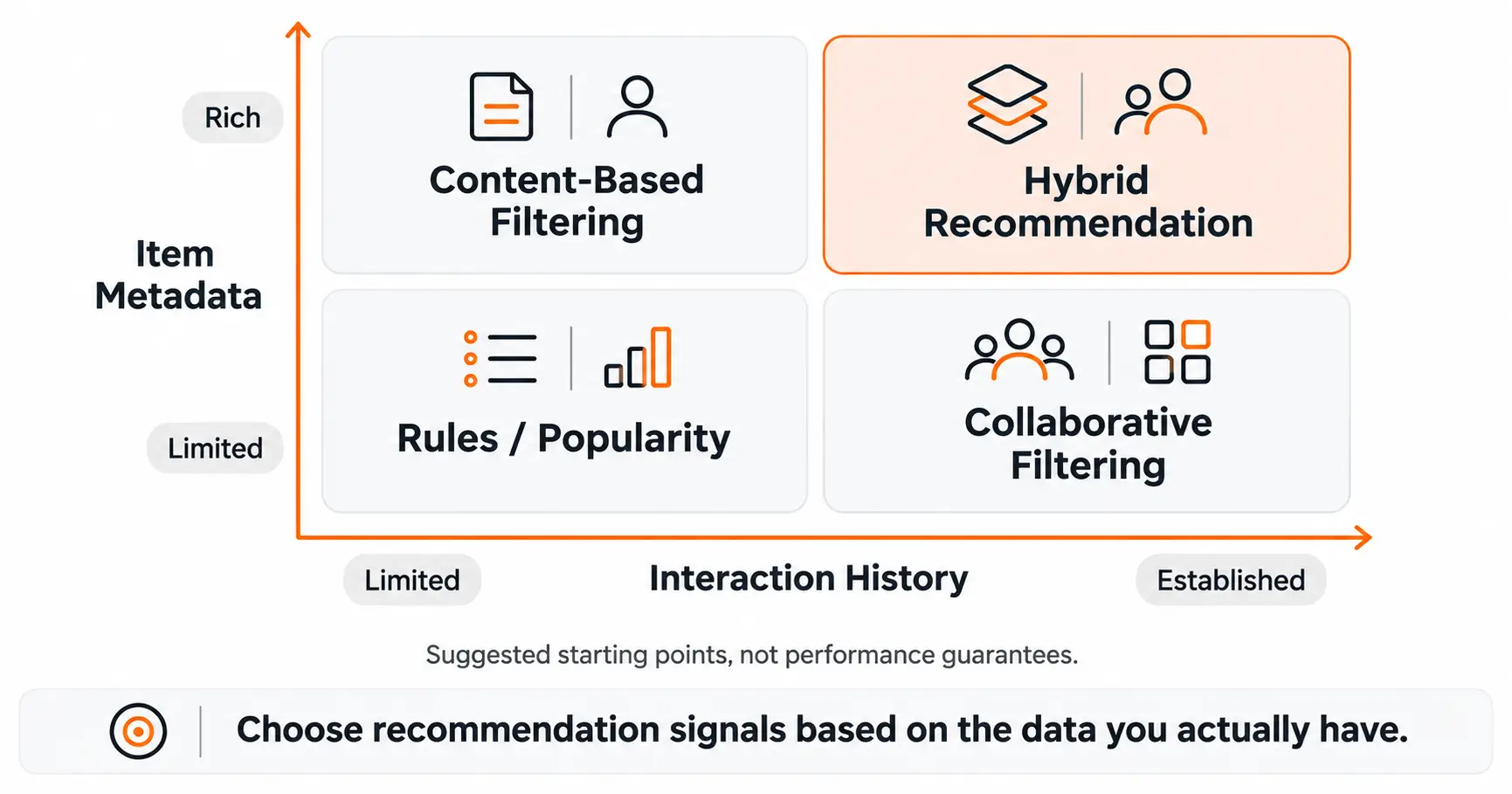
For most platforms, a practical approach combines collaborative and content-based retrieval with a shared scoring layer. This recommender system architecture allows teams to evaluate eligible candidates using consistent ranking objectives while applying diversity, freshness, and placement policies before displaying results.
What Data Does Each Recommendation Method Need?
Collaborative models need reliable identifiers and interaction events. Track impressions separately from clicks, saves, purchases, or hides, and preserve event time and placement position.
Content-based models need versioned item descriptions, tags, taxonomy, and relevant attributes. Image or text embeddings may help, but metadata should be refreshed when items change.
Hybrid systems need both sources aligned to common item IDs, feature versions, eligibility rules, and a consistent candidate contract. They also need clear handling of a missing or stale source.
Where Do Filtering Algorithms Fit in Production?
Collaborative and content-based filtering can operate during candidate retrieval, while a separate ranking stage determines the final relevance order. In production, these components work together rather than competing as standalone recommendation systems.
A typical architecture follows:
User Context → Candidate Retrieval → Merge & Deduplicate → Eligibility → Ranking → Re-ranking → Response
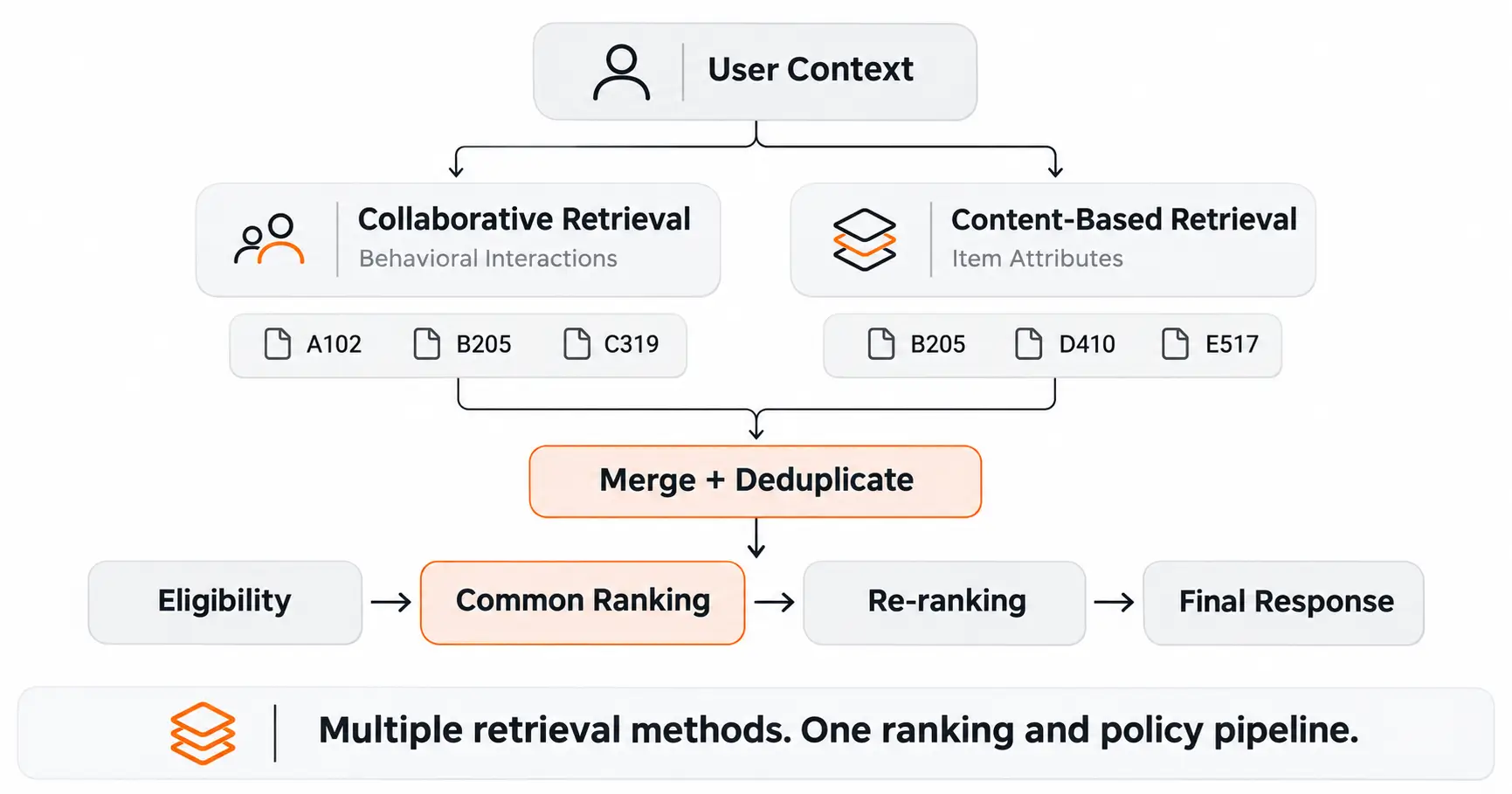
NVIDIA's recommendation-system architecture guide describes this multi-stage process, separating candidate retrieval, filtering, scoring, and final ordering based on business requirements.
More recently, Spotify Engineering's October 2026 research explores how production recommendation infrastructure is evolving beyond traditional retrieval-and-ranking pipelines toward generative recommendation models.
For most platforms, the practical architecture remains straightforward: use collaborative and content-based methods to identify relevant candidates, apply a common ranking objective, and enforce eligibility, diversity, and placement policies before serving results.
Our recommender systems guide for engineers explains how these components connect in a production recommendation pipeline.
How Should Engineers Compare Recommendation Algorithms?
Compare methods on the same evaluation population, eligible catalog, and time window. Start with a popularity or recency baseline before evaluating sophisticated models.
A high offline score does not establish improved business outcomes. Historical logs reflect previous exposure and ranking policies. Use randomized online experiments where feasible, with explicit reliability and user-experience guardrails.
Which Approach Is Easier to Operate?
A tag-based content recommender can be inexpensive to launch when item descriptions already exist. Semantic embeddings introduce indexing and refresh costs, but may still be simpler than full behavioral training.
Collaborative filtering adds interaction pipelines, sparse-matrix or embedding training, model refreshes, and new-item fallbacks. Hybrid systems add coordination between components, score normalization, and failure isolation.
Estimate total cost using catalog updates, request volume, candidate counts, latency, observability, and engineering maintenance rather than assuming the most sophisticated option is best.
Which Recommendation Algorithm Should You Choose?
Choose content-based filtering when item metadata is strong, inventory changes rapidly, and interaction history is sparse. It is useful for niche content, job postings, and newly listed marketplace inventory.
Choose collaborative filtering when repeated interactions are dense enough to reveal useful relationships and discovery beyond explicit item attributes matters.
Choose hybrid recommendation when both kinds of evidence are valuable, and your team can support reliable candidate merging, feature governance, and experiments.
The recommendation engine architecture guide covers how to maintain these boundaries without turning every component into one opaque service.
Can These Algorithms Support Sponsored Discovery?
Organic recommendation answers which items may be relevant. Sponsored selection answers which eligible paid items may occupy permitted positions. These are related but distinct decisions.
A marketplace may use collaborative or content-based methods to retrieve organic candidates, then apply a separate decision layer to coordinate organic ordering with sponsored candidates, advertiser eligibility, and placement limits.
Paid bids must not override safety or inventory requirements. Track organic engagement and retention alongside sponsored fill and revenue so monetization does not undermine discovery.
How We Connect Recommendation Signals to Decisions at Gortex
At Gortex, we're building decision infrastructure for platforms that already own candidate retrieval and want to rank and monetize their discovery surfaces through one API.
Your application can use collaborative filtering, content-based retrieval, or a hybrid pipeline to select eligible candidates. Our decision engine operates downstream, applying calibrated linear ranking, platform policies, and sponsored-placement decisions to the candidates you provide.
Through POST /v1/decide, we return an ordered result and decision metadata that connects what was served to later outcomes. We focus on the decision layer; your team keeps control of catalog retrieval, inventory, and the user interface.
Gortex is in private beta with an open waitlist. Teams can join the waitlist to explore a scoped integration against their existing recommendation workflow.
Conclusion
Collaborative filtering learns from collective behavior, content-based filtering matches attributes to interests, and hybrid recommendation combines both. Each solves a different data problem rather than representing a fixed ladder of sophistication.
For production teams, start with the most reliable signals available, measure candidate coverage and user outcomes, and preserve clear boundaries between retrieval, ranking, and placement policies. When discovery also needs monetization, Gortex helps connect those existing candidate signals to coordinated organic and sponsored decisions without replacing the entire recommendation stack.
Frequently Asked Questions
Is collaborative filtering always more accurate?
No. Accuracy depends on interaction coverage, labels, catalog dynamics, and the evaluation objective. Sparse platforms may benefit more from content signals.
Does content-based filtering require machine learning?
No. Tags and rules can be sufficient. Learned text or image embeddings are optional ways to represent item meaning.
Is hybrid recommendation always better?
No. Hybrids add coverage and complexity. They should outperform a simpler baseline in controlled evaluation before adoption.
Can a recommendation system use both retrieval approaches and a separate ranker?
Yes. Multiple generators can provide candidate pools while a common scoring and policy layer determines final ordering.