A recommender system is software that selects and ranks items for users based on relevance, preferences, behavior, and context. It helps applications decide which products, videos, articles, profiles, or posts someone should discover next.
Recommender systems typically combine candidate retrieval, scoring, re-ranking, and feedback collection. They can use rules, collaborative filtering, content similarity, machine learning, or hybrid approaches.
For engineers, the challenge is not simply predicting user preferences. It is building a reliable system that serves relevant recommendations within production latency, data, and operational constraints.
This guide covers the algorithms, architecture, evaluation methods, and engineering decisions behind practical recommendation systems.
What Is a Recommender System?
A recommender system, also called a recommendation system, is an information-filtering system that identifies potentially relevant items and determines which to present to a user.
The items vary by application:
-
Social platforms recommend posts and creators.
-
Marketplaces recommend products and sellers.
-
Streaming services recommend videos or music.
-
Dating applications recommend profiles.
-
Job boards recommend vacancies and candidates.
Recommendations can use explicit preferences, previous interactions, item attributes, or current session context.
Unlike ordinary sorting, personalized recommendation can produce different results for different users examining the same catalog.
A recommendation engine refers to the software responsible for these decisions. The distinction between a complete system and a specific API is explained in Gortex's recommendation API versus recommendation engine comparison.
How Do Recommender Systems Work?
Most large-scale recommender systems separate retrieval from scoring and re-ranking.
Google's recommendation-systems course describes three principal stages: candidate generation, scoring, and re-ranking.
1. Candidate generation
Retrieve a manageable subset from a potentially enormous catalog.
2. Scoring
Estimate each candidate's relevance using user, item, and contextual signals.
3. Re-ranking
Apply constraints involving diversity, freshness, eligibility, or business requirements.
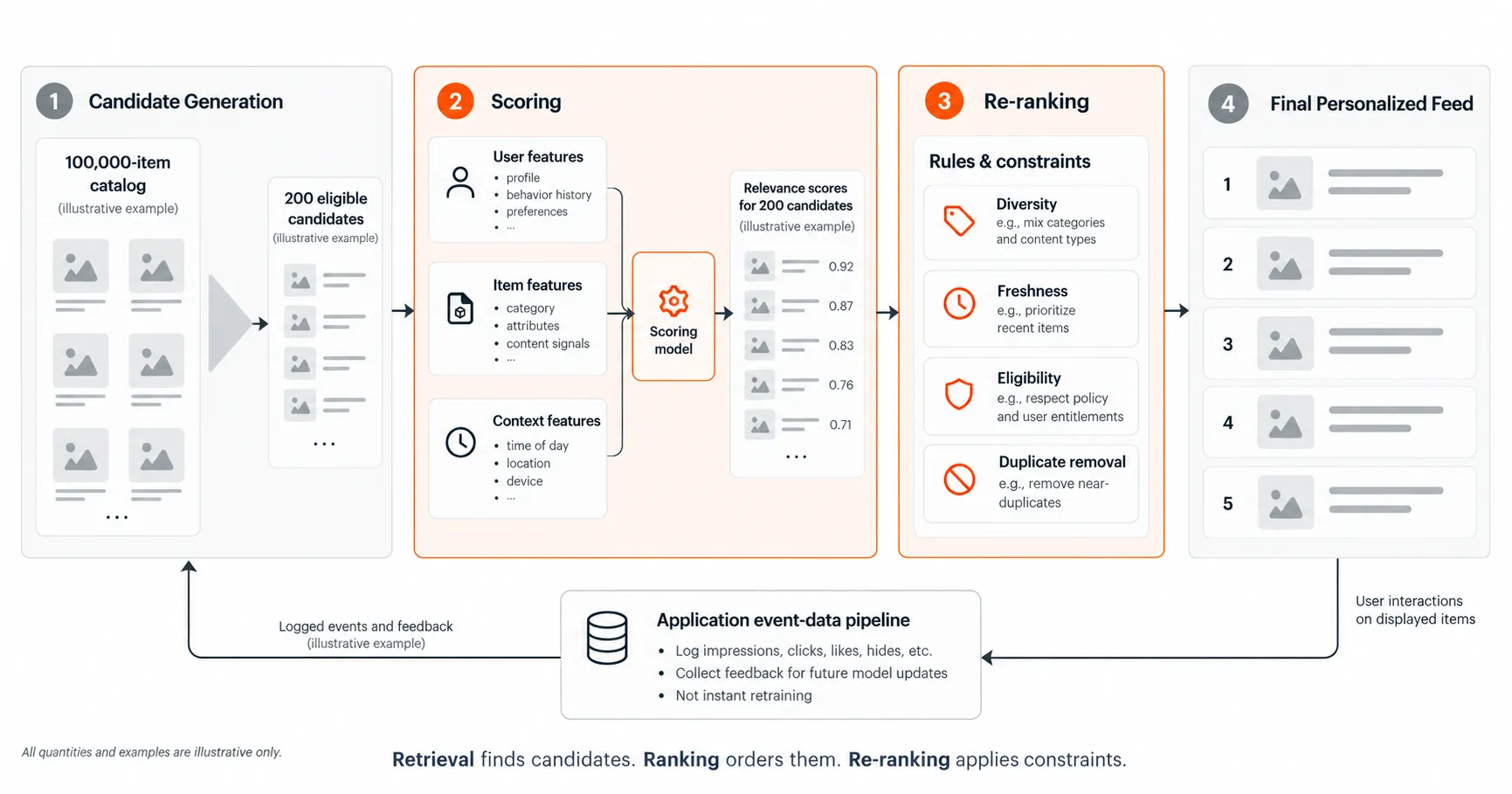
The application then renders the final ordering and records user interactions.
This separation exists because evaluating every catalog item with a sophisticated ranking model on every request is usually impractical.
The architectural distinction also determines which components should remain inside your application and which can be delegated to external services.
What Is Candidate Generation?
Candidate generation identifies items worth evaluating more carefully.
A social application might retrieve content from followed accounts, similar creators, trending posts, and recently published material.
A marketplace might retrieve products matching a search query, category, location, and availability requirements.
Candidate generators commonly use keyword search, filtering, collaborative retrieval, embedding similarity, or approximate nearest-neighbor indexes.
The objective is broad coverage under a strict computational budget.
Google's 2016 paper, Deep Neural Networks for YouTube Recommendations, describes separate candidate-generation and ranking networks for large-scale recommendation.
The architecture illustrates an enduring engineering principle: expensive relevance decisions should operate on a smaller candidate set.
Retrieval determines what can be recommended. Ranking determines which candidates appear first.
What Are the Main Recommendation Algorithms?
Recommendation algorithms vary in their data requirements, complexity, and adaptability.
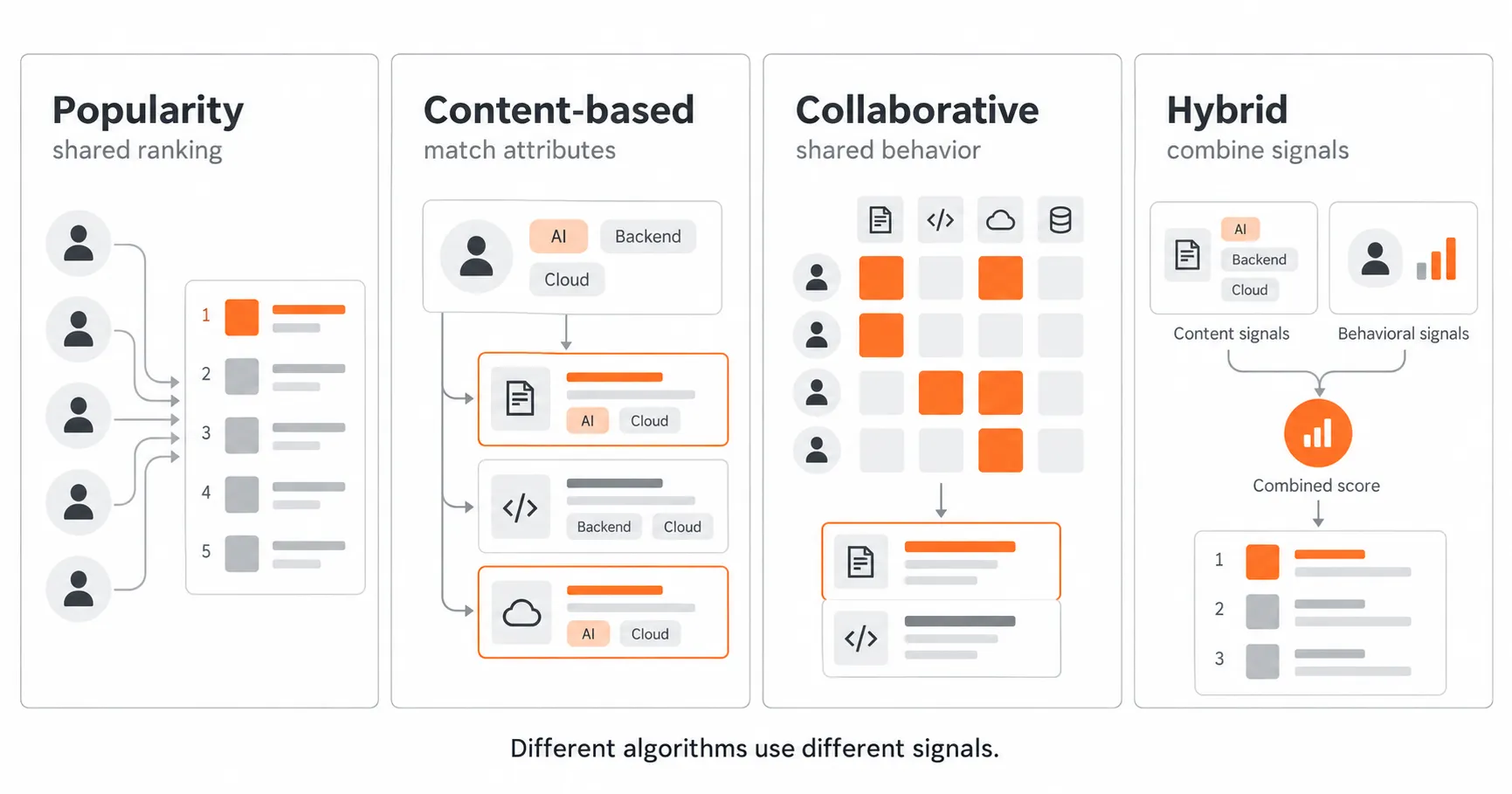
No algorithm consistently wins across every dataset or product.
Simple approaches can work well when interaction data is sparse, while more sophisticated models become useful when sufficient reliable feedback exists.
Choose algorithms through controlled evaluation rather than architectural fashion.
How Does Collaborative Filtering Work?
Collaborative filtering recommends items using patterns in collective user-item interactions.
Suppose two users repeatedly engage with similar content. Items preferred by one user may become reasonable candidates for the other.
User-based approaches compare users. Item-based approaches compare items. Model-based methods learn representations from interaction data.
Google's collaborative filtering documentation explains how models can learn embeddings representing relationships between users and items.
The approach can discover relationships that item metadata does not capture.
However, collaborative filtering struggles when new users or items have few interactions.
It can also reinforce exposure patterns already present in historical data.
For early-stage applications, that makes collaborative filtering a useful option, not an automatic starting point.
How Does Content-Based Filtering Work?
Content-based recommendation matches item characteristics against a user's known preferences.
A job board might use skills, seniority, location, and job descriptions. A content platform might use categories, topics, language, and semantic embeddings.
The advantage is that recommendations can operate without extensive interactions from other users.
New items may also become eligible immediately when meaningful metadata exists.
However, systems relying exclusively on content similarity can recommend overly repetitive items.
Users interested in one topic may never encounter adjacent topics.
Content-based filtering therefore works particularly well alongside exploration, freshness, or diversity mechanisms.
What Does Matrix Factorization Do?
Matrix factorization decomposes a user-item interaction matrix into lower-dimensional user and item representations.
Conceptually:
Predicted Preference ≈ User Vector · Item Vector
The dot product estimates compatibility between the user and candidate item.
For example, a user vector emphasizing technical content may produce a higher score for engineering articles than unrelated entertainment posts.
This is a simplified representation, not a universal formula for every model.
Matrix factorization can uncover latent relationships that are not explicitly described in product metadata.
Its limitations include sparse feedback, new-user cold starts, and the need to update representations as preferences change.
Engineers should compare it against simpler baselines before committing to a specialized training and serving pipeline.
How Are Candidates Scored?
Ranking assigns candidate scores based on the outcome the application wants to predict or optimize.
Inputs may include historical engagement, content freshness, item quality, session context, and eligibility constraints.
A simplified linear score might be:
Score = 0.5 × Relevance + 0.3 × Freshness + 0.2 × Quality
The weights are illustrative, and all three features must be placed on compatible scales.
More complex rankers may use gradient-boosted trees or neural networks.
TensorFlow Recommenders provides tooling for training and evaluating retrieval and ranking models using user, item, and contextual information.
The correct objective matters more than model complexity.
Optimizing clicks may reward attention-grabbing items rather than completed purchases, satisfaction, or durable retention.
Why Is Re-Ranking Necessary?
A relevance score does not necessarily produce a suitable final feed.
The highest-scoring candidates might come from one creator, repeat similar content, include unavailable products, or violate business constraints.
Re-ranking applies rules after initial scoring.
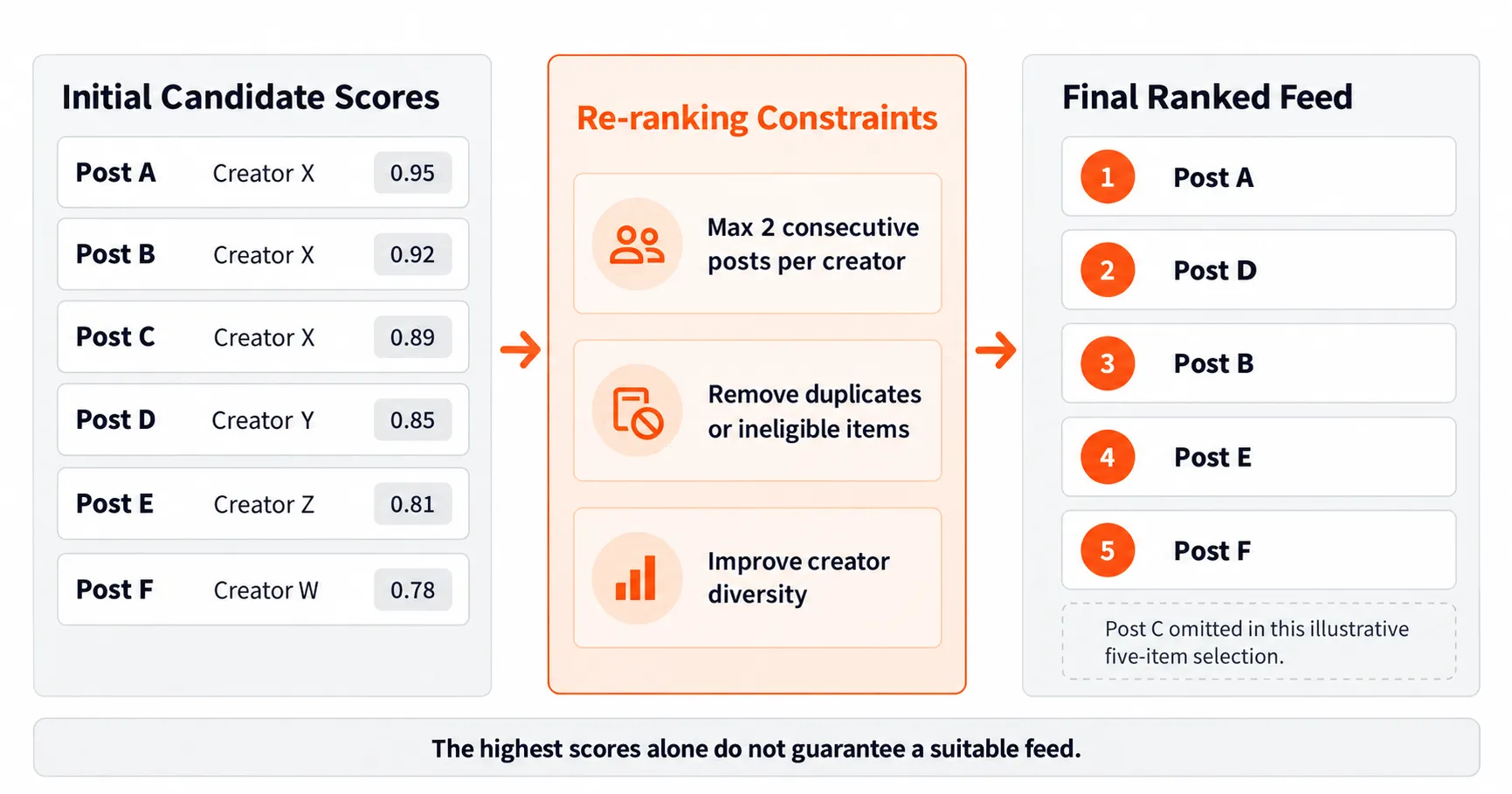
Examples include creator diversity, duplicate removal, category coverage, freshness adjustments, and inventory eligibility.
A marketplace may also reserve eligible sponsored positions, provided paid placement does not bypass mandatory quality controls.
Gortex's feed-ranking architecture guide describes how retrieval, ranking, serving, and logging interact in production.
Re-ranking should be measurable and deterministic where operational consistency is required.
Otherwise, business rules can quietly undermine the relevance model they were intended to improve.
How Do Recommender Systems Handle New Users?
Cold start occurs when a recommendation system lacks enough interaction data for a new user or item.
For new users, initial recommendations can use onboarding preferences, location where appropriate, session behavior, and broadly relevant content.
For new items, metadata and semantic similarity provide signals before interaction history develops.
A practical fallback might combine category relevance, recent quality signals, and controlled exploration.
Do not treat missing clicks as evidence that an unseen item is unpopular.
Likewise, global popularity should not become the permanent recommendation strategy.
Cold-start handling needs its own evaluation because aggregate accuracy often hides poor experiences for new users.
What Data Should Engineers Collect?
Useful recommendation data includes explicit preferences, impressions, clicks, saves, purchases, follows, and other meaningful actions.
However, signals differ in quality.
A purchase often indicates stronger intent than a click, while a short viewing session may be ambiguous.
Log the item, recipient, surface, position, timestamp, decision identifier, and resulting interaction.
Position matters because users encounter higher-ranked items more frequently.
Only collect personal data appropriate for the application, with suitable access controls, retention practices, and legal compliance.
The objective is reliable feedback, not indiscriminate data collection.
How Do You Measure Recommendation Quality?
Recommendation systems require offline and online evaluation.
Offline testing uses historical interactions to compare candidate models. Online experiments measure actual user responses after deployment.
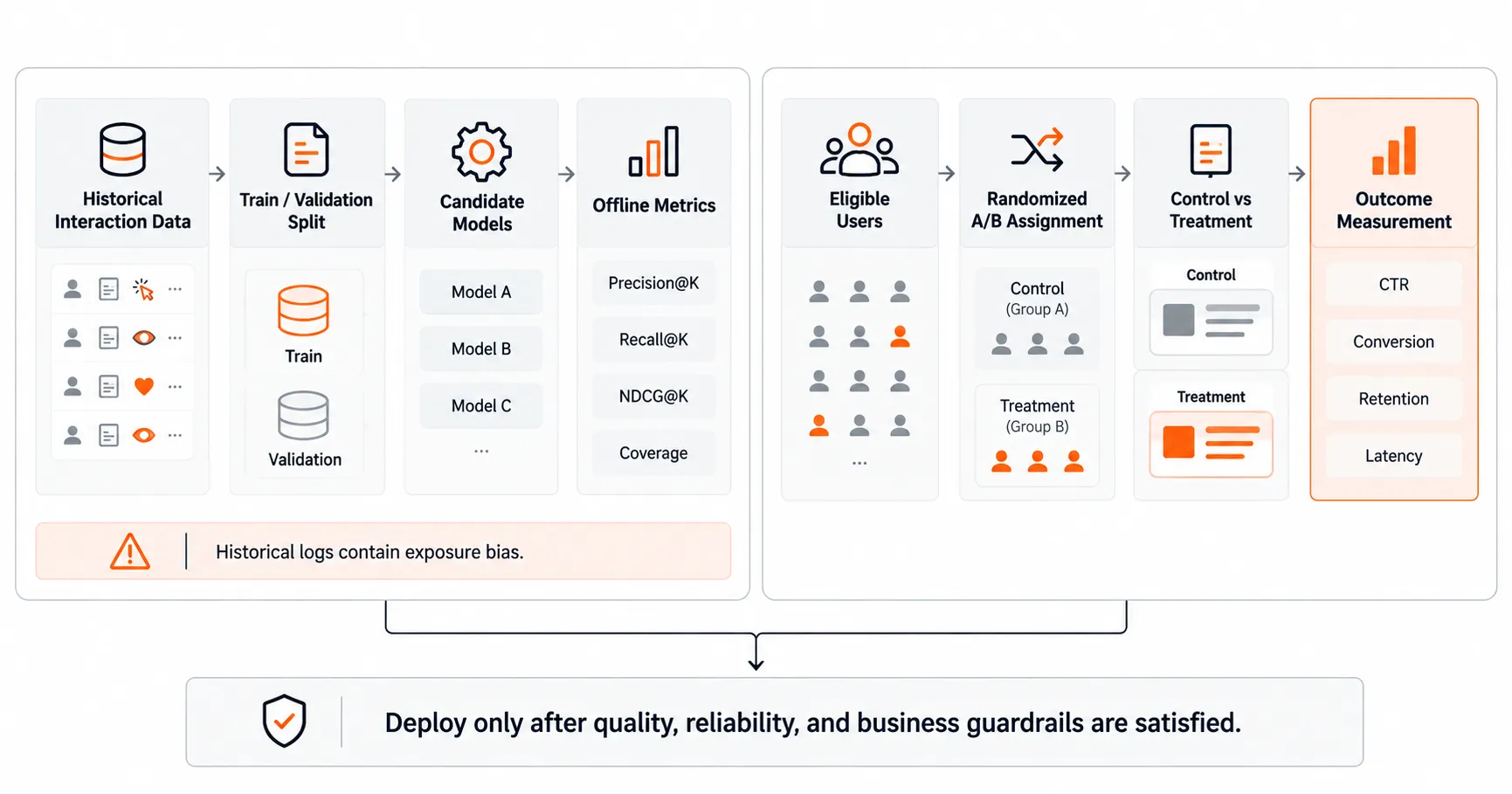
A 2024 systematic review of 57 recommender-evaluation papers found that evaluation frequently concentrates on a limited set of datasets and accuracy metrics.
Offline results also face exposure bias: users cannot interact with items they never see.
A 2025 ACM RecSys study examined how exposure and evaluation sampling can distort model comparisons.
Therefore, improvements in offline ranking metrics should be treated as evidence for further testing, not proof of business impact.
What Makes a Recommender Production-Ready?
A production recommender must deliver useful results within the application's latency and reliability budget.
Engineers should measure p50, p95, and p99 response times alongside error rates, timeouts, throughput, and fallback behavior.
Separate retrieval latency from ranking and rendering overhead.
Maintain a safe fallback when feature stores, indexes, or ranking services become unavailable.
Also version ranking configurations and record the decision associated with each served list.
Reliable logging makes regressions diagnosable and experiments reproducible.
A sophisticated model that frequently times out may provide a worse user experience than a simpler, dependable ranker.
Should You Build a Recommendation Engine?
Build when recommendation quality is a core differentiator and your team can own data pipelines, model training, evaluation, and production operations.
Consider a managed API when engineering capacity is limited or the immediate requirement is candidate re-ranking.
The critical distinction is scope.
A complete recommender may handle retrieval and ranking. A ranking-only API expects the application to provide eligible candidates.
Gortex's ranking API evaluation guide explains why that boundary matters when comparing integrations.
Evaluate vendors against actual data ownership, latency, debugging, fallback, privacy, and exit requirements.
Avoid selecting a service merely because it advertises machine learning.
Where Does Gortex Fit?
Gortex provides a decisioning API for applications that already retrieve their candidate items.
Its POST /v1/decide endpoint receives recipient, context, and candidate information, then returns ranked decisions and optional sponsored placements.
Currently documented capabilities include calibrated linear ranking, deterministic sponsored-slot filling, and decision identifiers.
Gortex does not currently provide a learned ranking model or complete candidate-retrieval infrastructure. Real-time auctions are also not a current production capability.
For engineering teams building feed or marketplace experiences, this represents a narrower integration option rather than a replacement for every component of a recommender system.
Its private-beta deployment should be evaluated through realistic testing before production adoption.
Conclusion
Recommender systems combine data, retrieval, scoring, re-ranking, and feedback to determine what users discover.
Effective implementations begin with clear objectives, simple baselines, dependable logging, and honest evaluation.
More sophisticated algorithms can improve results, but they introduce additional operational responsibilities.
For engineers, the most useful starting question is not which model to train. It is which recommendation decision the application needs, what data supports it, and how success will be measured in production.
Frequently Asked Questions
Are recommender systems always based on machine learning?
No. Rules, popularity ranking, and deterministic scoring can generate recommendations. Machine learning becomes useful when data and product requirements justify it.
What is the difference between retrieval and ranking?
Retrieval selects candidate items from a larger catalog. Ranking orders those candidates by estimated relevance or another defined objective.
Do recommendation systems require large datasets?
Not necessarily. Simple content-based and rules-based approaches can operate with limited interaction data. Data-hungry collaborative models need stronger feedback coverage.
Can recommender systems support sponsored content?
Yes. Applications can combine organic recommendation with clearly labeled, eligible sponsored placements while preserving relevance and policy requirements.