A recommendation API is an interface that lets applications request personalized recommendations. A recommendation engine is the underlying system that selects, scores, and ranks those recommendations. An API can expose a complete recommendation engine, a ranking-only service, or a narrower recommendation function.
That distinction matters when you're building a personalized feed, marketplace, content platform, or discovery product.
A team searching for a recommendation engine API might need an entire machine learning infrastructure. Another might already have candidate generation working and only need better ranking.
Buying the wrong solution can introduce unnecessary infrastructure, integration complexity, and long-term maintenance costs.
This guide explains how recommendation APIs and recommendation engines differ, what each architecture requires, how to compare costs, and when building or buying makes sense.
What Is a Recommendation API?
A recommendation API is a software interface that allows an application to request recommendations or personalized rankings from another service.
Typically, the application sends user information, contextual signals, or candidate items. The API processes the request and returns recommended items or scores.
For example, a marketplace might request personalized product recommendations using a user's browsing history.
A recommendation API can provide:
-
Personalized item recommendations
-
Similar product or content suggestions
-
Candidate re-ranking
-
Context-aware ordering
-
Filtering and business rules
-
Recommendation scores or decision metadata
However, these capabilities vary significantly between providers.
For example, Amazon Personalize supports real-time recommendation requests through managed recommenders and deployed campaigns.
Other APIs require applications to supply candidates before ranking them.
The important distinction: An API describes how functionality is accessed, not necessarily how much recommendation infrastructure the provider manages.
What Is a Recommendation Engine?
A recommendation engine, also called a recommender system, is the software infrastructure responsible for selecting relevant items for users.
Unlike an API, which defines an interaction boundary, an engine describes the underlying decision-making functionality.
Recommendation engines may use:
-
Collaborative filtering
-
Content-based filtering
-
Machine learning models
-
User-item embeddings
-
Behavioral signals
-
Rule-based scoring
-
Hybrid recommendation strategies
A production recommendation engine may also require data pipelines, feature processing, model training, candidate retrieval, online serving, and monitoring.
According to TensorFlow's recommendation systems documentation, modern recommender systems commonly use multiple stages, including retrieval, ranking, and post-ranking.
These stages reduce large candidate collections into personalized selections.
A recommendation engine can run entirely inside your infrastructure or be operated by a third-party provider.
Recommendation API vs Recommendation Engine: What's the Difference?
These are not mutually exclusive products. A recommendation engine may expose a recommendation API.
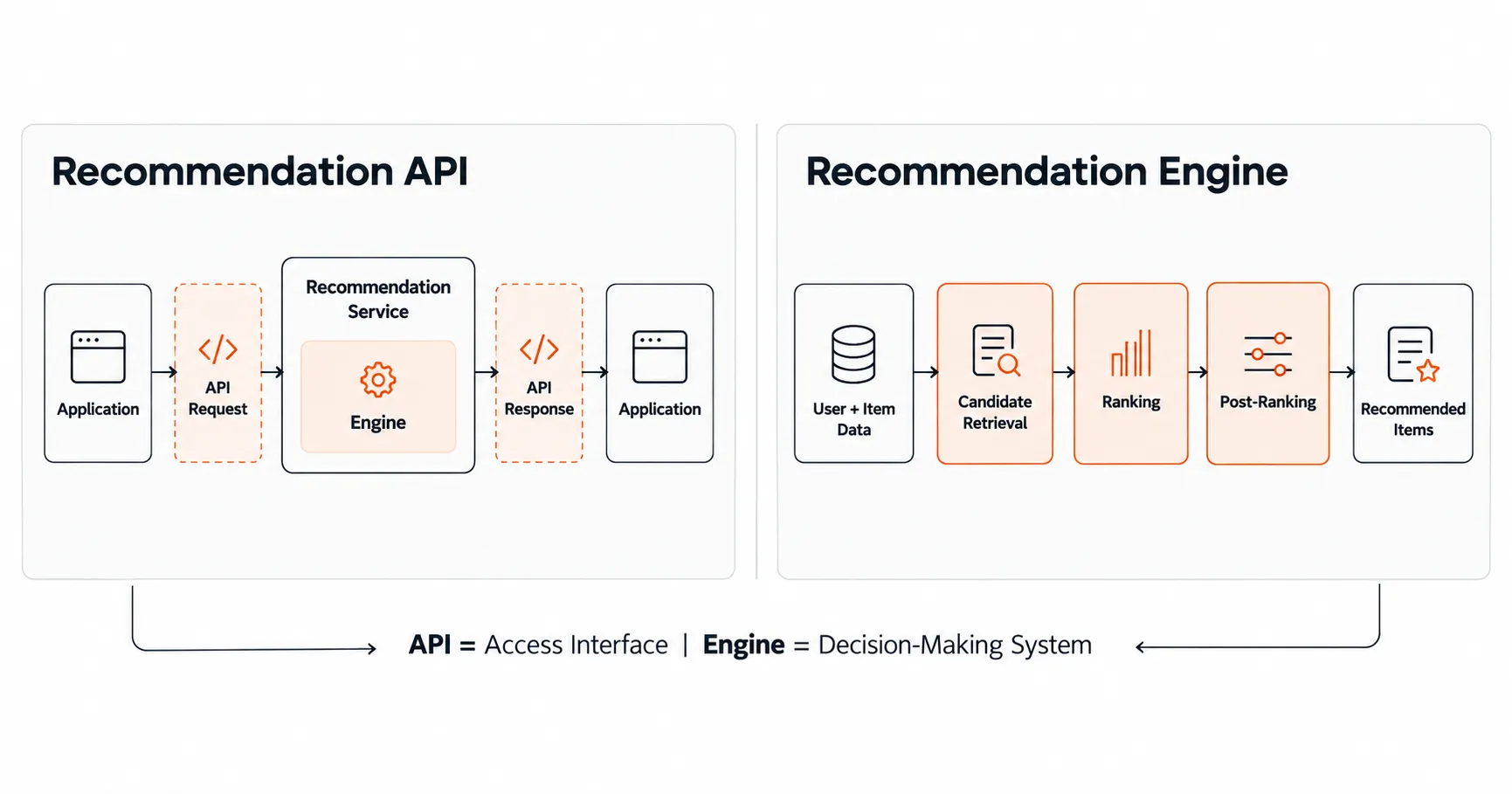
The purchasing decision is about which responsibilities remain with your engineering team.
How Does a Recommendation Engine Actually Work?
A production recommendation system commonly follows five stages.
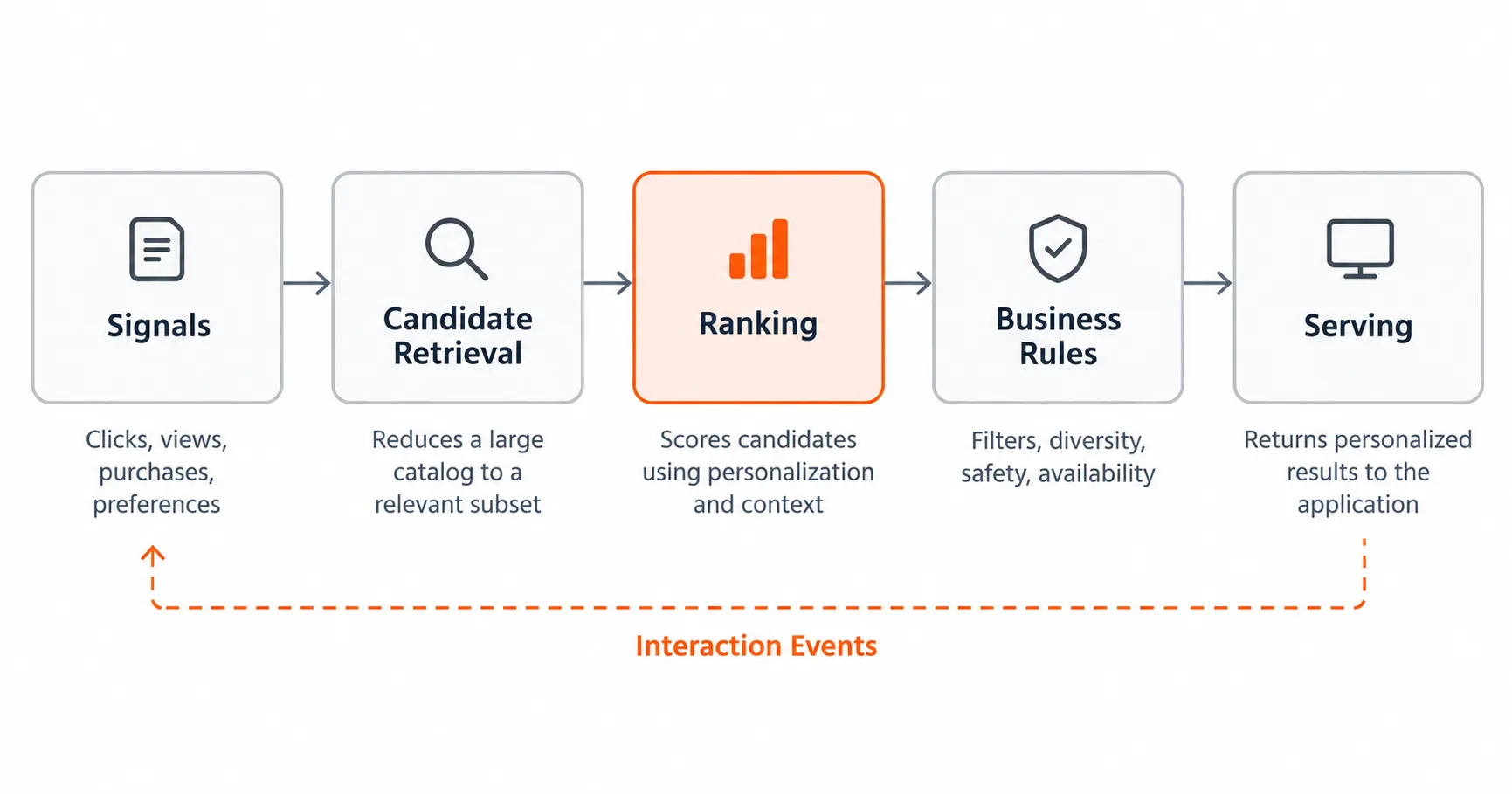
1. Collect User and Item Signals
The system processes information such as clicks, purchases, views, preferences, item categories, and session activity.
Signal quality matters because a click, purchase, and accidental impression represent different levels of user intent.
2. Generate Candidate Items
Candidate retrieval identifies potentially relevant items from a larger catalog.
A TensorFlow engineering example describes large-scale systems narrowing catalogs containing more than 100 million items into hundreds of candidates for downstream processing.
This is an architectural example, not a universal requirement.
3. Rank Candidates
The ranking stage scores retrieved items using user, item, and contextual features.
For example, a content platform might consider viewing history, freshness, creator affinity, and predicted engagement.
The strongest candidate is not necessarily the most popular item globally.
4. Apply Business Constraints
A post-ranking layer may enforce availability, diversity, safety policies, frequency caps, or commercial placement rules.
These constraints prevent purely predictive scores from determining every displayed result.
5. Serve and Measure Results
The system returns recommendations and records impressions, clicks, conversions, and other relevant outcomes.
Those signals support evaluation and future model improvements.
For a deeper architectural explanation, see Gortex's recommendation engine architecture guide.
How Does a Recommendation API Work in Practice?
Consider a social platform with a personalized "For You" feed.
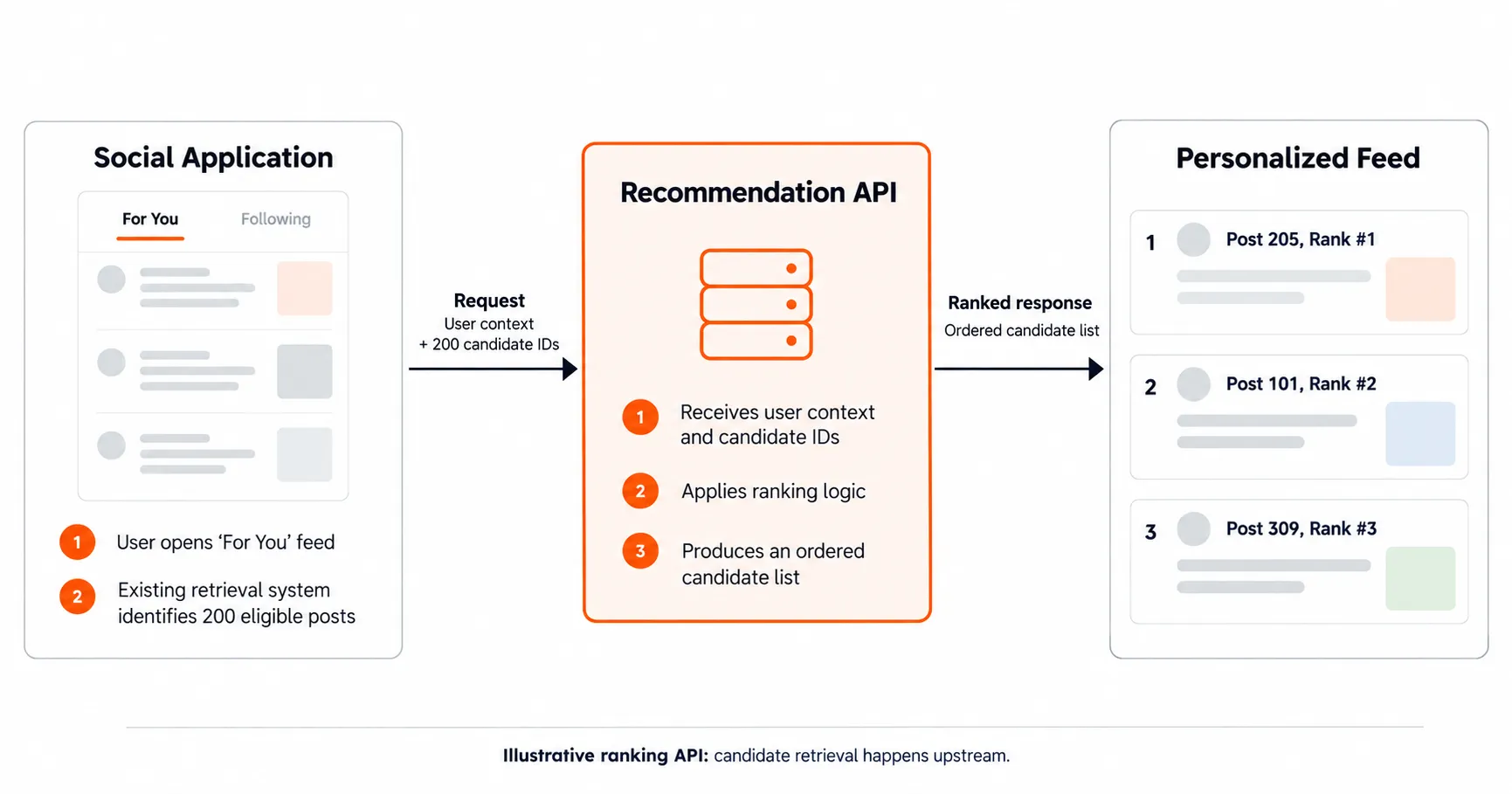
Its existing retrieval service selects 200 eligible posts. Instead of building a ranking service internally, the application sends those candidates to a recommendation or ranking API.
A simplified, illustrative request might look like:
{
  "user_id": "user_8120",
  "context": {
    "surface": "for_you",
    "device": "mobile"
  },
  "candidate_ids": [
    "post_101",
    "post_205",
    "post_309"
  ],
  "limit": 3
}
The service returns an ordered list based on its ranking logic.
This example is vendor-neutral; actual API schemas differ.
The critical question is whether the provider generates candidate items or expects your application to provide them.
That determines the amount of infrastructure your team must maintain.
Gortex's ranking API guide explains this boundary in more detail.
Recommendation API vs Ranking API: Are They the Same?
Not exactly.
A recommendation API may generate personalized items from an entire catalog. A ranking API usually scores and reorders an existing candidate set.
Consider a job marketplace containing 100,000 active listings.
A full recommendation service might retrieve suitable jobs and personalize their order.
A ranking-only API might receive 100 shortlisted jobs from your search infrastructure and decide their final order.
Both support personalized discovery, but they solve different architectural problems.
The distinction becomes especially important when evaluating vendors that advertise recommendation engines but primarily deliver re-ranking capabilities.
For more context, read ranking vs retrieval.
Recommendation API vs Building an In-House Engine: Cost Comparison
Cost depends on request volume, model complexity, data requirements, infrastructure, and engineering salaries.
There is no reliable universal monthly price for either approach.
However, engineering ownership can be compared using a transparent example.
Assume a company needs two engineers for six months to build its first production recommendation system, with a fully loaded annual engineering cost of $150,000 per engineer.
The $150,000 development figure is calculated as two engineers multiplied by half a year of assumed loaded compensation. It is an illustrative scenario, not a measured industry benchmark.
At 20 million recommendation requests per month, even small differences in per-request pricing become material.
Compare total costs across a 12 to 24-month period, including integration, inference, event ingestion, operational staffing, and fallback infrastructure.
Gortex's personalization engine build vs buy guide examines these longer-term ownership decisions.
When Should You Build a Recommendation Engine?
Building internally makes sense when recommendation quality represents a significant competitive advantage and your team has the capability to maintain it.
Examples include platforms requiring proprietary recommendation objectives, specialized data pipelines, or unusual algorithmic constraints.
An internal engine provides greater control over feature engineering, model experimentation, deployment, and system architecture.
However, it also creates ongoing responsibilities.
Your team must handle production incidents, model performance changes, data quality failures, retraining schedules, and infrastructure scaling.
The relevant question is not whether your engineers can build a recommendation model.
It is whether operating that system deserves their continuing attention.
When Should You Use a Managed Recommendation API?
A managed recommendation API becomes attractive when personalization matters, but owning the underlying infrastructure does not provide sufficient strategic advantage.
Typical situations include:
-
A marketplace replacing increasingly complex ranking rules
-
A social application introducing personalized feeds
-
A content platform without dedicated ML engineers
-
A startup that needs faster experimentation
-
An application adding recommendations to existing retrieval infrastructure
Managed services can reduce implementation effort, although integration, data preparation, evaluation, and vendor monitoring remain necessary.
Buying an API does not automatically eliminate machine learning complexity. It changes who operates particular parts of the system.
What Should CTOs Evaluate Before Choosing a Recommendation API?
A technical evaluation should go beyond recommendation quality demonstrated in a sales environment.
AWS documentation illustrates why operational details matter: Amazon Personalize campaigns deploy trained solution versions with provisioned transaction capacity.
That serving configuration can influence operational cost.
For production applications, test vendors using representative traffic rather than relying exclusively on published benchmarks.
Where Does Gortex Fit?
Gortex provides decisioning infrastructure for consumer platforms that already have candidate retrieval and need personalized ranking.
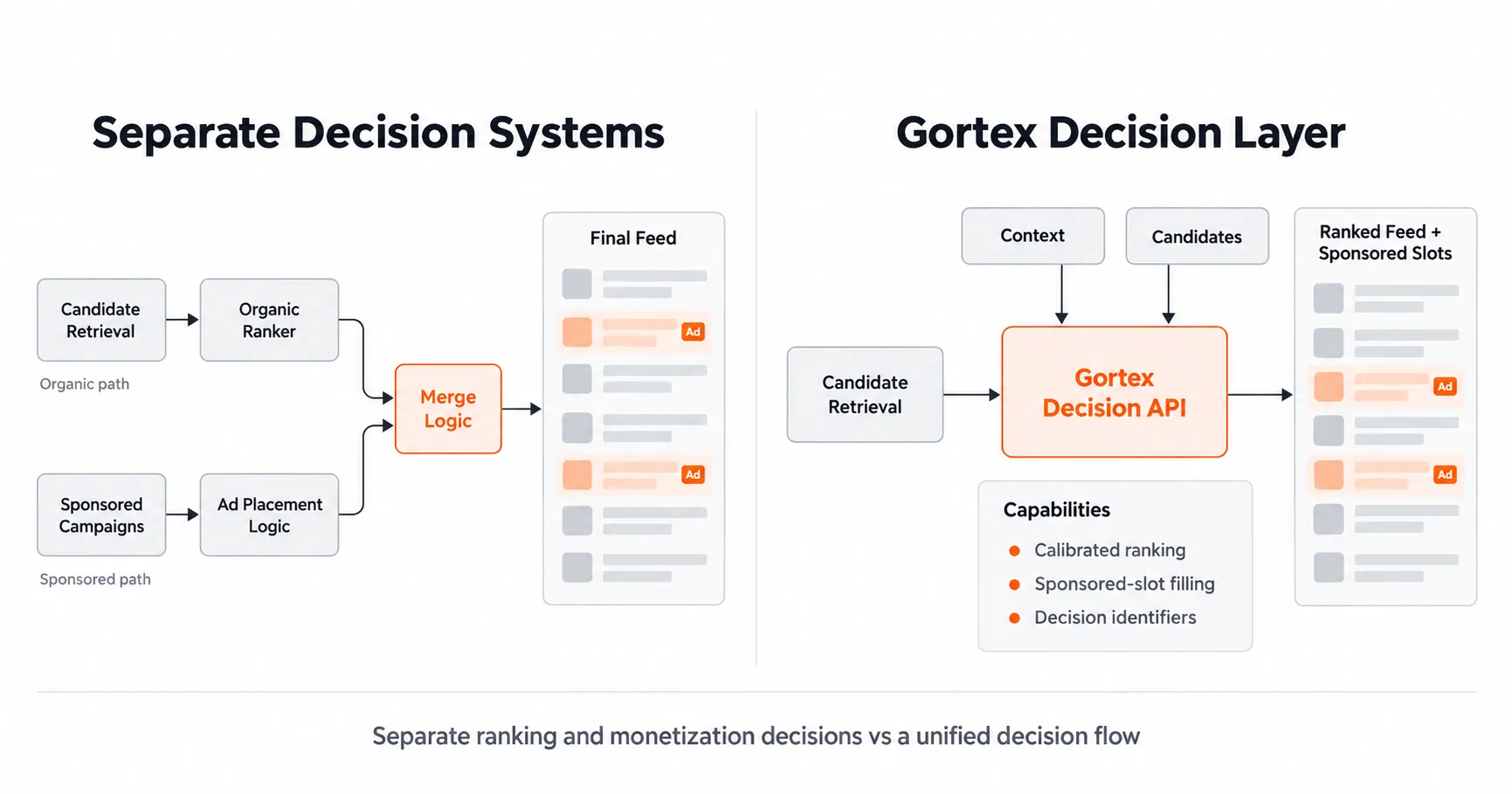
Rather than replacing an application's entire recommendation pipeline, Gortex handles the ranking decision between candidate generation and the user-facing surface.
Its API can return an ordered candidate set, sponsored placements, and decision identifiers through a single endpoint.
This architecture is relevant for marketplaces, personalized feeds, creator platforms, and other recommendation surfaces where organic relevance and monetization must coexist.
Gortex currently describes calibrated linear ranking and deterministic sponsored-slot filling as available capabilities. A learned ranker and real-time auction are roadmap capabilities.
That distinction matters: teams requiring a fully managed retrieval system or production real-time auction functionality today should evaluate alternatives accordingly.
Teams seeking ranking infrastructure with integrated sponsored-slot decisions can request access to Gortex.
Wrap-up: Choose Based on Infrastructure Ownership
The difference between a recommendation API and a recommendation engine is not simply technical terminology.
It determines which parts of your recommendation system you build, integrate, operate, and improve.
Choose a managed recommendation API when it removes infrastructure your team does not need to own. Build an internal recommendation engine when proprietary recommendation capabilities justify the investment.
And if you already generate relevant candidates, consider whether a dedicated ranking API is the narrower, more efficient solution.
The best architecture is the one that improves recommendation quality without creating unnecessary operational complexity.
Frequently Asked Questions
Is a recommendation API the same as a recommendation engine?
No. A recommendation API exposes recommendation functionality through an interface. A recommendation engine performs the underlying recommendation decisions. An engine can be accessed through an API.
Do recommendation APIs require machine learning?
Not necessarily. Recommendation APIs can use rule-based scoring, collaborative filtering, machine learning, or hybrid approaches. The appropriate method depends on available data and product requirements.
Can I build recommendations without a dedicated ML team?
Yes. Rule-based recommendations and managed APIs can provide useful personalization without a dedicated ML organization. More sophisticated systems may still require specialist expertise.
Can a recommendation API support sponsored listings?
Some can, but the capability is not universal. Confirm whether sponsored placements are integrated into ranking or require a separate advertising system.
Which is better for a startup?
A managed API is often preferable when speed and limited engineering resources matter most. An internal engine becomes more compelling when proprietary ranking is central to the product's competitive advantage.