Ranking algorithms order eligible items according to a defined objective. Production systems use everything from recency and popularity sorting to weighted scores, gradient-boosted trees, and neural rankers. The choice depends on feedback, latency, explainability, and measurable user value.
For marketplace, social, creator, and job-platform engineers, ranking is not the entire discovery pipeline. Retrieval supplies candidates; ranking scores them; downstream policies determine the displayable list.
This guide compares practical methods, their failure modes, and a realistic progression toward learning-to-rank.
Which Ranking Algorithms Are Used in Production?
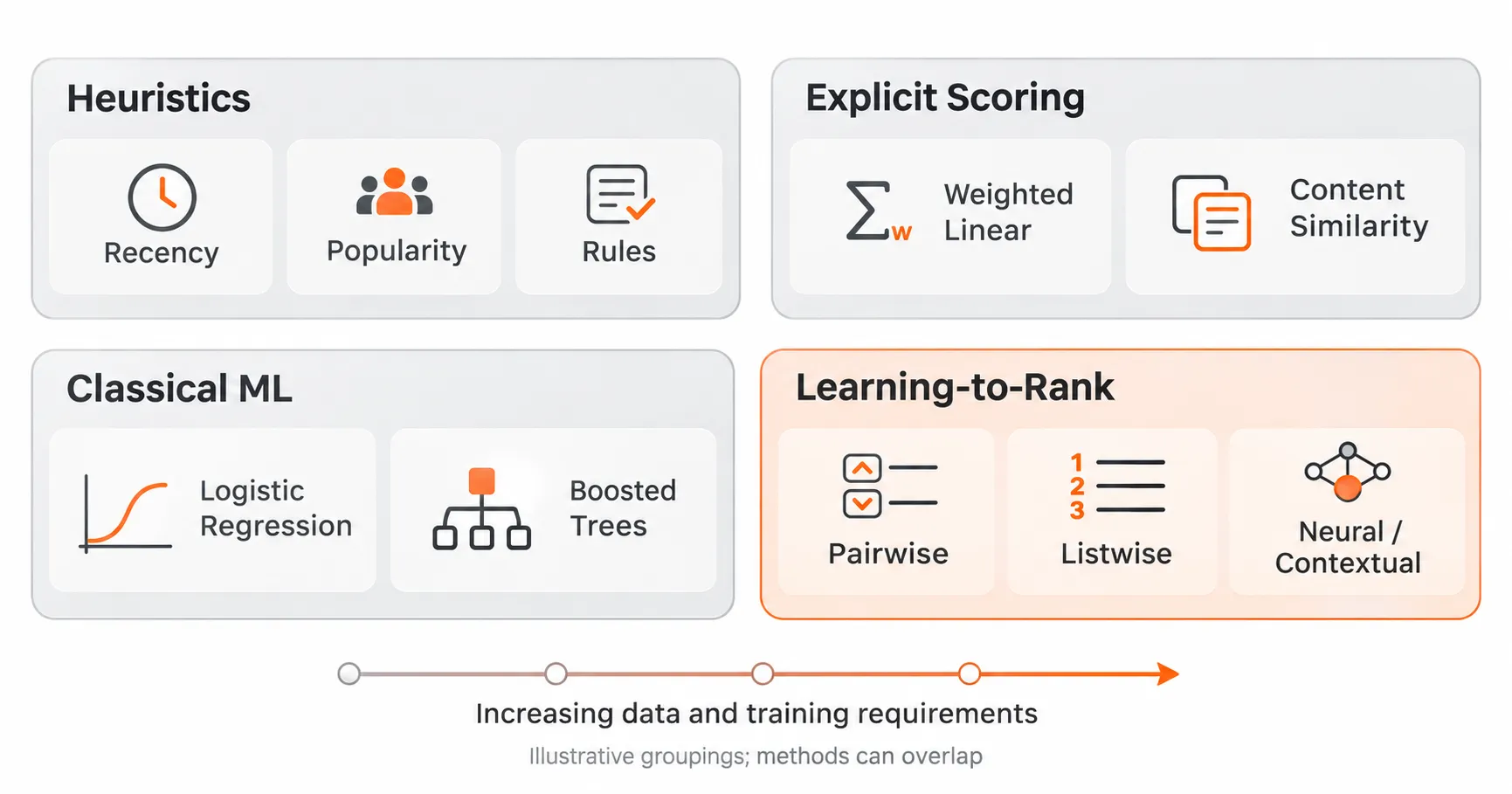
A feed can retrieve using similarity, score with a learned model, then apply deterministic policies.
Where Does Ranking Sit in the Request Path?
A common architecture is candidate retrieval → eligibility → scoring → re-ranking → response.
Google's recommendation architecture overview distinguishes candidate generation, scoring, and re-ranking. The first stage reduces the searchable corpus; the second assigns comparable relevance values; the third enforces additional constraints.
A ranking model cannot recover missing candidates, and a high-scoring result may still violate availability or safety rules. The existing ranking versus retrieval guide explains why these services need different metrics.
When Should You Use Recency and Popularity?
Recency sorting orders by creation or publication time. It works for time-sensitive updates, but frequently buries excellent older posts. Timestamps also require safeguards against manipulation and delayed ingestion.
Popularity ranking orders by views, saves, purchases, or a normalized engagement measure. It offers a useful default for unknown users, but often amplifies already-exposed items.
A crude popularity count rewards long-lived content. A better baseline might use engagement per eligible impression with a minimum-exposure threshold and a freshness adjustment. For small samples, smoothing prevents one interaction from dominating.
Use heuristics as measurable baselines, not as evidence that personalization is impossible. They are easy to replay, inexpensive to serve, and valuable fallback strategies.
When Do Rules and Priority Ranking Help?
Rules handle explicit policies: unavailable listings must disappear, restricted profiles must be excluded, and certain categories may require approved sellers.
Priority tiers can also rank, for example placing followed creators above suggested accounts. However, each new exception changes the precedence graph, and the final order becomes difficult to reason about.
Separate hard eligibility from soft preferences. A relevance weight can be traded against freshness; a safety prohibition cannot. The decision engine versus rules engine comparison explores this distinction for monetized discovery surfaces.
Rules should remain part of learned-ranking systems rather than being replaced by predictions.
How Does Weighted Scoring Rank Candidates?
A weighted linear ranker combines normalized signals into one score:
score = 0.50 × relevance + 0.30 × freshness + 0.20 × quality
The weights are illustrative. Suppose listing A has values 0.90, 0.20, 0.80, producing 0.67. Listing B has 0.75, 0.80, 0.70, producing 0.755. B ranks above A because freshness offsets weaker relevance.
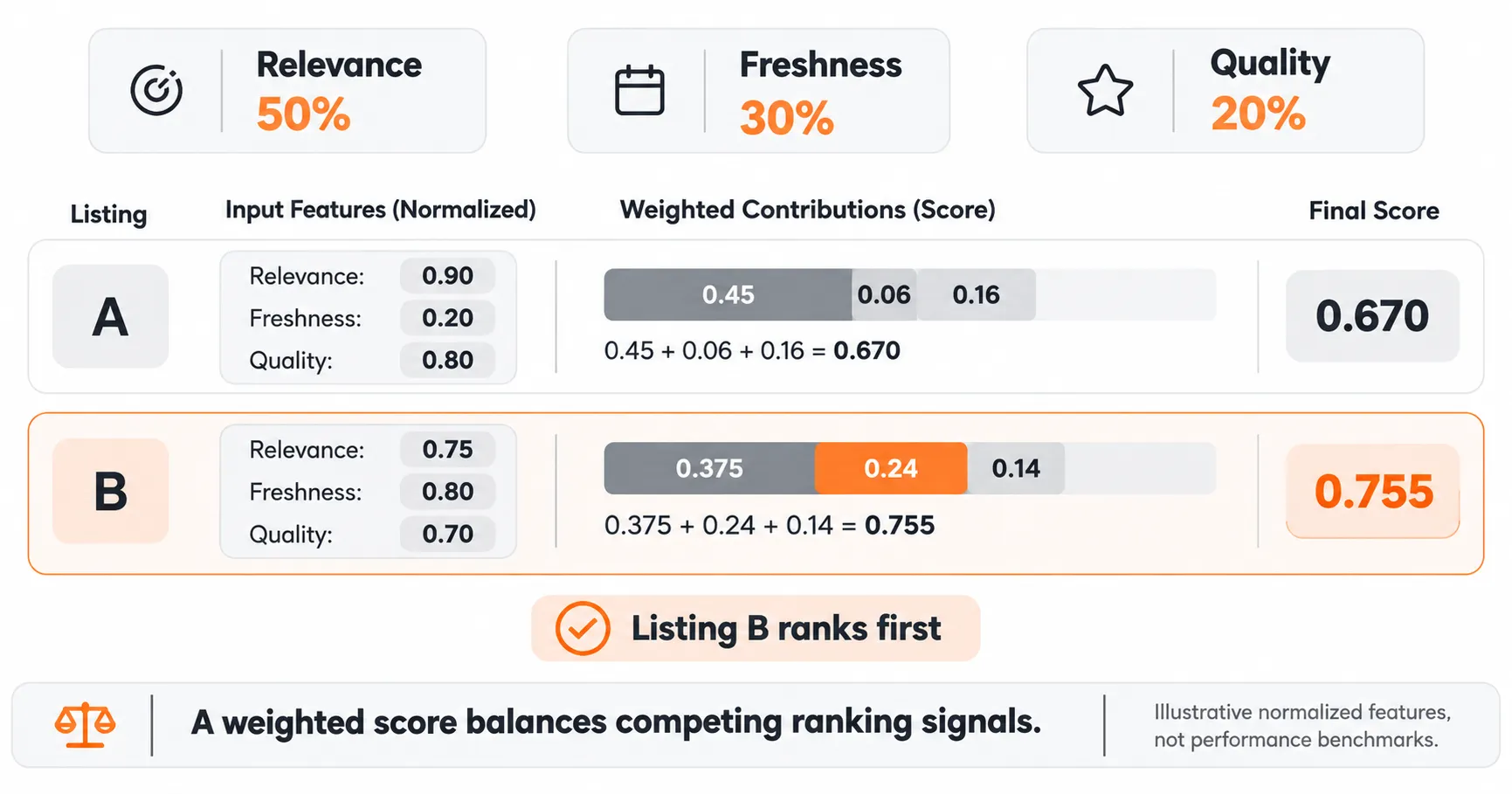
Linear scoring is inexpensive and interpretable. It can personalize results when relevance features are user-specific, while returning repeatable rankings for fixed inputs and configuration.
Its weakness is manual tuning and limited representation of nonlinear interactions. A change that benefits one surface may harm another, so version weights and run experiments before rollout.
Is Content-Based Ranking a Learned Ranker?
Content similarity scores candidates against a query, a user-interest representation, or a previously viewed item. Signals can come from shared topics, categorical attributes, or embedding similarity.
Embedding-based similarity may use learned representations, but cosine distance alone is not equivalent to a supervised model trained on downstream purchases or retention. Similarity measures likeness, not necessarily usefulness.
For creator feeds, similarity can surface related posts with little interaction history. Without re-ranking, it may show nearly identical content repeatedly. Combine relevance with diversity and eligibility constraints.
Similarity also appears upstream during candidate retrieval, where approximate nearest-neighbor search finds the shortlist. Its position in the pipeline determines what it is responsible for.
When Should You Move to Machine Learning Ranking?
Learned rankers fit when reliable feedback exists and hand-tuned weights no longer capture important feature interactions. Common features include user affinity, query relevance, item age, availability, past exposure, and contextual behavior.
Choose the training target carefully. A click label is convenient, but a click is not a purchase or a satisfied user. Google's scoring guidance describes how optimizing clicks can promote clickbait and optimizing watch time can overfavor long content.
Start with logistic regression or another simple supervised baseline. Compare it against weighted scoring on identical candidates before adopting heavier architectures.
Training requires versioned data, consistent online features, error analysis, and deployment controls. A model that looks accurate offline but worsens retention is not a successful replacement.
What Are Pointwise, Pairwise, and Listwise Rankers?
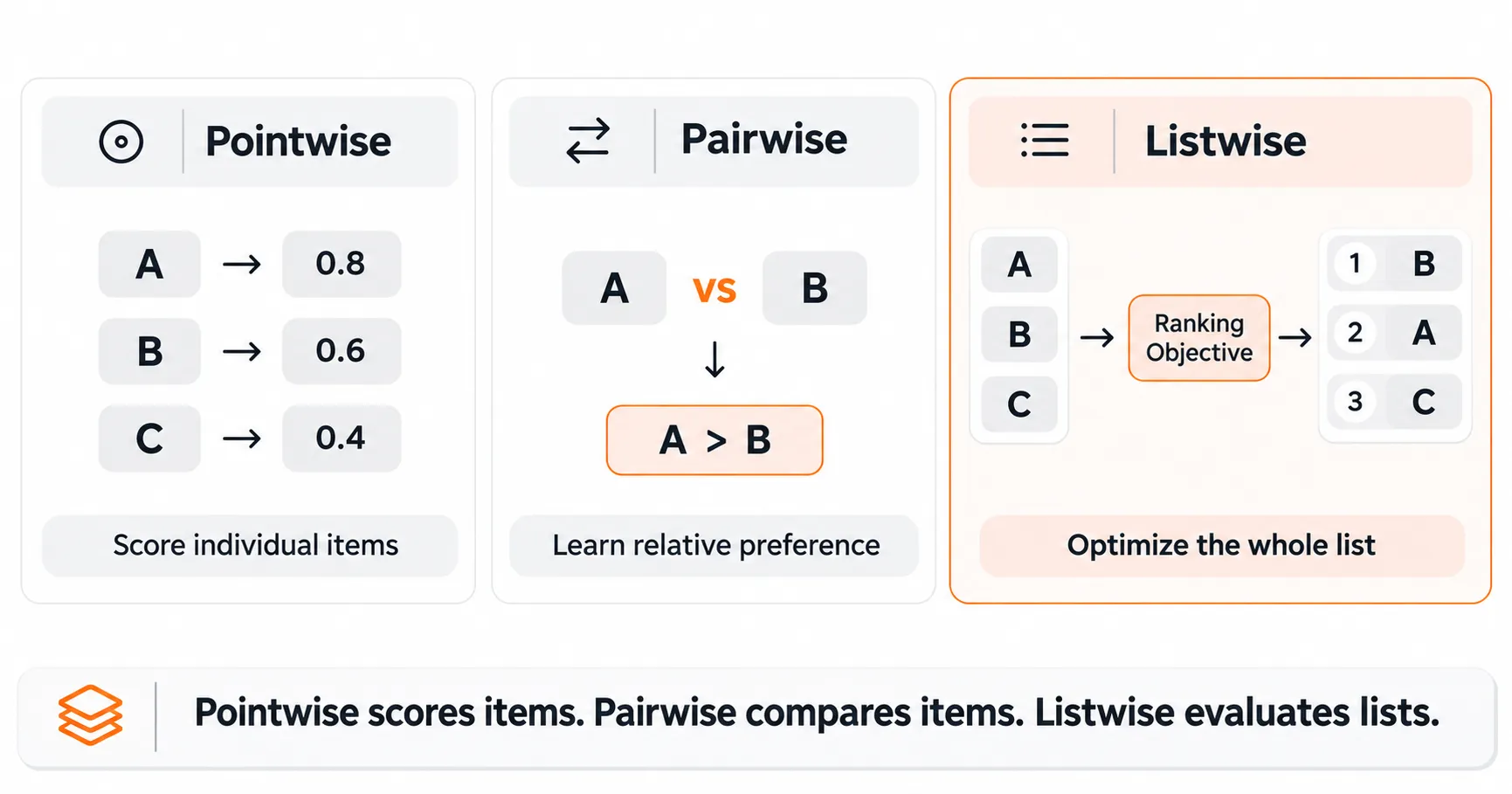
Pointwise models are straightforward and can predict click or conversion probabilities. They do not directly train on ordering relationships, although sorting their scores creates a ranking.
Pairwise methods compare item pairs within a query or request group. Listwise methods incorporate list structure or ranking metrics during training.
The current XGBoost learning-to-rank documentation explains LambdaMART objectives such as rank:ndcg, rank:map, and rank:pairwise, with training examples grouped by query identifier.
These methods require thoughtful labels and grouping. Mixing unrelated sessions into one training group creates invalid comparisons.
Why Are Gradient-Boosted Rankers Practical?
Gradient-boosted decision trees model nonlinear interactions across tabular features without requiring a large neural serving stack. They are often a useful intermediate step beyond linear weights.
LightGBM's ranking documentation supports lambdarank and rank_xendcg, including parameters that focus optimization near the top of a list.
Tree ensembles still need feature freshness, label quality, and careful latency tests. Gains depend on the dataset, not on the framework name.
Benchmark memory use and inference time at realistic candidate counts. Compare p95 and p99, not just average prediction speed. An offline winner may not fit the hot-path budget.
When Are Neural and Contextual Rankers Worthwhile?
Neural rankers can encode user histories, content semantics, and complex interactions, but introduce training cost, deployment complexity, and often harder explanations.
A July 2026 Netflix engineering report on GenRec describes an LLM-backed ranker using textual representations of histories and item metadata. Netflix reported statistically significant online gains against its production baseline, while also explaining limitations of generic LLM recommenders.
That is a possible direction for mature platforms, not a recommendation for every feed. Smaller teams should first establish a cheaper baseline, representative tests, and a clear business objective.
Which Metrics Actually Show Improvement?
Ranking evaluation should reflect the position of useful items, not merely average classification accuracy. Use NDCG@K for graded relevance, MRR when finding the first relevant result matters, and Precision@K or Recall@K where appropriate.
Offline gains are insufficient because logged clicks reflect what previous rankings exposed. Compare randomized traffic cohorts, examine position bias, and record decisions and impressions. Monitor conversion, retention, coverage, diversity, and safety violations alongside click-through rate.
Define a minimum improvement threshold before running an experiment. Avoid selecting a winning model based on whichever metric improved after results arrived.
What Makes a Ranker Production-Ready?
Production readiness depends on repeatable decisions, predictable latency, and failure handling. Keep candidate IDs, feature versions, model or weight versions, policy outcomes, and request identifiers in trace logs.
Use shadow traffic to compare a new ranker against the live baseline without changing display order. Then deploy to a randomized cohort with guarded rollback and an eligible-content fallback.
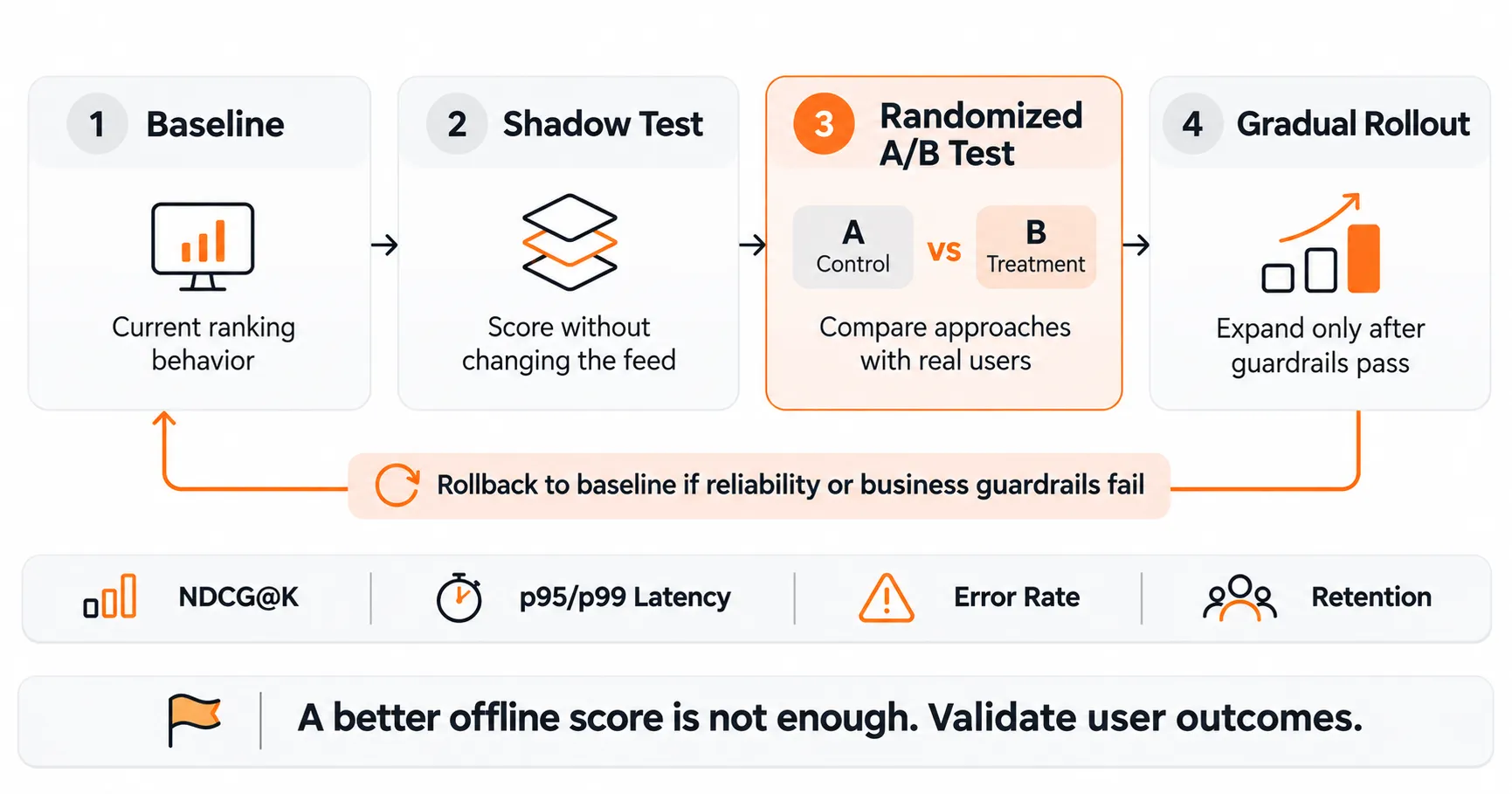
Monitor feature drift, missing values, score distributions, and p99 end-to-end latency. Retraining is not instantaneous just because users click; event ingestion, validation, and model rollout are separate processes.
The candidate-generation, ranking, and re-ranking architecture details the service boundaries that make these checks possible.
What Changes When Ranking Includes Sponsored Items?
Sponsored discovery adds advertiser eligibility, campaign constraints, placement limits, and disclosure requirements. Organic relevance and commercial selection must be reconciled rather than merged unpredictably in the frontend.
Bids do not replace safety or product eligibility. Where auctions are used, they allocate among eligible advertising candidates; a separate policy layer protects the overall feed experience.
Measure sponsored revenue alongside organic conversion and retention. A higher paid fill rate is not a win if it degrades discovery enough to reduce long-term marketplace activity.
Where Does Gortex Fit Among Ranking Algorithms?
At Gortex, we're building the decision infrastructure that helps consumer platforms rank and monetize discovery through a single API.
Our approach starts with calibrated linear ranking. Instead of requiring every platform to build and maintain complex machine-learning pipelines, we use interpretable scoring to order eligible candidates based on recipient context, item features, and platform objectives.
But ranking is only part of the problem.
Marketplaces, social networks, and creator platforms also need to decide where sponsored content belongs without compromising organic relevance. That's why we've designed our decision engine to coordinate organic ranking, sponsored selection, and placement policies in one request.
Through POST /v1/decide, platforms supply their eligible candidates and context. We return a ranked order, sponsored-placement decisions, and a decision ID that connects the result to subsequent outcomes.
We handle the ranking and placement decision. Platforms retain control of retrieval, inventory, and their user experience.
For teams still relying on manually maintained ranking rules or separate advertising logic, our ranking API offers a more unified approach to managing discovery and monetization.
We're currently bringing this infrastructure to platforms through private-beta integrations, with a longer-term vision of building an advertising network for AI agents.
Conclusion
Production ranking evolves through better objectives and evidence, not simply more complex models. Start with clean eligibility, strong retrieval, and measurable heuristic baselines. Introduce supervised rankers when interactions, labels, and tests show a meaningful advantage.
For marketplaces and feeds adding commercial discovery, ranking quality must coexist with placement rules and advertiser eligibility. Teams can evaluate Gortex through a scoped decision-layer pilot to compare organic and sponsored decisions while keeping control of their existing candidate retrieval and user experience.
Frequently Asked Questions
Are heuristic ranking algorithms obsolete?
No. Recency, popularity, and weighted scoring remain useful baselines and reliable fallbacks, particularly with limited behavioral data.
Is learning-to-rank always neural?
No. Logistic models, boosted trees, and other supervised methods can learn ranking signals. Neural architectures are one option.
Does a deterministic ranker prevent personalization?
No. User-specific features can produce different orders while keeping each fixed request repeatable.
Which ranking algorithm is best for a small team?
Begin with eligibility filters and transparent weighted scoring. Add learned models only when data and controlled experiments justify their cost.