A rules engine evaluates explicit conditions; a decision engine selects an outcome using rules, scores, models, or combinations of them. Neither term determines whether ranking is deterministic. A weighted ranking engine can return identical results for identical inputs, while a machine-learning model can also be repeatable when its execution is controlled.
For CTOs and platform architects, the practical question is which decisions require fixed policy and which require comparing competing candidates. This matters when feeds add personalization and sponsored placements.
This guide compares architectures and provides a ranking example without assuming ML is essential.
What Is a Rules Engine?
A rules engine evaluates conditions and executes specified outcomes. Typical rules include “exclude unavailable products,” “show only age-eligible profiles,” and “limit promotional exposure.”
Rules can be written as code, decision tables, or managed configurations. IBM's decision-logic documentation describes conditional rules and tables whose rows represent complete decision rules.
A rules engine excels when the requirement is explicit and enforceable: is this item allowed? It can also rank using ordered priorities, but complex relative preferences usually require additional scoring logic.
Rules are not inherently outdated. Eligibility, disclosure, privacy, and commercial restrictions should remain enforceable even when learned models are introduced.
What Is a Decision Engine?
A decision engine accepts a set of options and context, evaluates them against objectives and constraints, and returns a decision. In discovery products, that decision often includes an ordered list of items and eligible sponsored positions.
Decision engines can contain rules engines. They may also include calibrated scoring, optimization, experimentation, or predictive models. A decision engine is therefore an architectural role, not a synonym for AI.
The Gortex decision engine, for example, operates on candidates supplied by a platform and coordinates ranking, sponsored placement, and decision identifiers. Candidate retrieval remains outside that decision boundary.
Production systems typically need both selection and policy enforcement.
Decision Engine vs Rules Engine
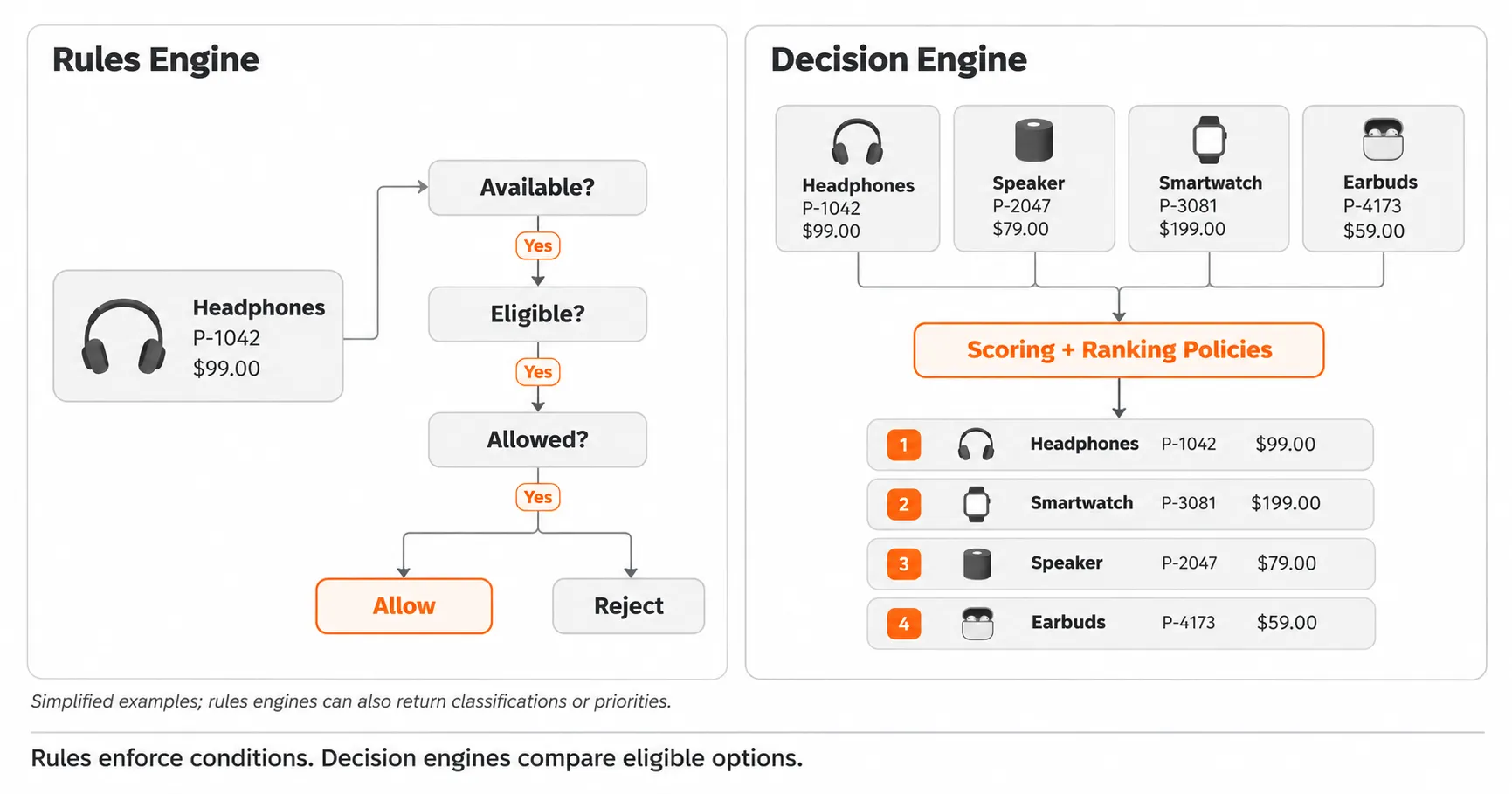
This is not a strict product taxonomy. Some enterprise rules platforms call their execution component a decision engine, as IBM's Operational Decision Manager documentation demonstrates. Compare responsibilities and contracts instead of vendor labels.
What Does Deterministic Ranking Mean?
Deterministic ranking returns the same order when the candidate set, features, configuration, and execution conditions are identical. It does not mean every user sees the same ranking.
For example, a deterministic linear scoring function can personalize a feed:
score = 0.50 × relevance + 0.30 × freshness + 0.20 × quality
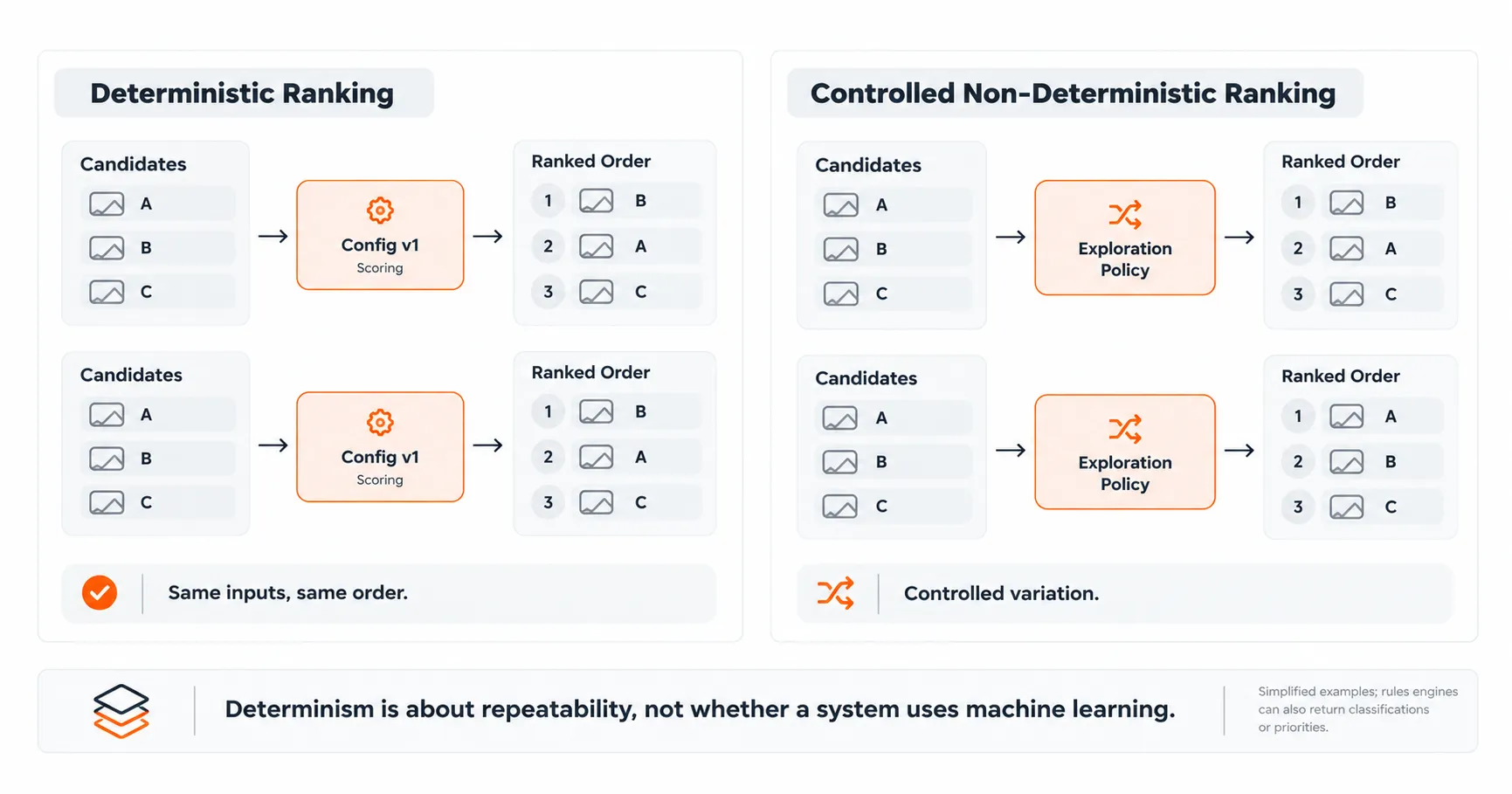
The weights are illustrative, and features must be normalized onto compatible scales. Different users produce different relevance inputs, so their resulting feeds differ. Repeating a request with the same inputs and versioned configuration produces the same result, assuming stable arithmetic and tie-breaking.
Determinism helps with regression tests, audit trails, debugging, and reproducible experiments. It does not guarantee relevance, fairness, or business performance. A perfectly repeatable poor ranking is still poor.
What Is Non-Deterministic Ranking?
Non-deterministic ranking can return different orders even when the nominal request looks identical. Reasons include randomized exploration, stochastic sampling, changing external features, concurrent processing, unstable tie-breaking, or nondeterministic computation.
A learned ranker is not automatically non-deterministic. Once trained, many models score consistently under fixed inference conditions. Conversely, a rules-based system drawing a random winner or querying changing inventory may produce varying outcomes.
Some variation is intentional. For instance, a platform may explore less-exposed creators to learn whether they deserve future distribution. Exploration needs logged probabilities or suitable experimental design so its effects can be evaluated.
The important question is whether variation is controlled and observable.
How Would Each Approach Rank Marketplace Listings?
Assume a marketplace has three eligible listings for the same query. The following numbers are illustrative and already normalized.
A priority-rule approach might display newest eligible listings first, producing B, C, A. It is easy to inspect but prioritizes freshness regardless of relevance.
The weighted formula above produces A = 0.70, B = 0.81, and C = 0.72, so the final order is B, C, A as well. Same order, different reasoning: scores weigh three objectives rather than applying one priority.
If the business instead weights relevance more heavily, the ordering may change without adding another conditional branch. Neither proves scoring outperforms rules.
A real selection system also excludes ineligible listings before either approach runs.
Where Should Rules and Scores Sit?
A practical request flow is:
Application retrieval → Eligibility rules → Candidate scoring → Re-ranking policies → Final response → Event logging
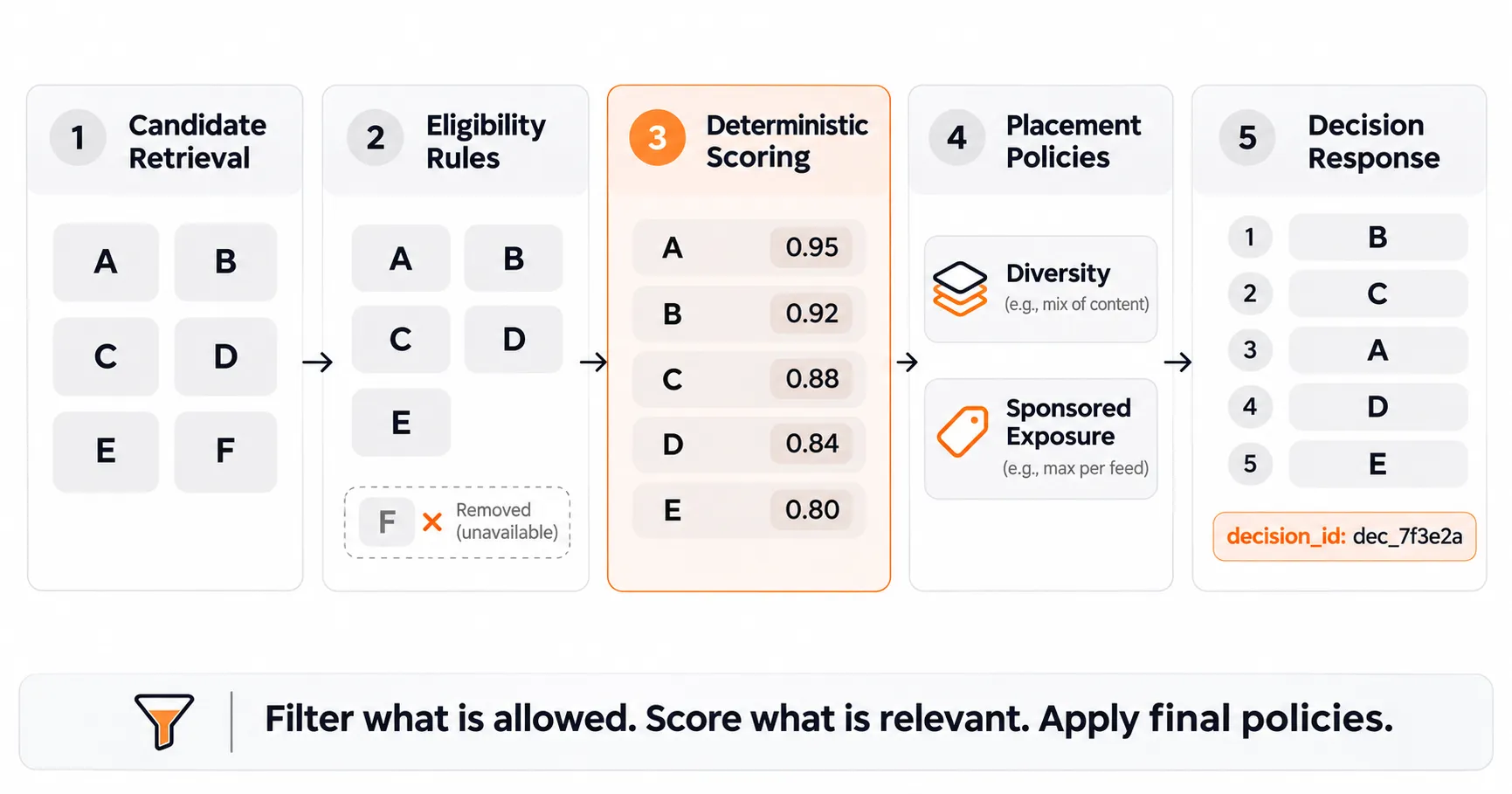
Retrieval gathers candidates. Hard rules remove anything unavailable, unsafe, or otherwise prohibited. Scoring compares eligible items using current context. Re-ranking enforces list-level requirements, such as diversity or sponsored-slot limits.
Google's recommendation-system architecture guide separates candidate generation, scoring, and re-ranking. Its re-ranking documentation describes filtering and score adjustments for freshness and diversity.
Use a single comparable score where several retrieval sources feed one surface. Otherwise, source-specific scores may represent incompatible quantities. Preserve policy traces so engineers can distinguish a ranking change from an eligibility decision.
How Do Rules Engines Resolve Conflicting Decisions?
When multiple rules match the same request, a rules engine needs a defined execution strategy. Otherwise, overlapping conditions can create unexpected decisions.
The Drools rule engine documentation explains how matching rules enter an execution agenda and how priorities determine which rules execute first.
Consider a marketplace where a sponsored product qualifies for promotion but violates a category restriction. Eligibility must take precedence over promotional scoring, regardless of the advertiser's bid or the item's predicted relevance.
Engineers should explicitly define rule priorities, test overlapping conditions, and version policy configurations. Deterministic behavior requires consistent inputs, rule execution, and conflict-resolution logic.
For ranking systems, rules should enforce non-negotiable constraints, while scoring determines the relative order of candidates that remain eligible.
When Does Machine Learning Add Value?
ML becomes useful when relationships between user behavior, item attributes, and outcomes are too complex to maintain as hand-written conditions. A learned ranker might estimate purchase likelihood or meaningful engagement from historical observations.
However, optimizing the wrong signal can degrade user experience. Google's ranking-objective guidance notes that click optimization can favor clickbait and that ranking scores from separate candidate generators may not be comparable.
Learned scoring still needs deterministic eligibility rules, monitoring, and fallback behavior. Models must be evaluated for new-user cold starts, changing inventories, biased exposure data, and operational costs.
Do not introduce ML because a platform calls its service a decision engine. Introduce it when experiments show meaningful gains over a transparent baseline.
How Do Sponsored Listings Change the Decision?
Advertising turns ranking into a decision involving relevance, permitted commercial exposure, and advertiser demand. The platform must first establish which sponsored candidates are eligible under targeting, budgets, and policy constraints.
A decision layer then determines whether and where a sponsored item can appear relative to the organic order. An auction, if present, resolves competition among advertisers; it does not erase organic eligibility or user-experience requirements.
For example, a six-position marketplace feed might place disclosed sponsored listings at positions two and five. Those are hypothetical positions, not universal requirements.
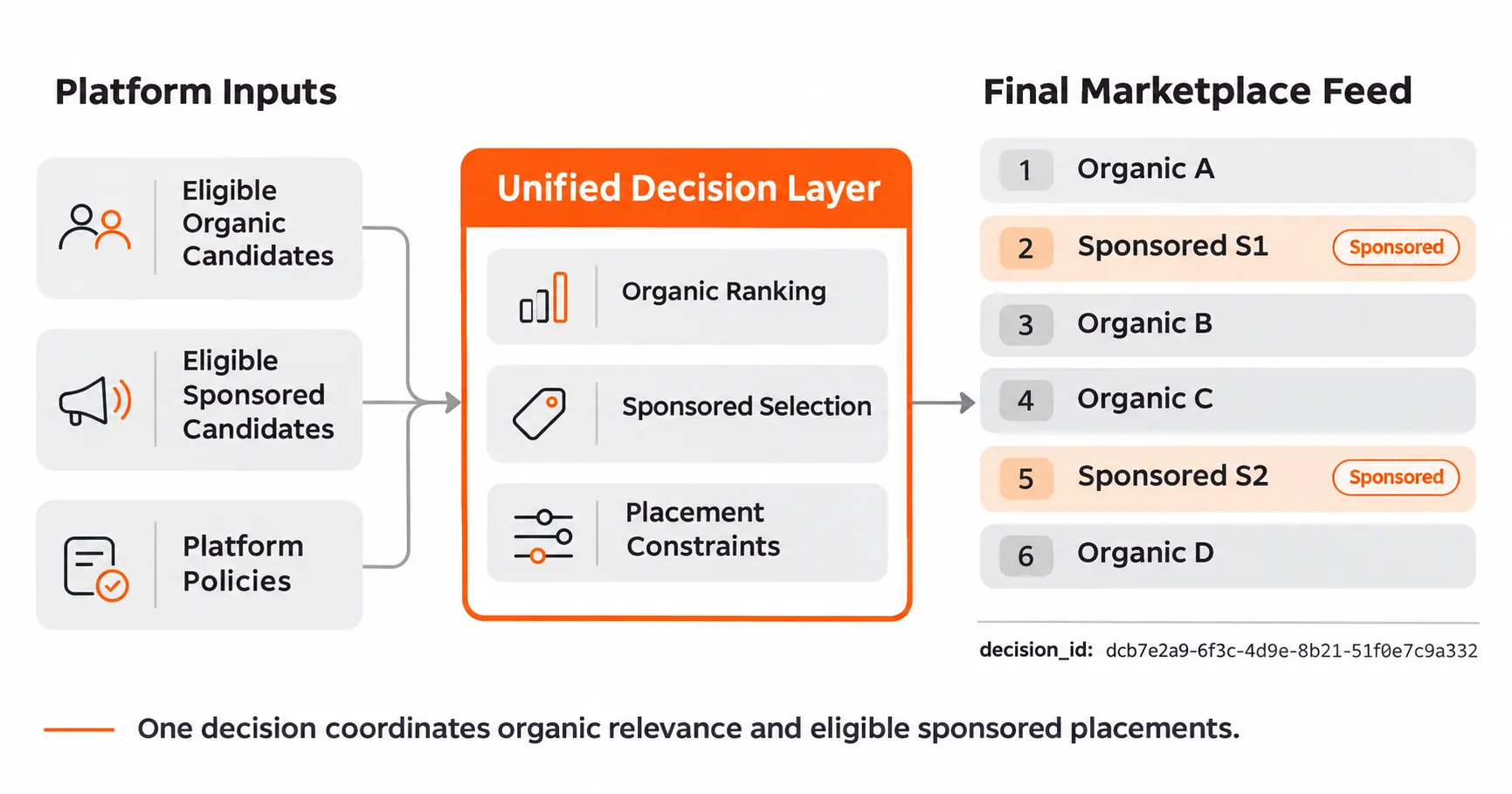
Separate ad selection and organic ranking are possible, but the application must reconcile placements, log outcomes, and prevent policy conflicts. The sponsored listings API guide explains this integration boundary.
What Should Engineers Measure?
Decision quality is only part of production readiness. Measure request latency at p50, p95, and p99, decision errors, fallback frequency, eligibility violations, and reproducibility across configuration versions.
For ranking, monitor conversion, meaningful engagement, diversity, and retention. For advertising, measure sponsored fill and revenue alongside organic engagement, not in isolation.
Record a decision identifier, candidate identifiers, policy version, scoring configuration, surface, and displayed positions. Log subsequent impressions and outcomes against that decision.
A replay should explain which inputs were available at decision time; live feature stores may have changed afterward. Deterministic replay requires snapshots or versioned feature evidence, not merely the same user ID.
Which Approach Should Your Team Choose?
Choose explicit rules when the objective is binary eligibility, routing, compliance, or a small priority list. Choose deterministic scoring when several measurable signals must be combined into a comparable ranking.
Choose learned ranking when sufficient behavioral data exists and controlled tests establish a worthwhile improvement. Use deliberate randomized exploration only when the product can measure and govern it.
For most consumer platforms, a hybrid architecture is the practical starting point: hard rules for eligibility, scoring for relevance, and policies for final placement.
The recommendation engine architecture guide explores how those services connect. Before buying infrastructure, confirm candidate ownership, API contracts, observability, policy controls, and total operating cost.
How Does Gortex Apply This Architecture?
Gortex helps platforms operate their own advertising marketplaces by combining organic ranking and sponsored-placement decisions over supplied candidates.
Its POST /v1/decide path uses calibrated linear scoring, platform policies, and decision identifiers. Published private-beta materials also describe advertising-marketplace capabilities; buyers should verify the scope of auctions, advertiser workflows, and integrations during evaluation rather than assuming complete production maturity.
Gortex does not replace catalog retrieval or provide a deep learned recommendation model. Its decision-oriented architecture is relevant when a marketplace, social platform, or creator app already retrieves candidates and wants unified placement decisions under its own policies.
A sensible evaluation begins in shadow mode: compare decisions and policy traces with the current ranking before exposing users to changes.
Conclusion
A rules engine and a decision engine solve overlapping but distinct problems. Rules determine what is allowed; decision systems compare valid options and decide what should appear, in what order, and under which commercial constraints.
Determinism is an execution property, not a product category. Start with auditable policies and transparent scoring, then add learned models or controlled exploration only when they improve measured outcomes.
For teams preparing to monetize an existing discovery surface, Gortex's decision infrastructure offers a way to evaluate organic ranking and sponsored placement together while keeping retrieval and platform policy ownership clear.
Frequently Asked Questions
Is a decision engine always non-deterministic?
No. A decision engine using fixed rules, features, and scoring can be deterministic. Randomized exploration or changing inputs may introduce variation.
Can rules engines rank products?
Yes. They can sort by explicit priorities or weights. Comparative scoring usually offers more flexibility when objectives multiply.
Does deterministic ranking mean no personalization?
No. User-specific features can generate different personalized results while remaining repeatable for identical inputs.
Should ML replace eligibility rules?
No. Hard business and safety requirements should remain enforceable independently of predictive scores.