A sponsored listings API lets a marketplace, directory, or consumer platform add paid placements to search results, feeds, or category pages without building a complete ad server. Your application sends the relevant context and candidate items, the API returns the sponsored decision, and your existing UI renders the result as a native sponsored listing.
The alternative is building campaign management, auction logic, budget controls, attribution, reporting, and advertiser tooling yourself. For many platforms, that is unnecessary infrastructure.
The better starting point is to identify the monetized slots you already have and add a decisioning layer to them.
What Is a Sponsored Listings API?
A sponsored listings API is an API that determines which paid listing should appear in a defined position within an existing search or ranking experience.
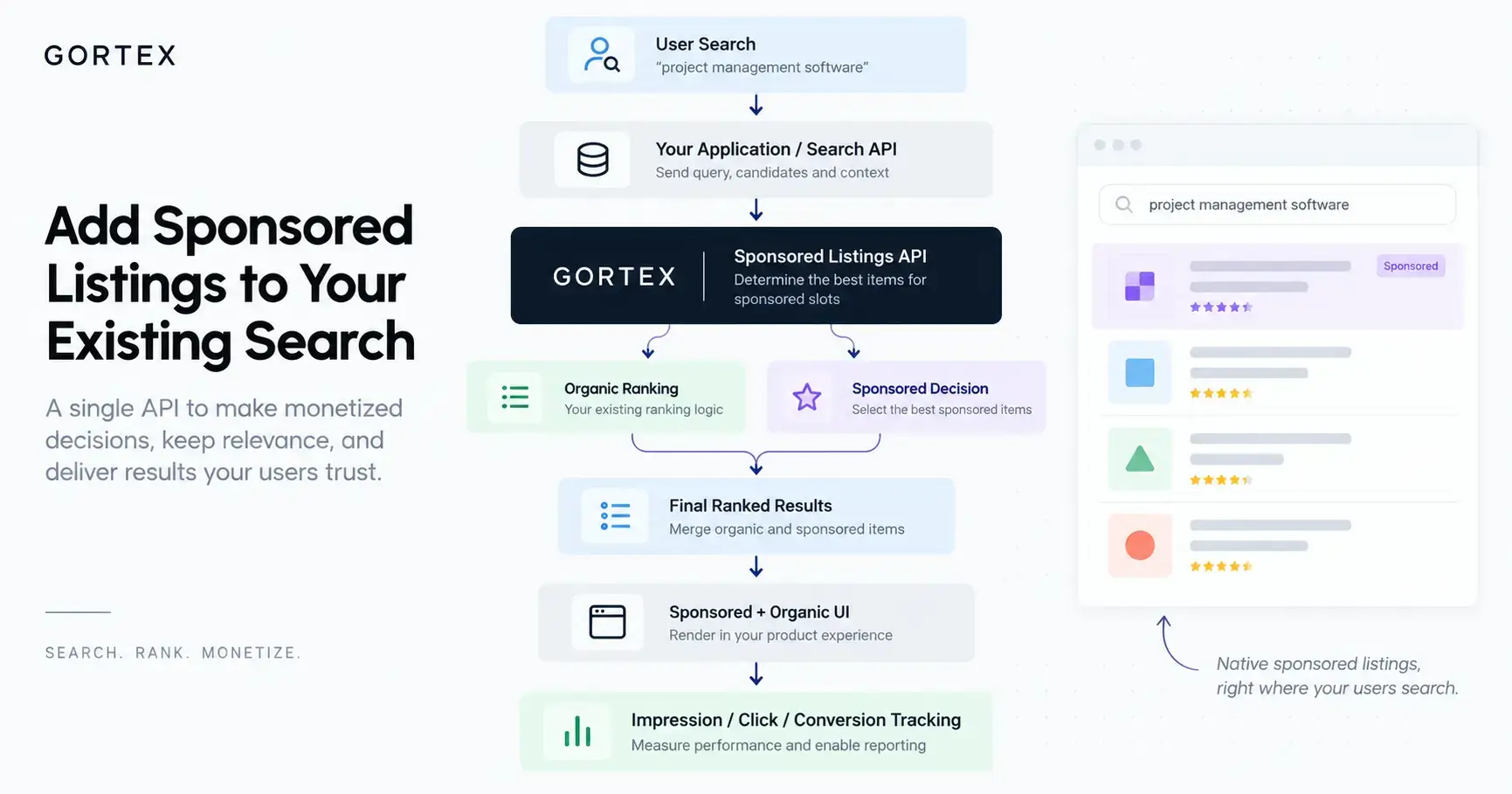
A typical request can include:
-
Search query
-
Candidate product or listing IDs
-
Category or surface
-
Number of sponsored slots
-
Placement information
-
Session or contextual signals
The response identifies the sponsored item or items that can fill those slots. Your application then renders them using its existing listing or product components.
This is different from traditional display advertising.
A display ad normally occupies a predefined creative container. A sponsored listing is part of the result experience itself. It can use the same underlying product or listing data as organic results while being clearly labeled as sponsored.
The distinction matters because the platform still controls the user experience. The API provides the monetization decision rather than forcing the platform to rebuild its entire frontend around an advertising system.
Why Add Sponsored Slots Instead of Building an Ad Server?
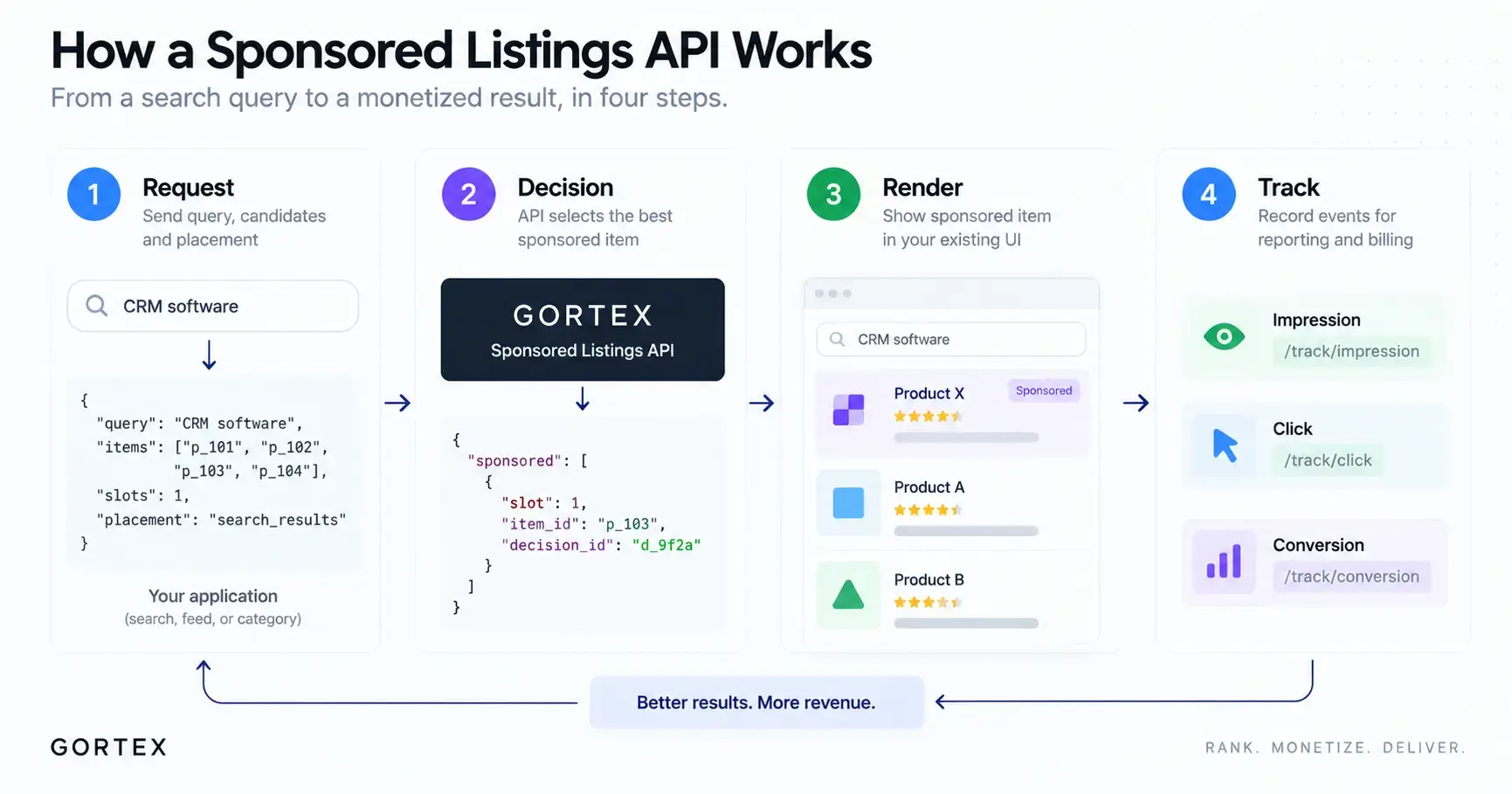
An ad server is a much larger system than a sponsored placement.
A production advertising platform may need to handle:
If advertising is the core product, building these systems internally can make sense.
But many marketplaces and consumer platforms already have most of the infrastructure required to display a sponsored listing:
-
A search or ranking system
-
A candidate set
-
A frontend component for each result
-
Users with commercial intent
-
Sellers, brands, or businesses that want additional visibility
The missing piece is the mechanism that determines which sponsored item gets which slot.
A sponsored listings API can provide that layer without requiring the platform to operate the entire ad-serving stack.
How Does a Sponsored Listings API Work?
The basic request flow is:
Request → Decision → Render → Track
1. Define the Monetized Slot
Start by deciding where sponsored inventory belongs.
Common placements include:
-
Search results position 1
-
Search results position 4
-
Top of a category page
-
A defined position in a marketplace feed
-
A sponsored position inside a recommendation surface
The placement should be explicit.
For example:
search_results:
  sponsored_slots: [1]
You can add more positions later, but starting with a small number of defined slots makes the effect on both revenue and organic engagement easier to measure.
2. Send the Candidate Set and Context
Your application already knows which items are eligible for the page.
For example, a search for "CRM software" might produce:
{
  "surface": "search",
  "query": "CRM software",
  "slots": 1,
  "items": [
    "product_101",
    "product_204",
    "product_318",
    "product_442"
  ]
}
The sponsored decisioning layer can use that candidate set to determine which eligible item should occupy the sponsored position.
This is important because candidate generation and sponsored placement do not have to be the same problem.
Your application can continue determining which items are relevant. The monetization layer then decides which eligible sponsored item can occupy the defined slot.
3. Return the Sponsored Decision
The API returns the item that should fill the slot, along with an identifier used for attribution.
Conceptually:
{
  "sponsored": [
    {
      "slot": 1,
      "item_id": "product_318",
      "decision_id": "decision_abc123"
    }
  ]
}
Your application can then retrieve the item's normal data and render it using the existing result component.
The sponsored listing should remain clearly identified as sponsored.
4. Track What Happens Next
The sponsored decision is only useful if you can measure its outcome.
Typical events include:
-
Impression
-
Click
-
Add to cart
-
Purchase
-
Lead or other conversion
These events connect the sponsored placement to advertiser reporting, attribution, and billing.
For example, an impression can be associated with the decision ID returned by the API. A later click or conversion can use the same identifier to connect the event to the original sponsored placement.
Where Should Sponsored Listings Appear?
Start where users already demonstrate intent.
Search results and category pages are usually stronger starting points than generic homepage placements because the user has already expressed an interest.
Consider a marketplace search for:
"Project management software"
The organic ranking system returns:
-
Product A
-
Product B
-
Product C
-
Product D
A sponsored slot at position 1 could produce:
-
Product X - Sponsored
-
Product A
-
Product B
-
Product C
The sponsored result should still satisfy the relevance requirements of the surface.
A high bid should not make an unrelated product relevant.
This is why candidate eligibility and relevance rules matter. If your existing search system already knows which products belong in the result set, use that information when determining which products can be sponsored.
You can also define limits around:
-
Maximum sponsored listings per page
-
Allowed categories
-
Seller eligibility
-
Minimum relevance
-
Frequency
-
Placement positions
The goal is to monetize the ranking surface without making the ranking itself less useful.
Sponsored Listings vs Traditional Ad Serving
The two approaches solve different problems.
Sponsored listings are particularly useful when the platform already owns a high-intent ranking surface.
A marketplace ranks products.
A directory ranks businesses.
A content platform ranks articles.
A recommendation product ranks items for each user.
In each case, the platform already makes a decision about what the user should see. Sponsored listings add a commercial constraint to that existing decision.
Build an Ad Server or Use an API?
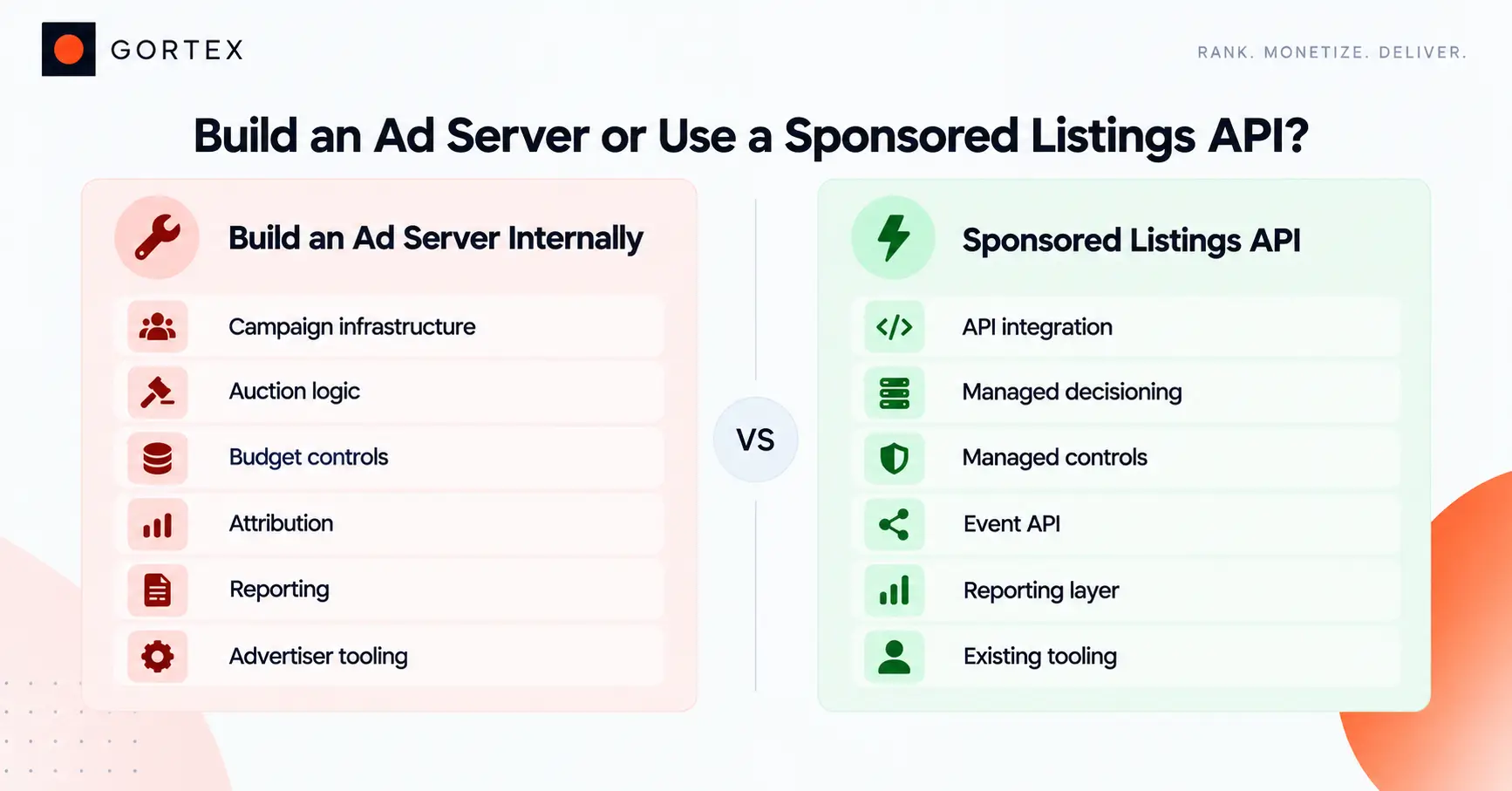
The right choice depends on how deeply advertising is embedded in your business.
Building internally gives you maximum control, but it also creates a long-term infrastructure responsibility.
An API reduces that engineering burden while allowing your application to retain control of the actual user experience.
For a platform that wants to validate sponsored inventory before investing heavily in advertising infrastructure, this can be a more practical path.
For platforms where advertising itself is the primary business, owning more of the stack may eventually justify the additional engineering effort.
How Should Sponsored Listings Work With Organic Ranking?
This is where many implementations become unnecessarily complicated.
You already have an organic ranking system. It may consider:
-
Relevance
-
Quality
-
Availability
-
Engagement
-
User preferences
-
Business rules
Sponsored placement introduces another requirement: monetization.
The system therefore needs to answer two related questions:
Which items should appear?
Which eligible items should occupy the sponsored positions?
One approach is to operate separate ranking and advertising systems, then merge their outputs afterward.
Another is to make the sponsored decision part of the same decisioning flow that determines the final result.
For platforms already operating a ranking system, the second approach can reduce the amount of logic required to reconcile separate outputs.
This is also where a decision engine can be useful: candidate items enter the system, ranking determines their organic order, and sponsored slots are resolved against the same result context.
Gortex is built around this model. Its API accepts a candidate set and returns ranked results and sponsored slots in the same response. The current API uses a single POST /v1/decide endpoint, with a documented p99 latency of under 200ms.
If you are evaluating the architecture specifically for marketplace or feed monetization, see the Gortex Sponsored Listings API.
What Should You Measure After Adding Sponsored Slots?
Revenue is only one side of the measurement.
Track both monetization and the underlying user experience.
Monetization Metrics
-
Sponsored impressions
-
Sponsored CTR
-
Conversion rate
-
Revenue per 1,000 searches
-
Revenue per sponsored slot
-
Advertiser spend
Organic Metrics
-
Organic CTR
-
Engagement
-
Conversion rate
-
Search refinement rate
-
Downstream user actions
The useful question is not simply:
"Did sponsored revenue increase?"
It is:
"Did the additional revenue justify the impact on the organic experience?"
If sponsored placements generate revenue but reduce engagement or conversions substantially, the placement strategy needs adjustment.
That can mean reducing sponsored density, changing slot positions, tightening eligibility, or improving relevance.
How to Launch Your First Sponsored Slot
You do not need to monetize every surface at once.
A practical rollout looks like this:
1. Choose one high-intent surface.
Start with search or a category page where users already demonstrate intent.
2. Define one or two slots.
Make the positions explicit rather than inserting sponsored items unpredictably.
3. Set eligibility rules.
Only allow relevant items and eligible advertisers to compete for the placement.
4. Keep organic ranking intact.
Do not replace your existing candidate-generation system just to add monetization.
5. Render the listing natively.
Use your existing UI components and clearly identify sponsored content.
6. Instrument the events.
Track impressions, clicks and conversions against the sponsored decision.
7. Measure revenue and organic performance together.
Use the results to determine whether additional slots are justified.
Once the first placement works, you can expand into additional search positions, category pages, feeds, or other monetizable surfaces.
Conclusion
A platform does not need to build a complete ad server to monetize its existing search and ranking inventory.
If you already have candidates, ranking logic, high-intent traffic, and businesses willing to pay for visibility, the missing piece may simply be a reliable way to add sponsored slots and measure what happens after they are shown.
The core architecture is straightforward:
Candidate set → ranking context → sponsored decision → monetized slot → event tracking
Start with one high-intent placement. Keep relevance rules intact. Track both revenue and organic engagement. Expand only when the economics support it.
If you want to add sponsored listings without building the decisioning layer yourself, explore Gortex's Sponsored Listings API or request access.
Frequently Asked Questions
1. Do I Need an Ad Server to Add Sponsored Listings?
No. A sponsored listings API can provide the decisioning and event infrastructure required for sponsored placements while your application controls the final UI and integration.
2. What Is the Difference Between Sponsored Listings and Sponsored Ads?
Sponsored listings are paid placements inside an existing search, feed, or ranked inventory. Sponsored ads is a broader term that can include sponsored listings, native ads, display ads, and other paid formats.
3. Can Sponsored Listings Use My Existing Ranking System?
Yes. Your existing system can continue generating the candidate set and ranking organic results. The sponsored layer can then determine which eligible paid items occupy defined positions.
4. Should Sponsored Listings Replace Organic Results?
Not necessarily. Sponsored placements should have explicit positions, relevance rules, and clear disclosure. The objective is to add monetization without undermining the usefulness of the underlying ranking surface.
5. Is a Sponsored Listings API the Same as an Ad Server API?
Not exactly. An ad server API can expose a broader advertising infrastructure, while a sponsored listings API focuses specifically on placing monetized listings within an existing product surface. The actual capabilities depend on the provider.