Recommendation systems work by collecting signals, retrieving eligible items, scoring their relevance, applying product rules, and displaying an ordered selection. User interactions then provide feedback for future decisions.
Marketplaces recommend products; social apps rank posts; job platforms suggest openings.
Follow a feed request from opening the app through logging its outcome, with clear boundaries between retrieval, ranking, and policy enforcement.
What Are the Steps in a Recommendation System?
A typical recommendation request follows seven steps:
-
Collect the user's context and available signals.
-
Retrieve a shortlist of eligible candidate items.
-
Prepare features for each user-item pair.
-
Score and rank the candidates.
-
Apply eligibility, diversity, and placement policies.
-
Return and render the selected items.
-
Log exposures and outcomes for evaluation.
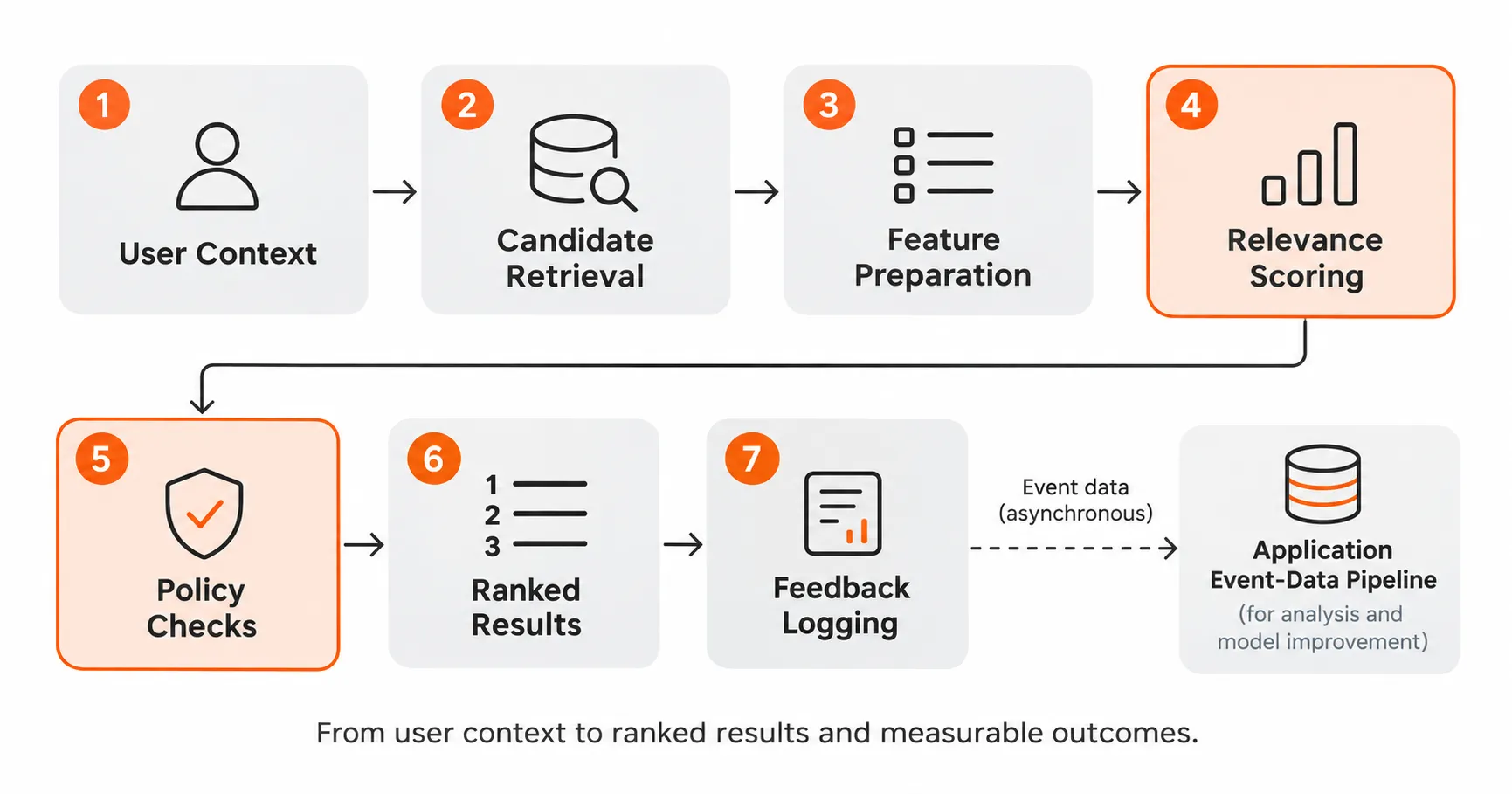
Google's recommendation-systems documentation groups the central serving stages into candidate generation, scoring, and re-ranking. The other steps explain application responsibilities.
What Happens When the User Opens a Feed?
The application receives a request containing the user or session identifier, requested surface, and permitted context.
A home feed might use followed creators, recent interactions, language preferences, or session activity. A marketplace search page also has an explicit query, category, and inventory constraints.
An impression records exposure, not preference. A purchase usually signals stronger intent than a quick click.
Collect only necessary data, respect preferences, and provide defaults for users without history.
How Does Candidate Retrieval Work?
Candidate retrieval reduces a large catalog to a smaller set worth scoring.
Imagine an illustrative content app with 100,000 available posts. Instead of evaluating every post with the most expensive scoring process, it selects 200 possible matches using followed accounts, topic matching, search indexes, and recent activity.
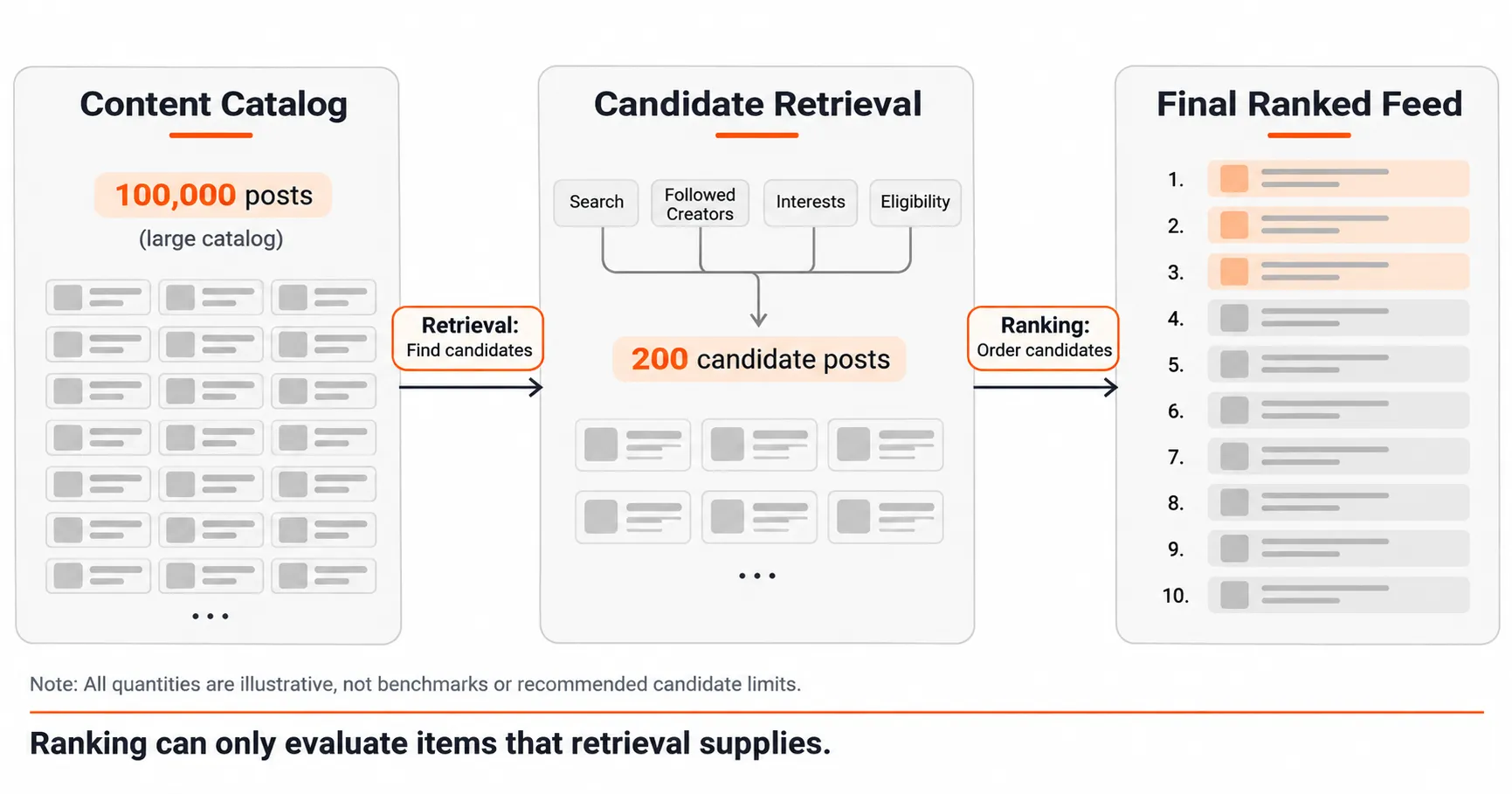
The numbers are examples, not recommended production limits.
Candidate generation might use keyword filters, content similarity, collaborative filtering, or vector search. Sources contribute to a pooled shortlist, followed by eligibility checks.
Google Cloud's two-tower retrieval architecture explains how embeddings can efficiently retrieve a relevant subset before downstream ranking.
The essential distinction: retrieval decides which items are considered; ranking decides their order. An excellent ranker cannot rescue an item that retrieval omitted.
Which Features Are Prepared Before Scoring?
For each candidate, the system assembles signals describing the user, item, and situation.
Keep feature definitions consistent. Default missing values and check stale inventory flags.
Avoid unnecessary network calls for latency-sensitive features.
How Does the System Score Each Candidate?
Scoring estimates how suitable each candidate is for the current request. The objective might be a purchase, meaningful engagement, successful match, or another outcome relevant to the product.
A simple ranker could combine normalized signals:
Score = 0.5 × Relevance + 0.3 × Freshness + 0.2 × Quality
Weights are illustrative. Learned rankers can use richer features.
Google's scoring guidance warns that optimizing clicks can reward clickbait, while maximizing watch time can favor long content irrespective of satisfaction.
Consider three posts with scores 0.91, 0.83, and 0.76. The ranking stage initially orders them from highest to lowest. But that sequence is provisional: availability and diversity rules can still change the displayed order.
Why Are Re-ranking and Policies Necessary?
The highest numerical scores do not always produce a good user experience.
A feed might contain four consecutive posts from one creator. A marketplace result might include an unavailable product. A dating app may need reciprocal eligibility and safety restrictions before any profile can appear.
A re-ranking layer can remove ineligible items, enforce diversity, limit repetition, and promote suitable fresh content. Google's re-ranking documentation describes score adjustments and filtering for these additional requirements.
Commercial discovery introduces another decision: which eligible sponsored items may occupy paid positions without violating the platform's relevance or disclosure rules.
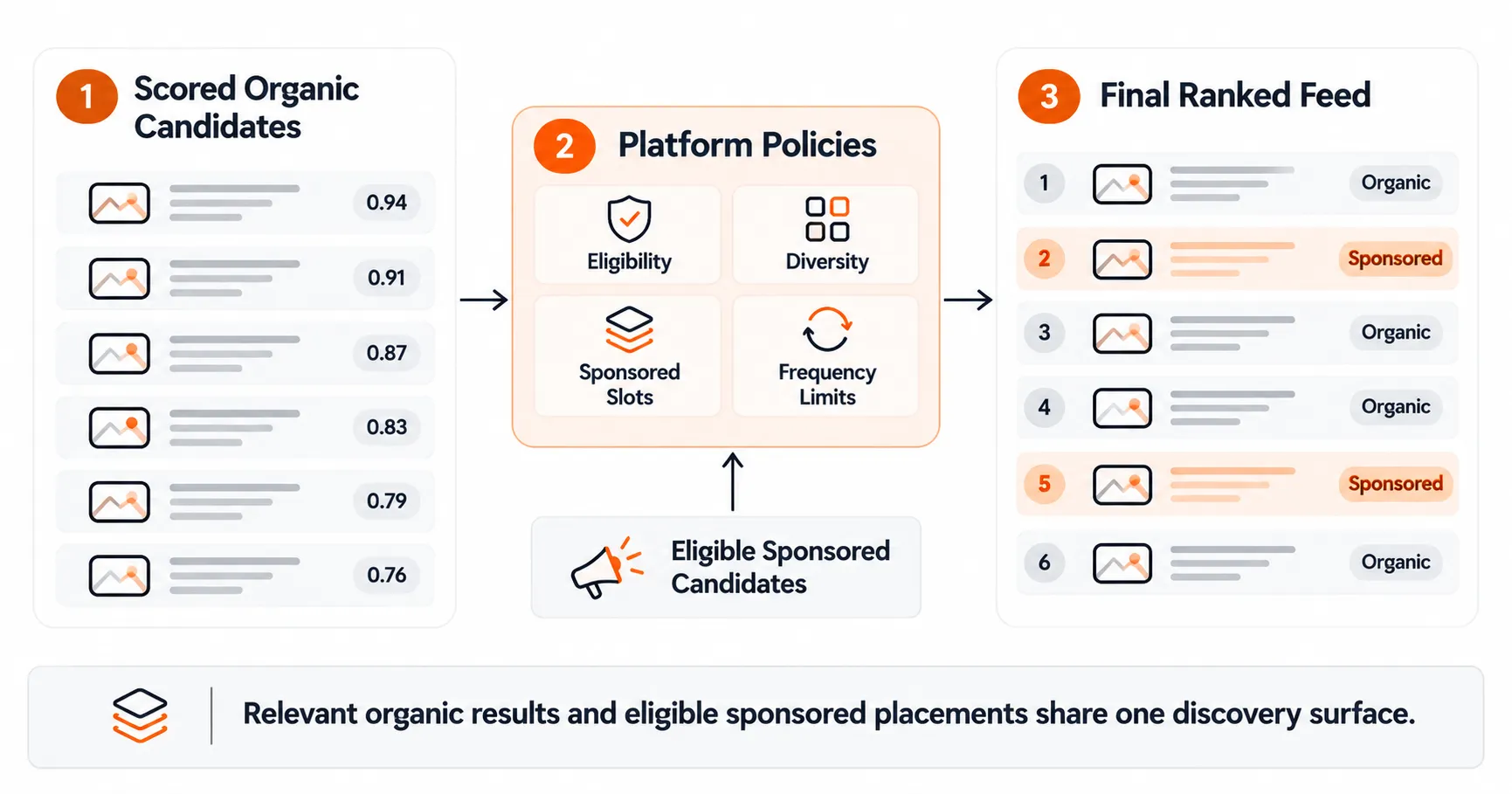
Advertising bids and budgets are distinct from organic relevance.
What Does the API Return to the App?
Once the ordering is finalized, the service returns item identifiers or content references, their order, and any required decision metadata.
The application resolves the corresponding content, renders the cards, and labels sponsored placements clearly when present. It also needs a predictable fallback if the recommendation service times out or returns no usable items.
A conceptual response might include ranked_items, sponsored_items, and decision_id. Those labels illustrate the response structure, not a universal API specification.
Retrieval, ranking, and rendering may have separate owners. The Gortex feed-ranking architecture guide shows why the boundaries between these stages matter operationally.
How Does Feedback Improve Future Recommendations?
After displaying results, the application records what users actually saw and what happened afterward.
Useful events include impressions, position, clicks, saves, hides, purchases, and successful matches. Link events to the specific recommendation decision so investigators can reconstruct what was served.
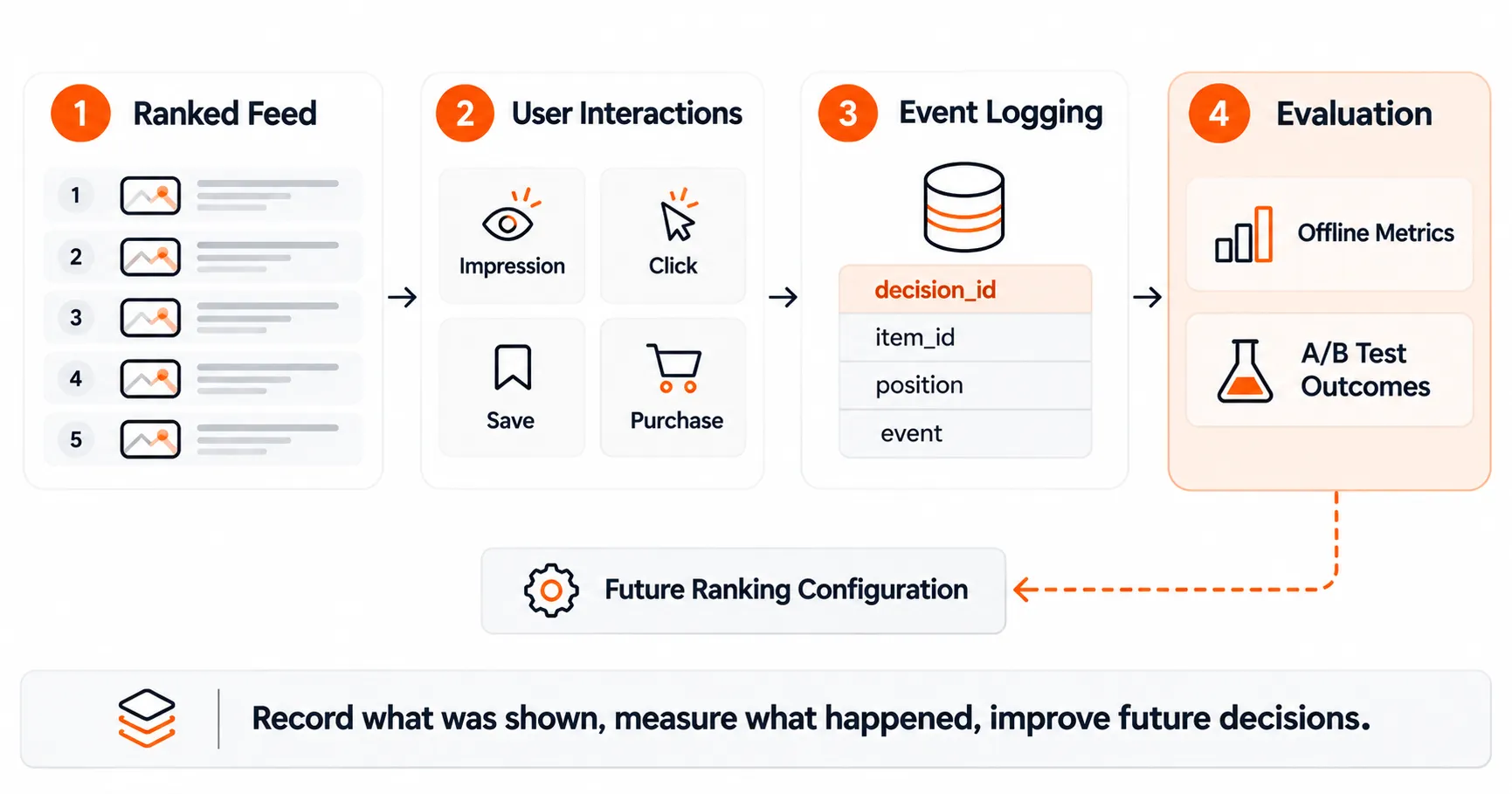
Feedback may update short-term session features quickly, while model training usually occurs on a separate schedule. A new click does not automatically mean the entire ranking model retrains immediately.
Position bias matters: items shown first get more opportunities to earn clicks. A 2025 ACM RecSys study examined how exposure and sampling choices can distort offline comparisons.
Reliable logs make experiments trustworthy.
What Does One Recommendation Request Look Like?
Consider a fictional creator platform with 100,000 eligible posts and a viewer opening the home feed.
These figures are illustrative, not measured results.
If the viewer is new, preferences and broadly relevant content may replace interaction-heavy personalization. If retrieval fails, the application can fall back to eligible recent posts rather than showing an empty screen.
Define responses for normal and failure conditions.
A useful debugging exercise is to follow a single request identifier through every stage. Check which retrieval source contributed each candidate, why eligibility removed certain items, what score each surviving candidate received, and which final policy changed its position. If an expected post never appears, that trace tells engineers whether the failure happened during retrieval, scoring, filtering, or rendering. Without this separation, teams may incorrectly retrain a model to fix a catalog or serving problem.
Rules-Based vs Learned Recommendations
A useful baseline matters more than complexity.
Recent architecture research also shows that pipeline implementation is evolving. In May 2026, Meta described SilverTorch, a GPU-based retrieval approach that integrates previously separate operations. Meta reported up to 23.7 times the throughput of a specified baseline in its evaluation. That is a vendor-reported, workload-specific result.
How Do You Know the Pipeline Works?
Offline tests compare candidates and rankings against historical data using metrics such as Recall@K and NDCG@K. Online experiments measure user outcomes under actual serving conditions.
Monitor conversion, retention, coverage, diversity, error rate, and p95/p99 latency. Use randomized holdouts where appropriate, and watch for harm to organic engagement when sponsored slots are introduced.
An improvement in offline accuracy does not establish business impact. A 2026 ACM paper on evaluation standards highlights concerns about weak methodology and reproducibility in offline recommender studies.
Release through shadow testing, limited traffic, and fallback validation.
Where Does Gortex Fit in This Workflow?
Gortex focuses on the decision layer after a platform supplies eligible candidates. It helps platforms operate their own advertising marketplaces by coordinating organic ranking, sponsored placement, and platform policies.
The POST /v1/decide decision path takes supplied candidates, recipient context, surface details, and applicable policies, then returns ranked items, sponsored placements, and a traceable decision identifier.
Its published beta capabilities include calibrated linear scoring, platform controls, advertiser self-service, and multi-bidder auctions. Gortex does not replace full-catalog retrieval or provide a deep learned recommendation model.
For new integrations, its architecture documentation recommends planning around approximately 50 candidates per request, with 100 as an upper planning limit.
Its longer-term vision is an AI-agent advertising network for structured offers, not ads inserted into assistant answers.
Conclusion
Recommendation systems do more than predict what users might like. They connect candidate retrieval, relevance scoring, business rules, and feedback into a continuous decision-making process.
The strongest systems are not necessarily those with the most sophisticated algorithms. They are the ones that consistently deliver relevant results, respond reliably, and improve measurable user outcomes.
For marketplaces, creator platforms, social networks, and other discovery-driven applications, another consideration is becoming increasingly important: how to monetize discovery without compromising organic relevance.
That requires more than a recommendation model. Platforms need to coordinate organic rankings, sponsored placements, advertiser eligibility, and user-experience policies within the same request flow.
Gortex addresses this challenge through its unified decision infrastructure, helping platforms run their own advertising marketplaces while maintaining control over ranking and sponsored-placement policies.
If your platform already retrieves candidates and you're exploring how to introduce sponsored discovery, Gortex's decision API is a practical starting point for evaluating how organic ranking and monetization can work together.
Frequently Asked Questions
Does every recommendation system need machine learning?
No. Rules, content attributes, and popularity can support useful recommendations before a product has sufficient interaction data for learned models.
What is the difference between retrieval and ranking?
Retrieval chooses the items eligible for consideration. Ranking estimates their relative relevance and determines ordering.
Can recommendations include sponsored items?
Yes. Sponsored items can be selected alongside organic candidates when eligibility, relevance, labeling, and platform advertising policies are respected.
What happens when a new user has no history?
The system can use declared interests, session context, popular eligible items, and exploration until useful behavioral signals develop.