A recommendation engine is software that suggests products, content, people, or services a user is likely to find relevant. It uses information such as previous actions, item characteristics, and current context to decide what to show next.
A recommendation engine does not necessarily require advanced artificial intelligence. Simple rules can make recommendations; larger systems often use machine learning to handle more users, items, and signals.
This guide explains what recommendation engines do, how they work, their main types, and what businesses should consider before adopting one.
What Does a Recommendation Engine Actually Do?
A recommendation engine, also called a recommender system or recommendation system, helps users discover relevant options from a larger collection.
Instead of showing everyone the same list, it can change suggestions based on who is browsing, what they previously interacted with, and what is available now.
A shopping app might recommend running shoes to someone who browsed fitness equipment. A news app might suggest technology stories to a reader who follows software topics.
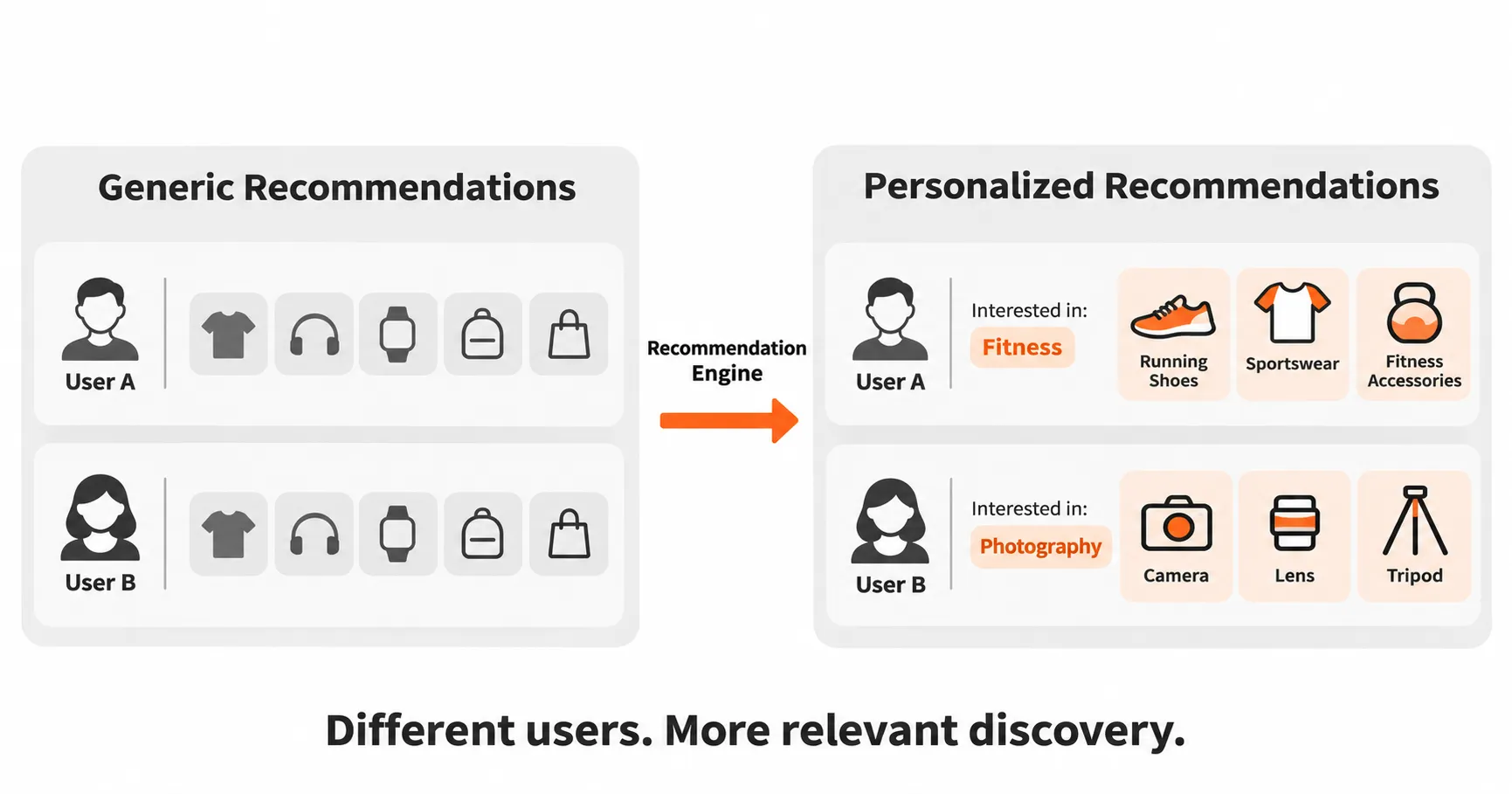
Google's introduction to recommendation systems explains how recommendations help people discover content they might not have searched for directly.
Where Are Recommendation Engines Used?
Recommendation engines appear wherever the number of possible choices exceeds what a user can review comfortably.
Some recommendations are personalized to a person. Others depend mainly on the item being viewed, recent popularity, or the current search context.
How Does a Recommendation Engine Work?
A common recommendation process has three stages: find candidates, score them, and adjust the final order.
1. Find candidates. From a large catalog, identify items that could reasonably match the user's needs. A shopping site might first select available shoes in the relevant category.
2. Score candidates. Estimate how useful each item might be, considering factors such as browsing behavior, item properties, and context.
3. Adjust and display. Remove unavailable or repeated items and consider variety, freshness, and other requirements before showing the final list.
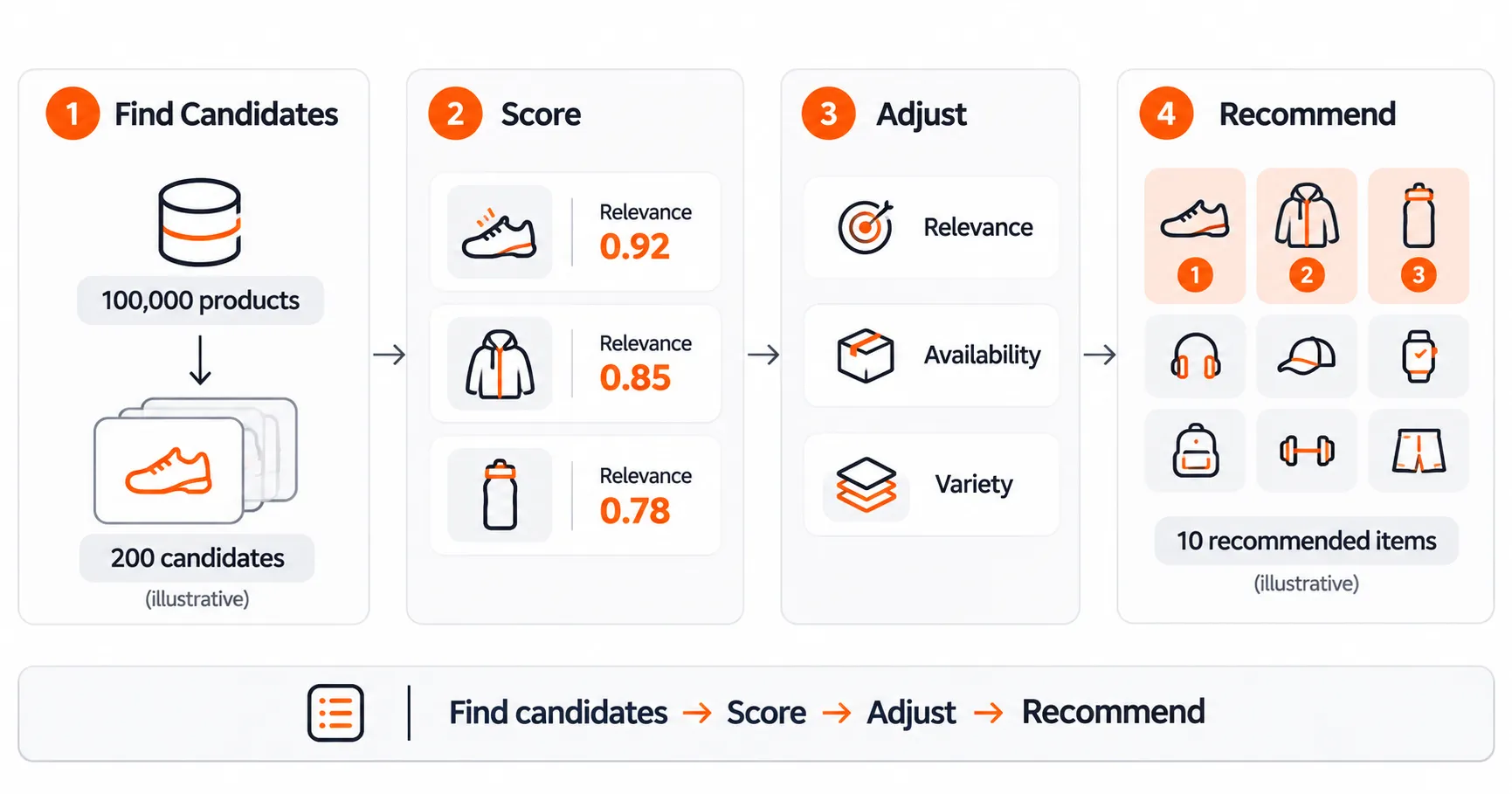
Google's recommendation-system architecture guide calls these stages candidate generation, scoring, and re-ranking.
Imagine an illustrative catalog of 100,000 products. The system retrieves 200 candidates, scores them, and presents ten. Those counts explain the workflow; they are not performance benchmarks.
What Information Does a Recommendation Engine Use?
A system may consider explicit preferences, such as selected interests or ratings, and behavioral signals, such as views, purchases, saves, follows, or skipped items.
It can also use item information: category, price, language, topic, availability, or publication date. Context may include the user's current search, device, or location when appropriate and permitted.
Reliable recommendations therefore depend on interpreting signals carefully, collecting only necessary data, and maintaining appropriate privacy controls.
New applications can start with item attributes and simple rules before accumulating large histories of user interactions.
What Are the Main Types of Recommendation Engines?
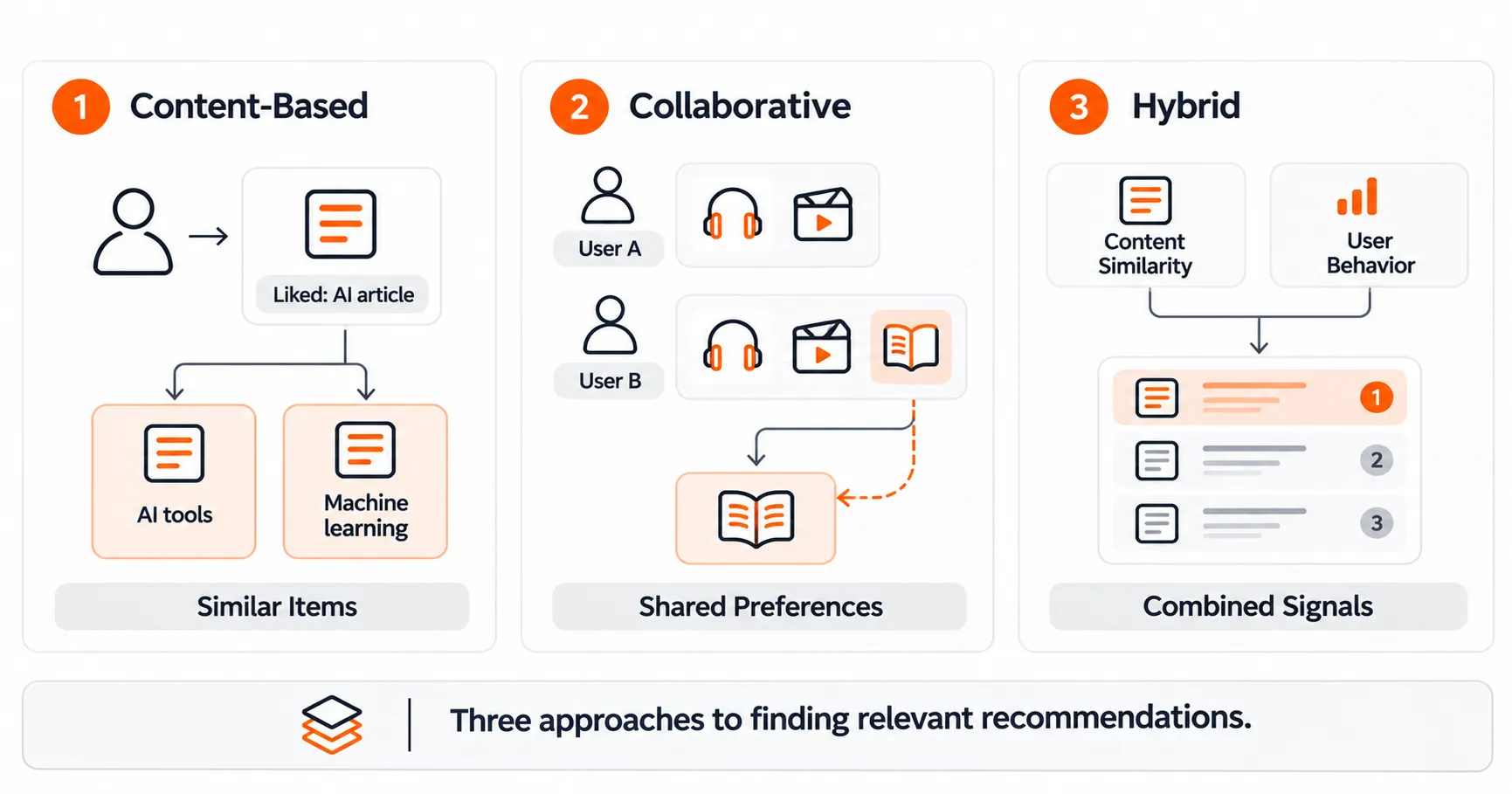
Three widely used approaches are content-based filtering, collaborative filtering, and hybrid recommendation.
Content-based recommendations
A reader interested in cloud computing might receive other cloud-related articles because the topics resemble their previous interests. This approach can work even when other users have supplied little feedback.
Collaborative filtering
If people with similar viewing patterns also enjoy a particular video, the system may recommend it to someone who has not watched it yet. Google's collaborative-filtering explanation describes how shared interaction patterns can reveal useful connections.
Hybrid recommendations
A hybrid system combines signals, such as content similarity and user behavior, to offset weaknesses in either approach alone. It still needs testing: combining algorithms does not automatically produce better outcomes.
Recommendation Engine vs Search vs Ranking API
These terms are connected, but they describe different jobs.
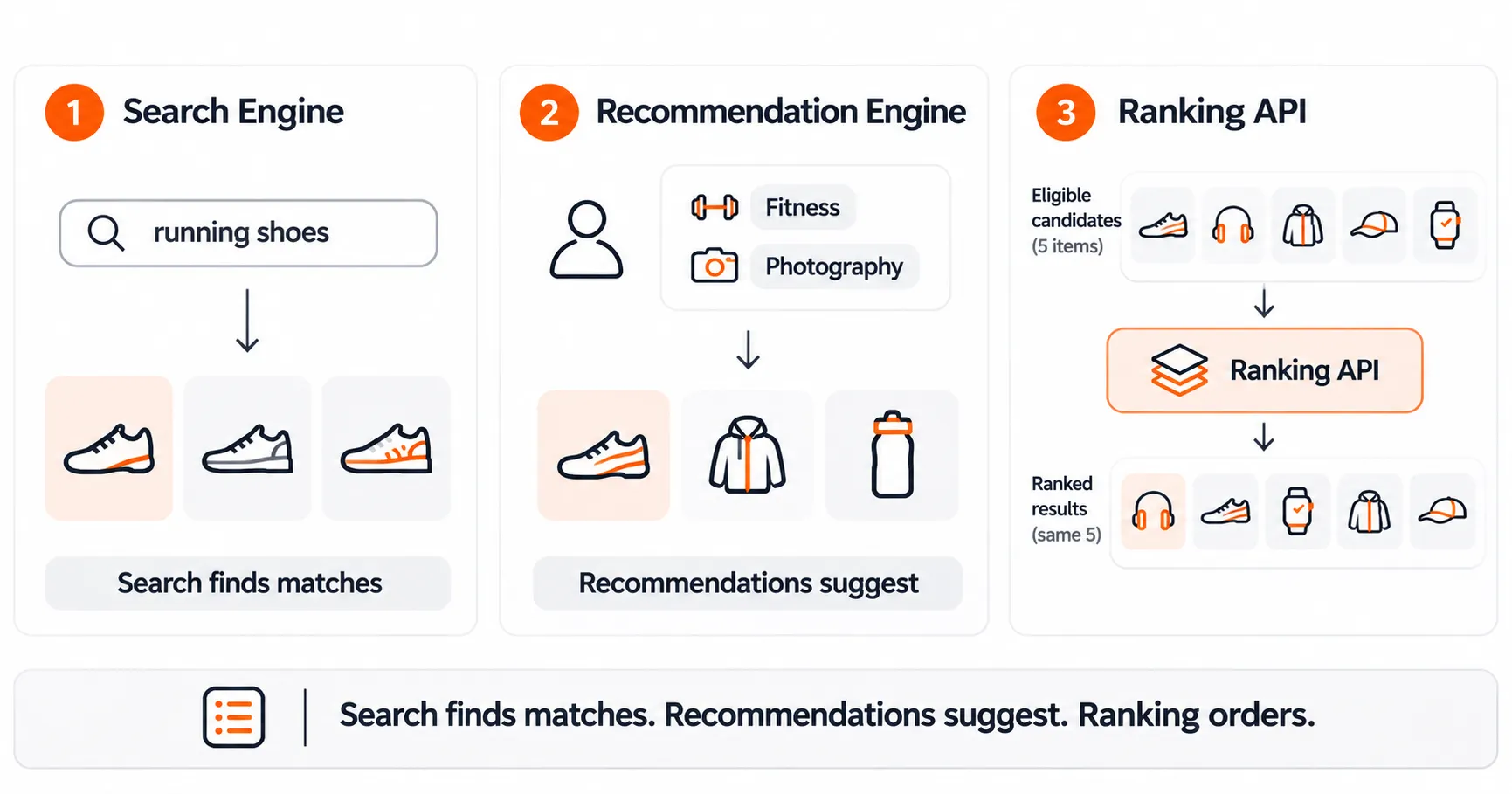
Search responds to something a person asks for. Recommendations can surface options before the person knows what to search for.
A ranking API usually needs an existing set of candidates. A broader recommendation engine may include both retrieval and ranking. The recommendation API versus recommendation engine explanation covers the distinction for teams assessing integrations.
A product can use search, recommendations, and ranking together. The question is which layer each service owns.
Why Do Businesses Use Recommendation Engines?
Potential business outcomes include more relevant product views, greater content engagement, better matching, and increased conversion. None is guaranteed merely by installing a recommendation engine.
Modern recommendation engines separate candidate retrieval from ranking to improve efficiency and scalability. Google Cloud's recommendation architecture explains how systems narrow millions of potential items into a smaller candidate set before applying more detailed ranking. More recently, Meta's 2026 SilverTorch research demonstrates how large-scale recommendation retrieval continues to evolve through GPU-based architectures. For businesses, the important principle remains straightforward: find relevant candidates efficiently, then rank them according to user needs and product objectives.
For a smaller app, the valuable lesson is simpler: identify good candidates first, then spend additional computation deciding their order.
Judge business impact through controlled experiments, not promotional uplift figures borrowed from unrelated products.
What Can Go Wrong With Recommendations?
A recommendation engine may repeatedly promote popular items, making discovery harder for new sellers or creators. It may also produce repetitive feeds when every suggestion resembles the last click.
Cold start is another challenge. New users have little interaction history; new products or posts have not had much exposure.
Recommendation systems can also confuse visibility with preference. Items shown near the top receive more opportunities for interaction, which can distort historical feedback.
Good systems need fallback recommendations, eligibility filters, diversity checks, and monitoring. They should also let the product team examine whether changes harm user retention or satisfaction.
How Do You Know Recommendations Are Working?
Measure both the quality of recommendations and the effect on real user behavior.
For example, if 1,000 recommendations are displayed and 40 receive clicks, the observed click-through rate is 4%. This is illustrative arithmetic, not an industry average.
Clicks alone can mislead. A recommendation might attract attention while reducing completed purchases or long-term satisfaction.
Should You Build or Buy a Recommendation Engine?
Building internally provides control over algorithms and data flows, but requires engineering work for retrieval, scoring, serving, monitoring, and maintenance.
Using a managed service can remove some responsibilities, though the application still needs good catalog data, integration, and measurement.
Before deciding, ask whether your team needs full recommendation generation, ranking for candidates it already retrieves, or sponsored placement alongside organic results.
The more technical recommender systems guide for engineers explains these architecture choices in depth.
For a new product with little interaction data, a simple approach with meaningful fallback rules may be more useful than a costly model-training project.
Where Does Gortex Fit?
Gortex's recommendation engine API focuses on a narrower decision: ordering eligible candidates already supplied by an application.
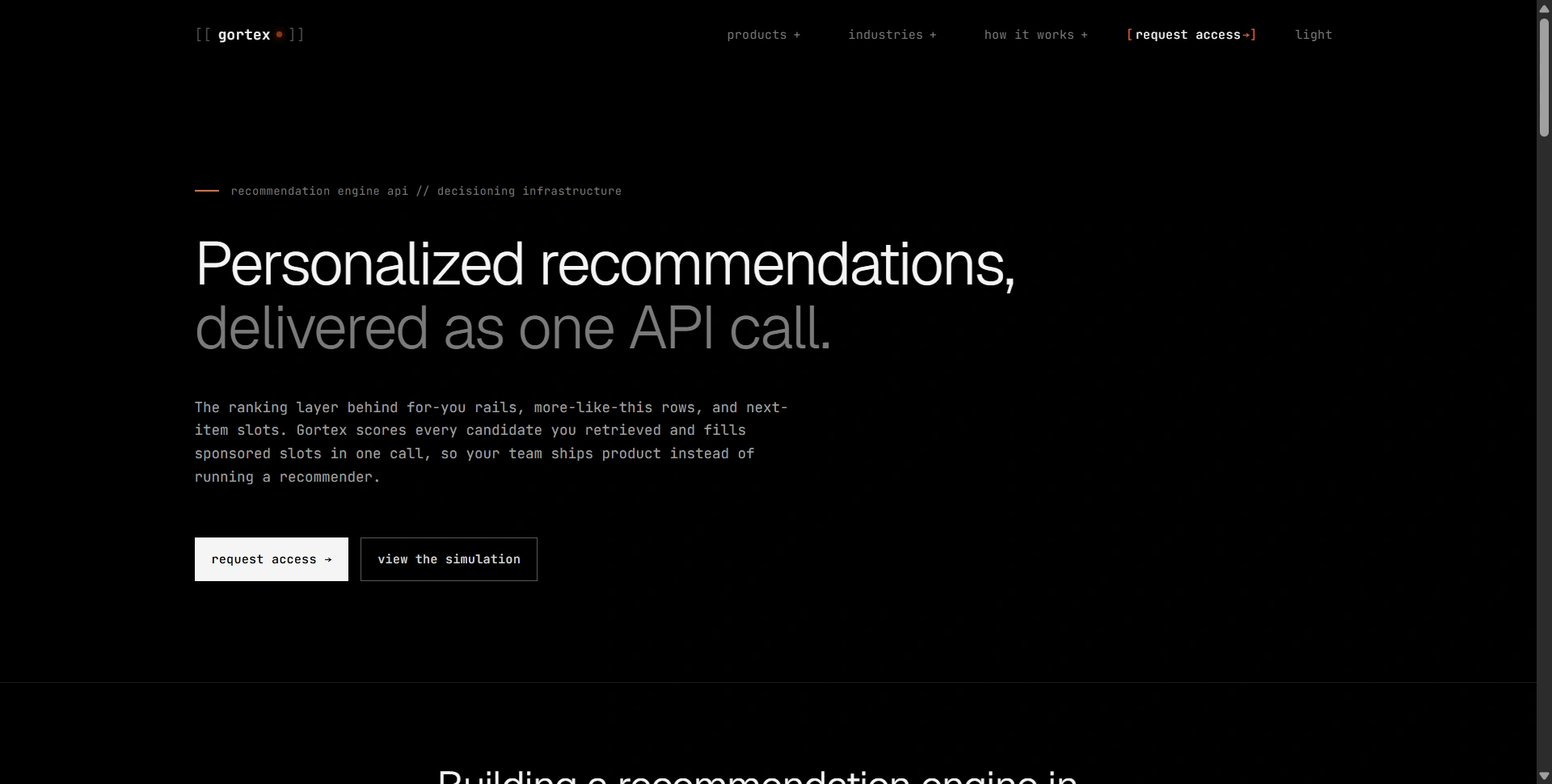
Through POST /v1/decide, applications send recipient, context, and item information and receive ranked results, optional sponsored placements, and decision identifiers.
Current capabilities include calibrated linear ranking, deterministic sponsored-slot filling, and decision tracing. Gortex does not replace full-catalog retrieval, advertiser billing, or campaign management; learned ranking and real-time auctions remain roadmap capabilities.
This makes it relevant to marketplaces and feed-based products that already find candidates and want a single decision endpoint for ordering and sponsored positions. Availability is through private beta.
Conclusion
A recommendation engine helps people discover relevant items by selecting, scoring, and ordering choices from a larger collection.
It can be simple or sophisticated, rules-based or machine-learned, and personalized or contextual. Its success depends less on terminology than on relevance, reliable data, sensible fallbacks, and measurable user outcomes.
For product teams, start with the discovery problem, identify which infrastructure is missing, and evaluate whether recommendations actually make the experience better.
Frequently Asked Questions
Is a recommendation engine the same as AI?
Not always. Recommendations can come from rules or popularity sorting. Machine learning is useful when interaction patterns and application scale justify additional complexity.
Is a recommendation engine the same as personalization?
Personalization is the broader practice of adapting an experience to a user. A recommendation engine is one way to personalize what someone discovers.
Do recommendation engines need user data?
They need relevant information, but not necessarily extensive personal histories. Item characteristics, current context, and explicit preferences can support useful starting recommendations.
Can recommendation engines work for new users?
Yes. They can use onboarding preferences, relevant popular items, and other safe fallbacks until reliable behavioral information becomes available.
Can recommendations include sponsored items?
Yes, provided paid placements meet eligibility and relevance requirements and are clearly disclosed. Sponsored selection and organic recommendations may be handled by different systems.