App monetization is the process of generating revenue from an application's users, transactions, content, or commercial activity. Beyond traditional display ads and recurring subscriptions, apps can earn through transaction fees, paid features, virtual goods, affiliate commissions, sponsored listings, and business partnerships.
The right model depends on what users already do inside your product.
A marketplace processes transactions. A creator platform connects audiences with creators. A social app distributes attention. Each creates different opportunities to generate revenue without charging everyone a monthly fee.
This guide compares seven app monetization models, explains their economics, and shows how founders can test revenue opportunities without undermining retention.
How Can You Monetize an App Without Ads or Subscriptions?
The strongest alternatives monetize an action users already value rather than adding unrelated advertising inventory.
Common approaches include transaction commissions, one-time purchases, paid promotion, virtual goods, affiliate referrals, licensing, and premium services.
Apple's app business model guidance recognizes multiple models, including paid downloads, freemium purchases, and optional digital transactions.
The distinction matters because revenue mechanics affect acquisition, retention, and infrastructure requirements differently.
A paid download monetizes access. A commission monetizes completed transactions. Sponsored placement monetizes visibility.
Before choosing a model, identify who receives measurable value, who pays, and what event triggers payment.
Which App Monetization Models Work Best?
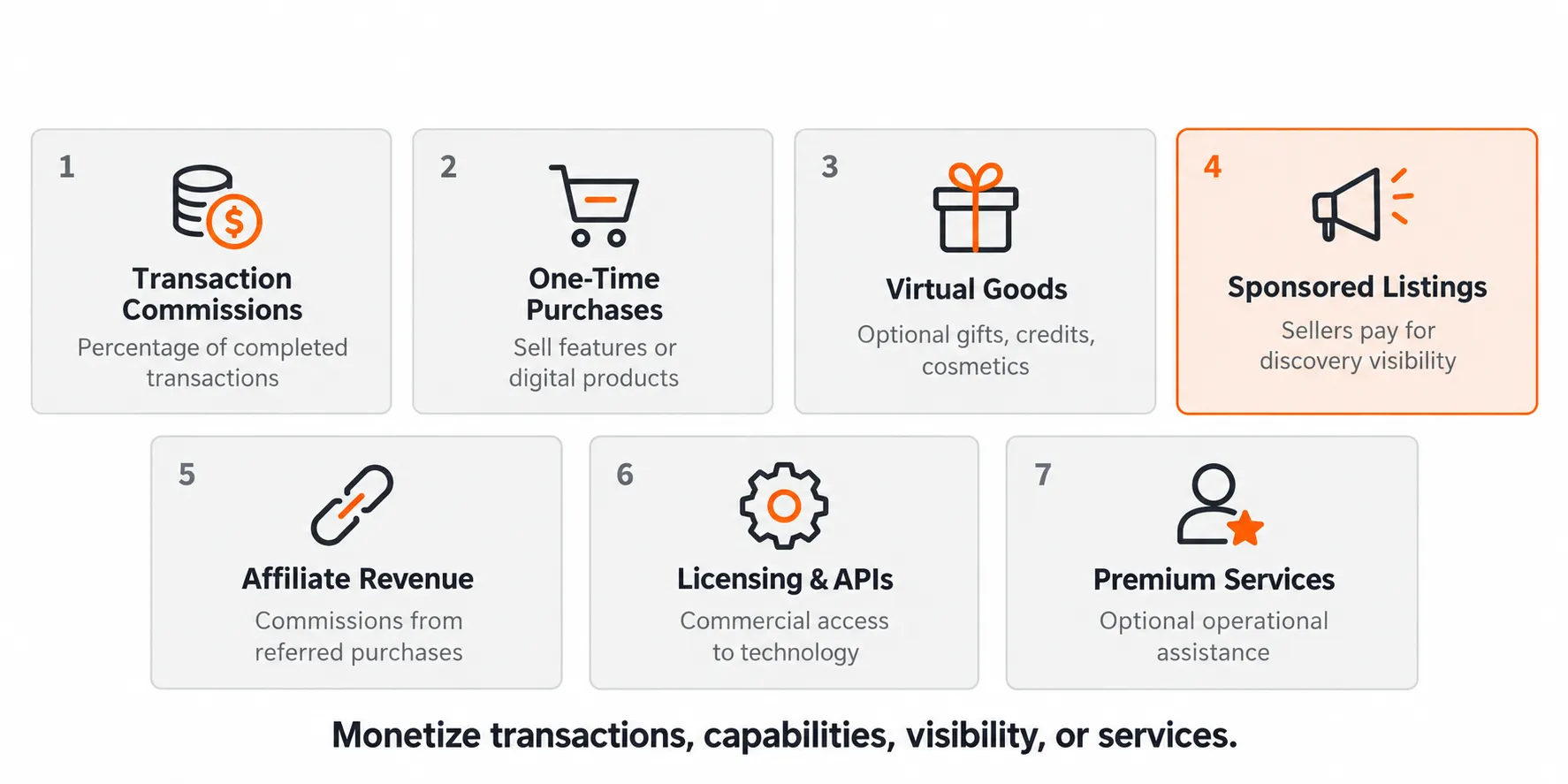
These models are not mutually exclusive.
A marketplace could earn commissions on transactions while selling sponsored visibility to participating sellers.
However, each additional model introduces pricing, payment reconciliation, customer support, and compliance requirements.
Start with the revenue mechanism most closely connected to your product's core activity.
How Do Transaction Fees Generate Revenue?
Transaction commissions allow platforms to earn a percentage or fixed fee when buyers and sellers exchange value.
This model works particularly well for marketplaces, booking platforms, service directories, and creator-commerce applications.
Consider a marketplace processing $500,000 in monthly gross merchandise value (GMV).
At a 10% platform commission:
$500,000 × 10% = $50,000 gross commission revenue
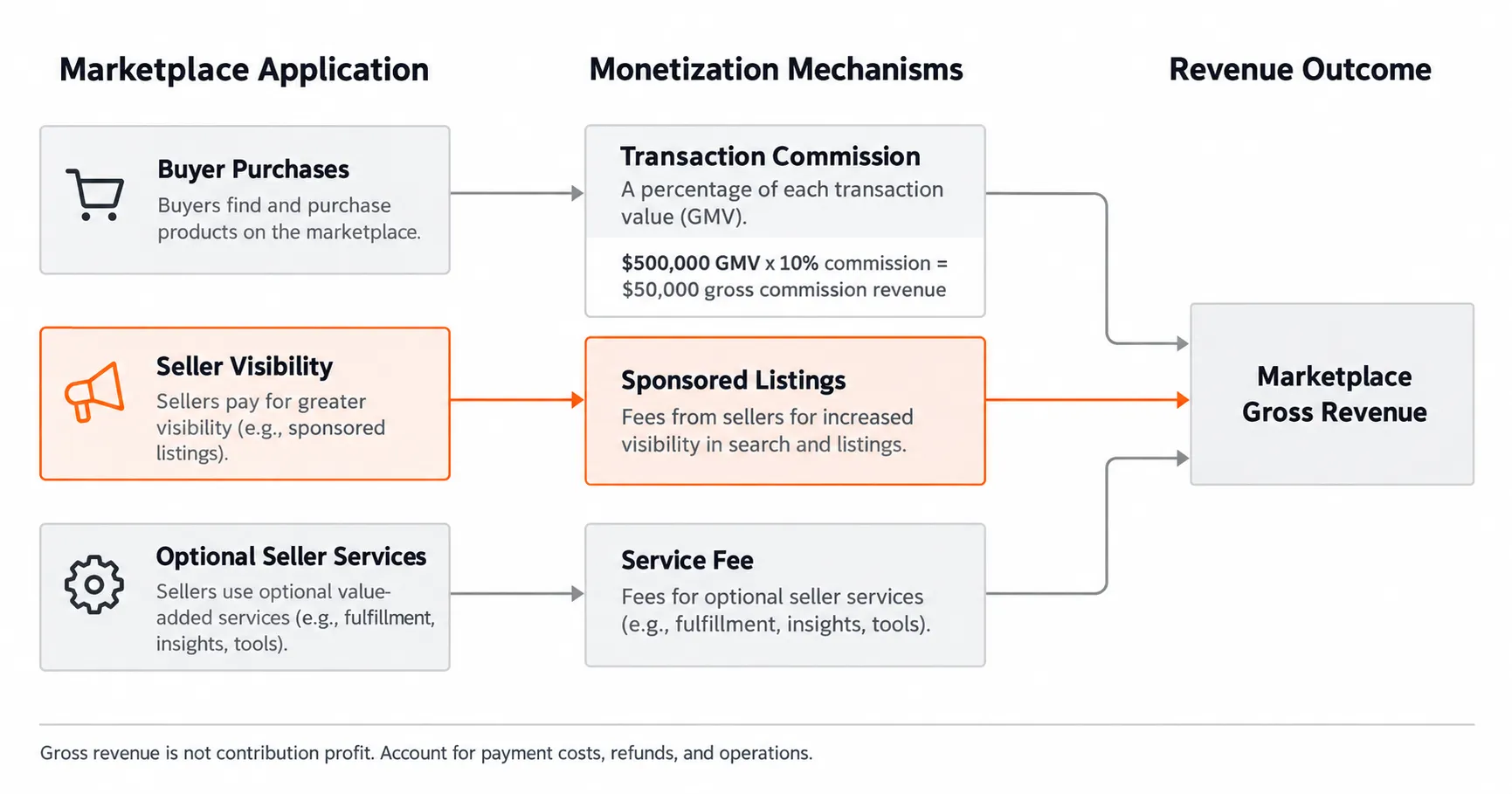
The platform still pays payment-processing costs and covers applicable refunds, fraud, support, and operational expenses.
Stripe Connect's marketplace documentation describes payment flows in which platforms collect funds, route payments to sellers, and retain fees.
A commission model aligns revenue with completed transactions, but excessive fees can encourage sellers to transact elsewhere.
Founders should measure take rate, transaction frequency, seller retention, and contribution margin rather than GMV alone.
Can One-Time Purchases Replace Subscriptions?
One-time purchases monetize a specific feature, digital product, or capability without requiring recurring payment.
Examples include advanced editing tools, downloadable templates, extra storage packages, and individual feature unlocks.
This works when users value a clearly defined outcome but do not need continuous access.
For instance, a photo-editing app could offer a free editor and charge for an advanced export feature.
The advantage is transparent pricing. Customers understand what they receive and when they pay.
The limitation is revenue predictability. A customer may purchase once and never generate another payment.
Therefore, measure purchase conversion, average order value, refunds, and repeat purchasing.
Avoid restricting essential functionality unexpectedly after users have already adopted the product.
When Do Digital Goods and Credits Work?
Virtual goods monetize optional digital items, upgrades, or interactions.
Common examples include game cosmetics, profile customization, digital gifts, and consumable credits.
Unlike subscriptions, users decide when to spend and how much.
A creator community might allow followers to purchase virtual gifts, while a game could sell cosmetic customization without affecting core functionality.
Successful implementation depends on perceived value, transparent pricing, and safeguards against accidental purchases.
Platform rules also matter.
Apple's App Review Guidelines generally require in-app purchase for digital goods consumed within an iOS app, subject to applicable exceptions and regional provisions.
Google Play's service-fee documentation describes a 15% tier on the first $1 million of annual earnings for enrolled developers.
These policies affect net revenue and must be reviewed before choosing a payment flow.
How Can Marketplaces Monetize Visibility?
Sponsored listings allow sellers to pay for additional exposure inside search results, category pages, or personalized feeds.
Unlike generic display advertising, sponsored items belong to the marketplace's existing catalog.
A buyer searching for running shoes might see a clearly labeled sponsored product alongside relevant organic results.
This approach works when three conditions exist: meaningful discovery traffic, sellers who value additional exposure, and enough relevance data to protect user experience.
The Gortex sponsored listings API guide explains how applications can introduce monetized positions without building an entire ad server.
Common pricing approaches include cost per click, cost per thousand impressions, and fixed-price featured placement.
Start with one or two positions rather than monetizing every visible result.
Sponsored revenue should be evaluated against changes in organic engagement and conversions.
How Much Can Sponsored Placement Earn?
Consider a hypothetical marketplace generating five million search requests monthly.
Assume one sponsored opportunity per request, 50% fill, 2% click-through rate, and $0.50 realized CPC.
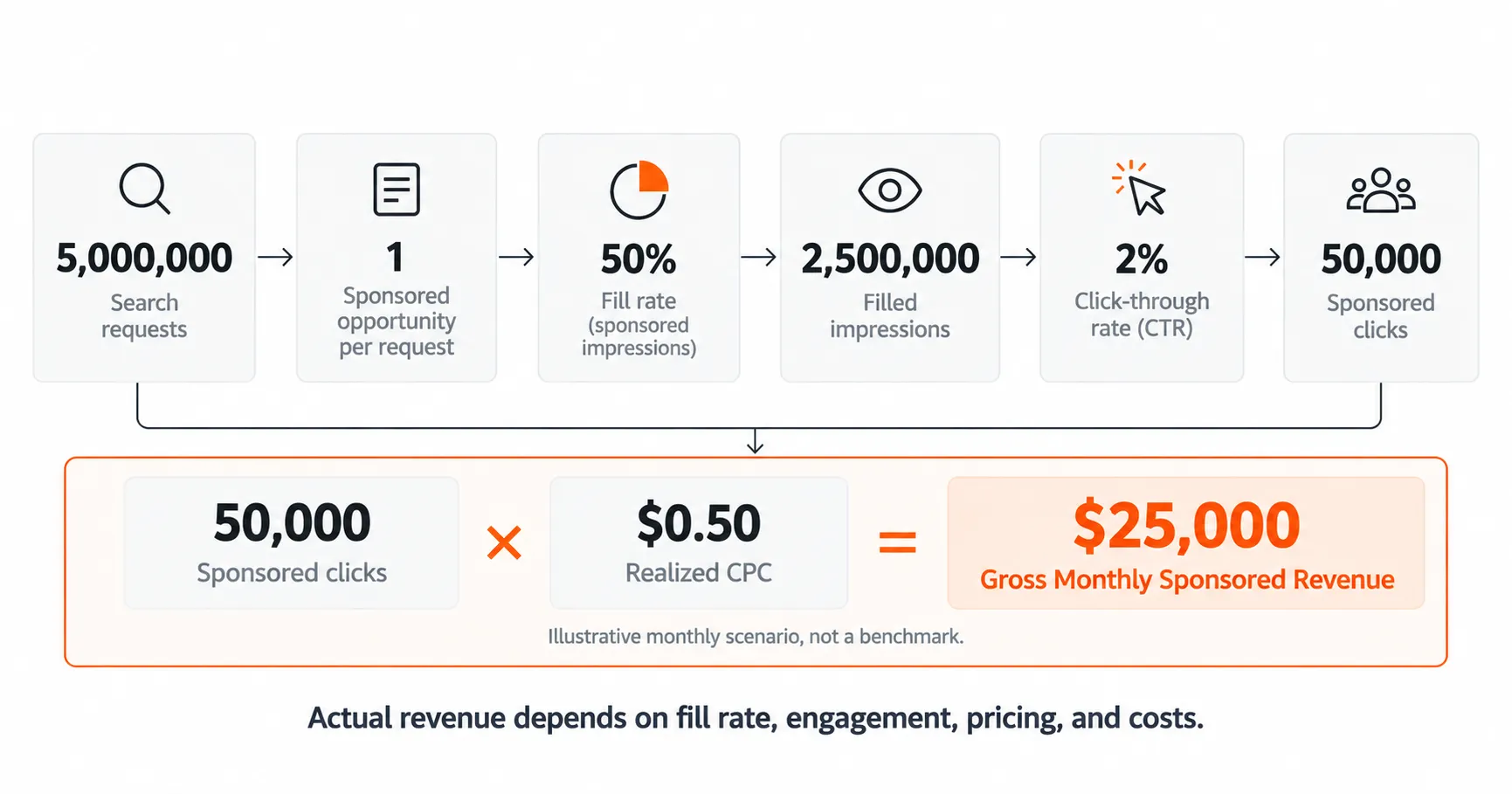
Calculation:
5M × 50% × 2% × $0.50 = $25,000
This is an illustrative financial model, not an industry benchmark or Gortex customer result.
The example excludes advertiser acquisition, infrastructure, invalid clicks, refunds, and potential losses from displaced organic purchases.
As discussed in Marketplace Advertising 101, higher advertising revenue does not automatically mean higher marketplace profitability.
The correct metric is incremental contribution after accounting for both advertising income and changes in organic transactions.
Can Apps Earn Through Affiliate Partnerships?
Affiliate monetization pays an app for referring users who complete qualifying actions with another business.
A travel discovery app might earn commissions when users book accommodation. A shopping recommendation app might receive revenue from purchases attributed to its referrals.
The model is attractive when the app influences purchase decisions but does not process transactions itself.
However, attribution windows, return policies, commission rates, and partner dependence affect realized revenue.
Commercial relationships also require transparency.
The FTC's endorsement guidance explains that material connections, including affiliate compensation, should be disclosed clearly and conspicuously.
Measure earnings per outbound click, conversion rate, reversal rate, and revenue per active user.
Avoid ranking inferior recommendations higher solely because they pay larger commissions.
When Should Apps Sell Licensing or API Access?
Applications that generate valuable infrastructure, workflows, or structured information may monetize through business licensing.
Examples include developer APIs, commercial integrations, white-label functionality, and enterprise access.
A consumer platform might license a specialized matching workflow to businesses while keeping its core application free.
This model can create larger contracts than consumer purchases, but introduces sales cycles, support obligations, and service-level expectations.
The buyer must receive a measurable business outcome.
For example, an API that reduces engineering work is easier to price when customers can compare integration costs against building the capability internally.
Licensing is most suitable when the product already solves a recurring operational problem for organizations.
Avoid creating a B2B offering solely because consumer monetization has not worked.
Can Premium Services Become a Revenue Stream?
Service fees monetize operational assistance rather than basic access.
A marketplace might charge for identity verification, expedited fulfillment, seller onboarding, or managed merchandising.
A professional network could provide optional recruiting assistance or portfolio reviews.
These offerings can generate revenue from smaller customer segments without forcing all users into paid plans.
However, services generally have higher variable costs than automated software features.
Evaluate delivery cost, refund rates, support time, and contribution per completed service.
The strongest services solve genuine problems users already experience, rather than introducing artificial friction to create a paid upgrade.
How Should Founders Choose a Monetization Model?
Choose based on existing user behavior and demonstrated willingness to pay.
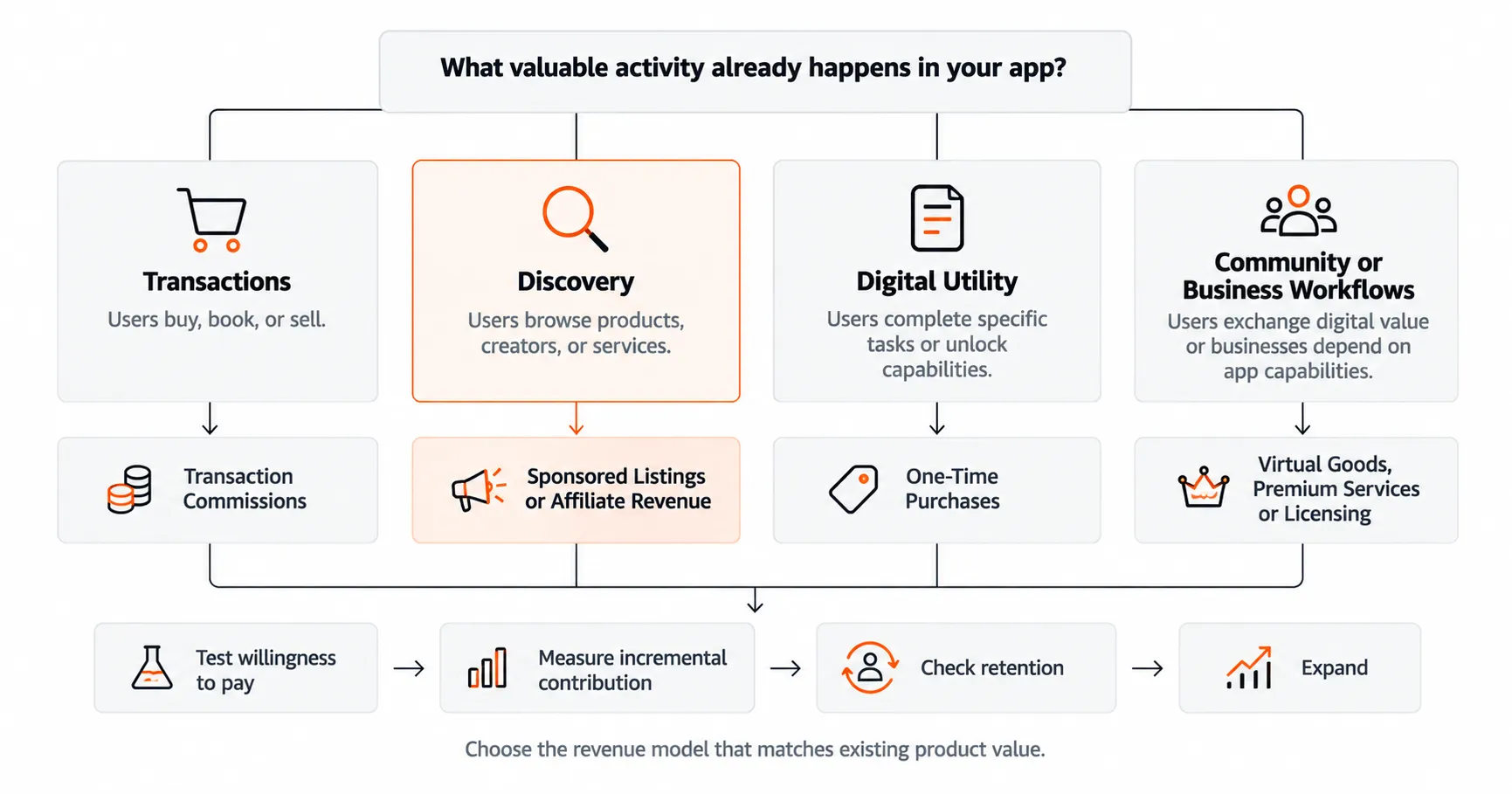
Treat these recommendations as starting hypotheses.
A sponsored-placement system cannot generate sustainable revenue without advertisers, while transaction fees require completed transactions.
Similarly, virtual goods depend on users finding genuine value in optional digital purchases.
Interview paying customers before investing heavily in implementation.
The best early signal is not whether users like a feature, but whether they repeatedly pay for it.
Which Monetization Metrics Actually Matter?
Revenue should be measured alongside retention and contribution margin.
Useful metrics include:
-
ARPU: Revenue divided by active users over a defined period.
-
Payer conversion: Paying users divided by eligible users.
-
Take rate: Platform transaction revenue divided by GMV.
-
Sponsored yield: Advertising revenue per thousand eligible requests.
-
Contribution margin: Revenue minus directly attributable variable costs.
-
Retention: Users returning after a specified interval.
For example, an app generating $30,000 monthly revenue from 100,000 monthly active users has an ARPU of $0.30.
That number alone says little about profitability.
A model with higher ARPU but lower retention or heavy servicing costs may perform worse.
Evaluate revenue per cohort and compare retained users against non-paying or control groups.
How Do You Test App Monetization Safely?
Begin with one model and one measurable commercial event.
For a marketplace, that could mean a limited sponsored-listing pilot on a high-intent category page.
Establish baseline retention, organic conversion, and revenue before launch.
Introduce the monetization feature to a limited, appropriately randomized cohort where practical.
Measure completed transactions, paid engagement, contribution margin, user complaints, and repeat purchasing.
Then compare incremental revenue against any deterioration in product experience.
For native sponsorships, preserve organic relevance and label paid content clearly.
Expand only when the economics remain positive after accounting for cannibalization and operational costs.
Where Does Gortex Fit?
For marketplaces and content applications, paid visibility can complement commissions and purchases when organic discovery already works.
Gortex's Sponsored Listings API focuses on ranking and sponsored-slot decisions within existing discovery surfaces.
Applications provide eligible candidates and context through POST /v1/decide, allowing organic ranking and deterministic sponsored placement to be coordinated in one response.
Gortex does not replace payment processing, advertiser billing, campaign-management software, or financial reconciliation.
Its current capabilities include calibrated linear ranking, deterministic sponsored-slot filling, and decision identifiers. Learned ranking and real-time auctions remain roadmap capabilities.
For founders evaluating monetization infrastructure, Gortex offers a narrower decisioning layer rather than a complete advertising business system.
Conclusion
App monetization works best when payment follows real value.
Marketplaces can monetize transactions and sponsored discovery. Creator platforms can offer gifts and commerce. Utility apps can sell specific capabilities, while business-focused products can license infrastructure.
No model guarantees profitability.
Start with the behavior users already value, test willingness to pay, and measure incremental contribution rather than gross revenue alone.
The strongest monetization strategy earns more from the product's existing value without making that product less useful.
Frequently Asked Questions
What is the easiest way to monetize an app?
The easiest model depends on existing behavior. Transaction-heavy apps can test commissions; utility apps can test paid features; marketplaces with advertiser demand can test sponsored visibility.
Can an app make money without ads?
Yes. Transaction fees, purchases, affiliate commissions, virtual goods, licensing, and services can generate revenue without display advertising.
Can free apps generate meaningful revenue?
Yes, when free usage creates valuable transactions, commercial discovery, or optional purchase opportunities. Profitability still depends on costs and retention.
Should apps combine monetization models?
Often, but only after validating each independently. Additional revenue streams introduce operational complexity and potential conflicts with user experience.