Marketplace advertising turns high-intent search results, category pages, and feed positions into paid placements. Sellers pay for additional visibility, while the marketplace earns advertising revenue alongside transaction commissions.
The opportunity is significant. According to Amazon's 2025 annual report, its advertising services generated $68.6 billion in 2025, up from $56.2 billion in 2024, approximately 22% growth.
Amazon's scale is exceptional, but the underlying model applies to smaller marketplaces: sellers value access to buyers who are already browsing, searching, or comparing products.
The challenge is deciding which positions to monetize without making discovery worse.
This guide explains marketplace advertising models, sponsored placement mechanics, revenue calculations, infrastructure requirements, and how to launch a monetization program without sacrificing buyer relevance.
What Is Marketplace Advertising?
Marketplace advertising allows sellers, brands, or service providers to pay for promotional visibility within a marketplace's owned discovery surfaces.
Common placements include:
-
Sponsored products in search results
-
Promoted listings in category pages
-
Paid positions within personalized feeds
-
Featured sellers in discovery sections
-
Sponsored recommendations
Unlike traditional display advertising, marketplace ads often appear alongside organic listings where buyers already have purchasing intent.
Consider a marketplace selling running shoes.
A buyer searches for "trail running shoes." The platform retrieves relevant products, ranks them organically, and reserves an eligible position for a sponsored product.
The advertiser pays according to the marketplace's pricing model, while the buyer sees a clearly labeled sponsored listing.
The objective is not simply selling visibility.
Successful marketplace advertising monetizes existing purchase intent while preserving the quality of discovery.
Why Is Marketplace Advertising a Revenue Opportunity?
Marketplaces traditionally monetize transactions through commissions, seller subscriptions, or listing fees.
Advertising introduces another revenue stream without necessarily requiring additional transactions.
This matters because marketplace operators already control valuable discovery inventory.
Every search, category visit, or feed refresh creates an opportunity to recommend products or sellers.
Amazon's advertising growth demonstrates the commercial potential of that inventory, although its reported advertising revenue also includes formats beyond marketplace sponsored listings.
Instacart's advertising documentation illustrates a more specific model: brands pay for sponsored products appearing in search, browsing, and other shopping experiences.
For founders and monetization teams, the opportunity depends on three conditions:
-
Buyers regularly discover products through marketplace-controlled surfaces.
-
Sellers have sufficient margins to justify paid acquisition.
-
The platform can distinguish sponsored placements without undermining organic relevance.
A marketplace with substantial traffic but weak advertiser economics may generate little revenue.
Advertising demand, not traffic alone, determines monetization potential.
Which Marketplace Advertising Models Work Best?
Different advertising formats serve different commercial objectives.
For many two-sided marketplaces, sponsored listings provide a practical starting point because they reuse existing listing cards and discovery surfaces.
They also create measurable connections between impressions, clicks, and purchases.
However, these formats require different operational capabilities.
A fixed-price featured listing may need straightforward scheduling and billing. Auction-based sponsored listings require eligibility checks, pricing rules, budget enforcement, and event tracking.
The right starting model depends on seller sophistication, available inventory, and engineering capacity.
How Do Feed Positions Become Advertising Inventory?
A marketplace position becomes monetizable when the platform makes it available for paid placement.
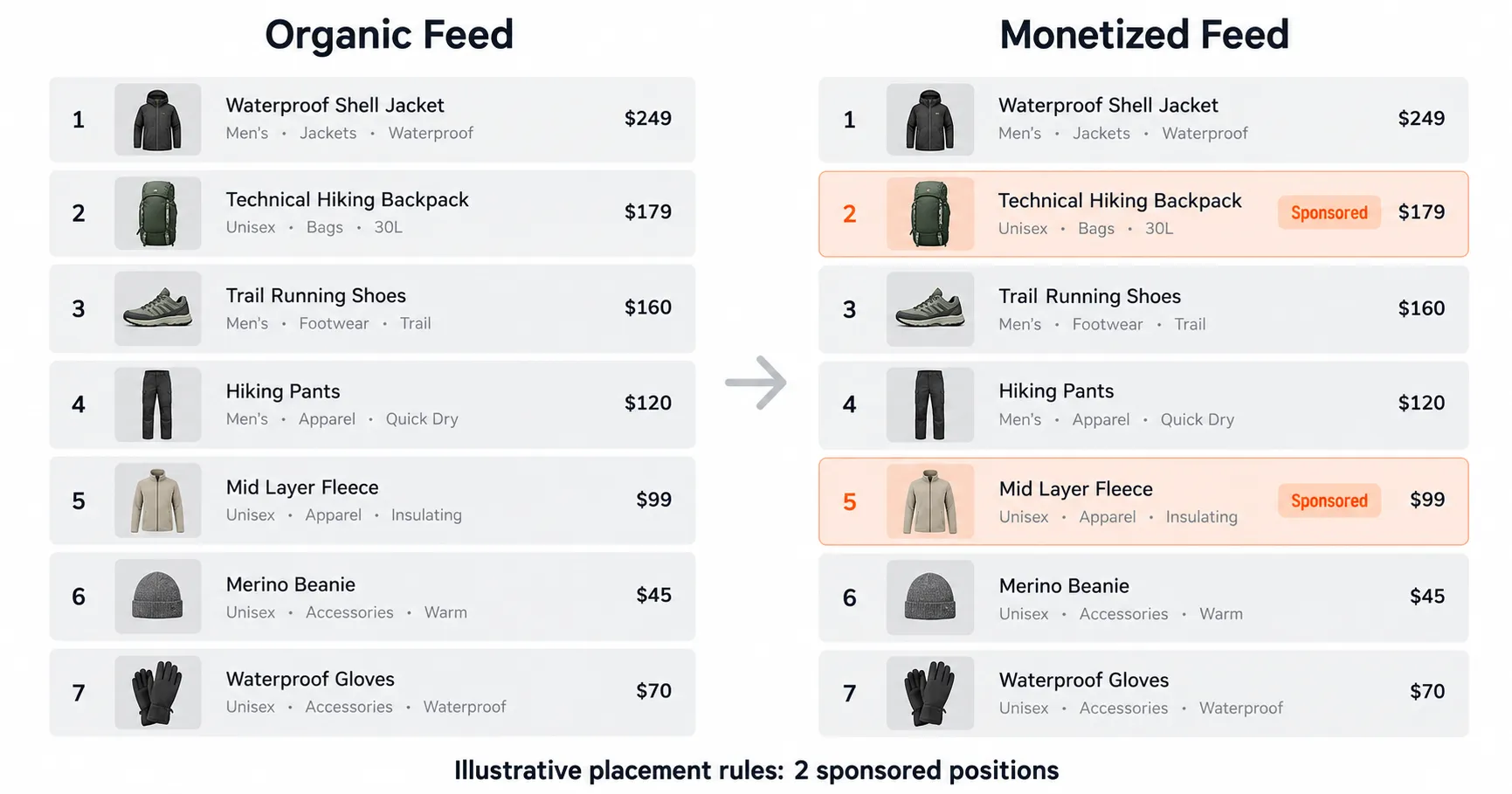
For example, imagine a category feed containing twenty visible listings.
The marketplace reserves two eligible sponsored positions while keeping the remaining results organically ranked.
A simplified arrangement might look like:
-
Organic listing
-
Sponsored listing
-
Organic listing
-
Organic listing
-
Sponsored listing
Actual placement rules should depend on relevance, device, surface, and user behavior.
The important architectural distinction is that sponsored inventory should not simply override the strongest organic results.
A paid listing competes for attention that an organic listing would otherwise receive.
That creates an opportunity cost.
Marketplace operators must consider whether incremental advertising revenue outweighs potential losses in engagement, conversions, or buyer trust.
For an implementation-focused explanation, see Gortex's Sponsored Listings API guide.
CPC vs CPM vs Fixed-Price Advertising
Marketplace advertising commonly uses three pricing models.
Instacart's advertising documentation distinguishes CPC-sponsored products from CPM-based display advertising.
For a marketplace launching sponsored listings, CPC can be attractive because sellers pay when users actively engage.
However, click-based pricing requires accurate click measurement and protection against invalid or duplicate events.
CPM can suit exposure-oriented campaigns, while fixed pricing may be easier for smaller seller communities.
The best pricing model is the one advertisers understand, can measure, and can profitably repeat.
How Much Revenue Can Sponsored Listings Generate?
A simple revenue model helps marketplace founders evaluate the opportunity before committing engineering resources.
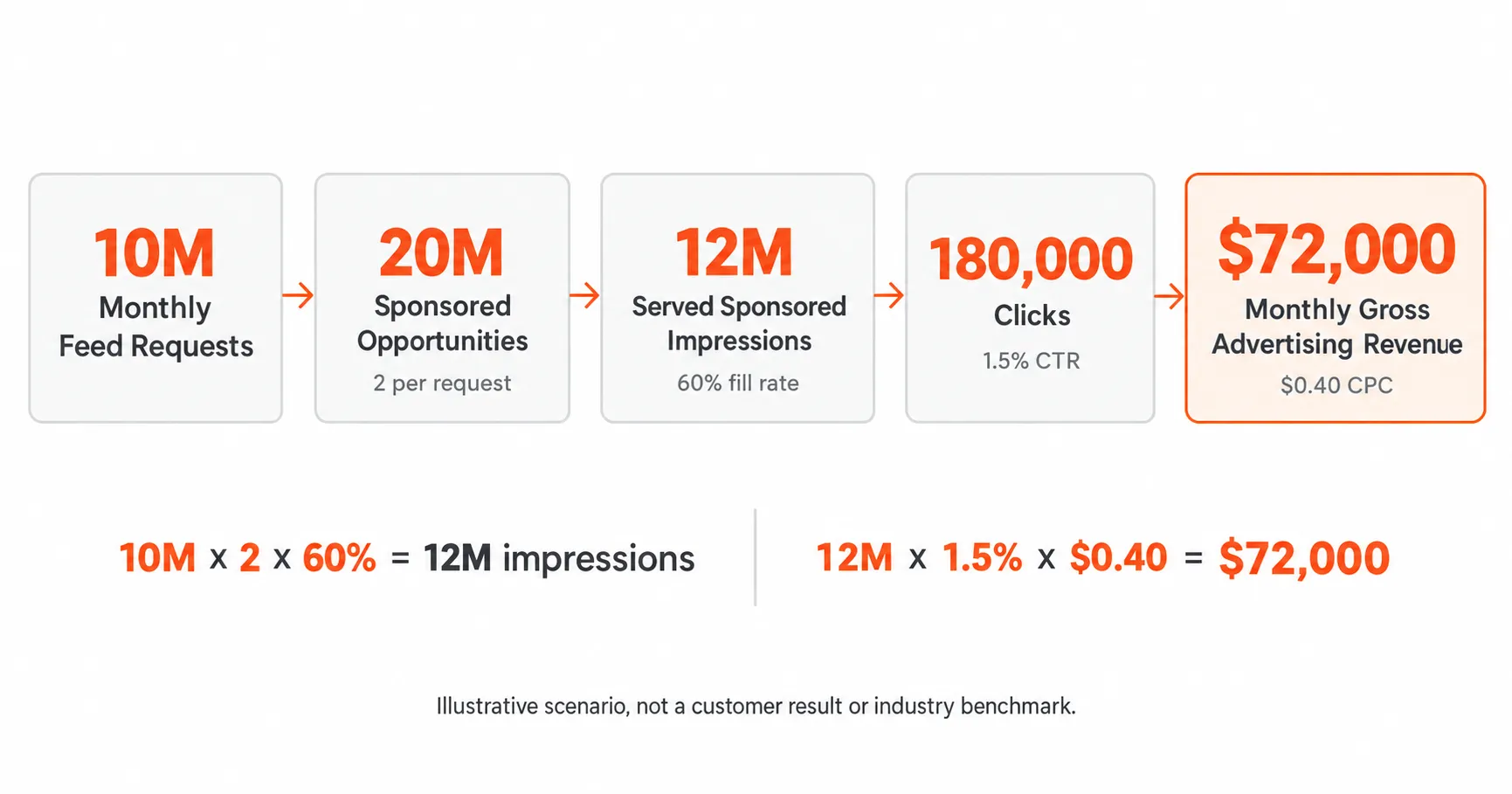
For CPC advertising:
Ad Revenue = Impressions × CTR × Average CPC
Consider a hypothetical marketplace with the following monthly assumptions:
The calculation is:
12,000,000 × 0.015 × $0.40 = $72,000
That represents $864,000 in annualized advertising revenue if those monthly assumptions remain constant.
These numbers are illustrative, not an industry benchmark or Gortex customer result.
They also represent gross advertising revenue before serving costs, fraud losses, refunds, and operational expenses.
The sensitivity is important.
Doubling available sponsored positions does not guarantee doubled revenue. Additional slots may have weaker engagement, lower advertiser demand, and higher relevance costs.
A stronger strategy optimizes realized revenue per feed request alongside buyer and seller outcomes.
How Are Sponsored Listing Winners Selected?
Auction-based marketplace advertising determines which eligible advertisers receive available placements.
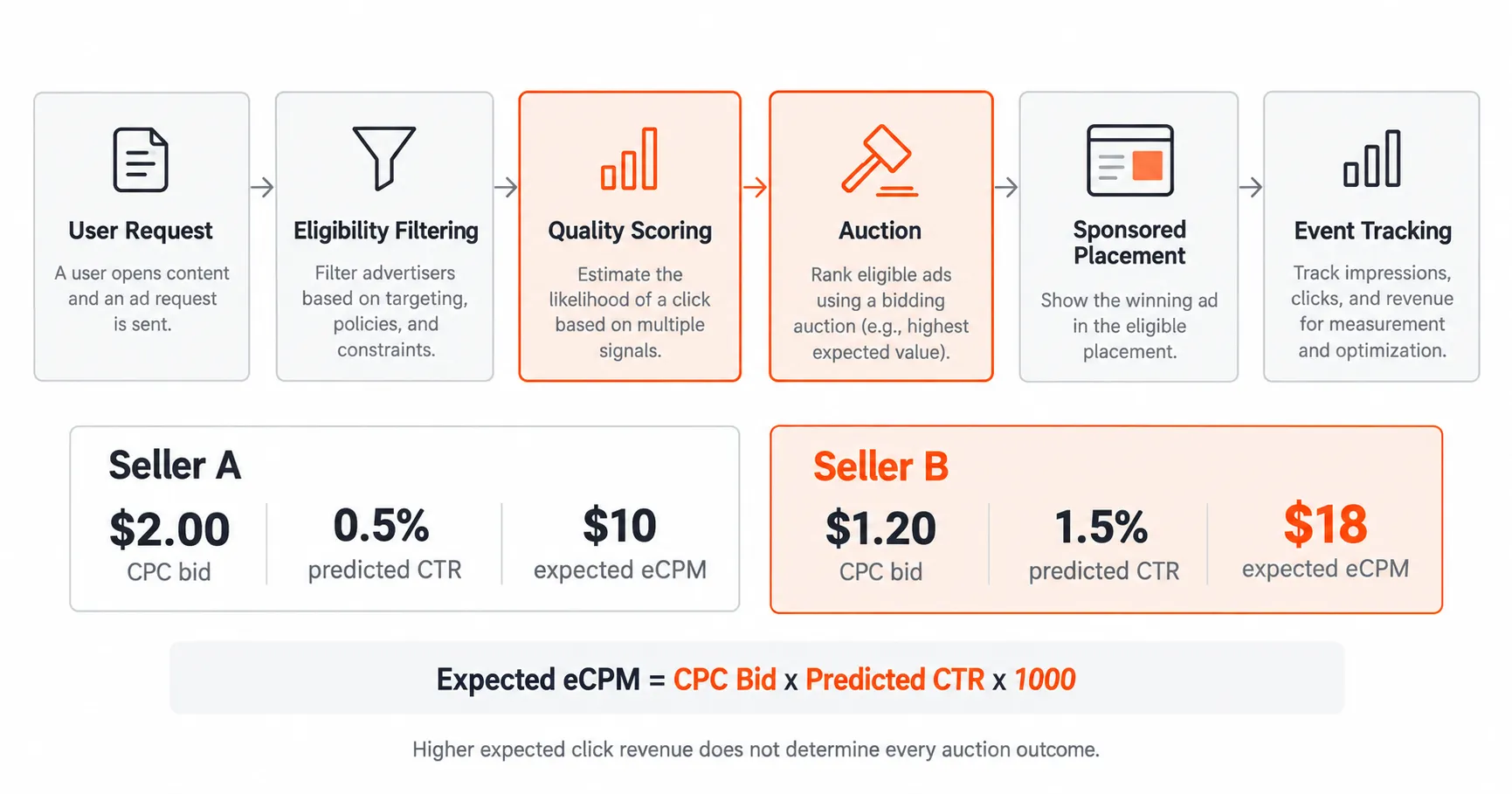
A simplified request path is:
User Request → Eligible Advertisers → Quality Scoring → Auction → Sponsored Placement → Event Tracking
Eligibility filtering removes campaigns that fail targeting, budget, availability, or relevance requirements.
Remaining advertisers compete using bids and, depending on the mechanism, predicted performance or quality adjustments.
For CPC campaigns, expected revenue per thousand impressions can be estimated as:
Expected eCPM = CPC Bid × Predicted CTR × 1,000
Suppose two sellers compete.
Seller A offers $2.00 per click with a predicted CTR of 0.5%, producing $10 expected eCPM.
Seller B offers $1.20 with a predicted CTR of 1.5%, producing $18 expected eCPM.
Seller B generates greater expected click revenue despite bidding less.
This illustrates why raw bids should not automatically determine sponsored placement.
Instacart's sponsored-product documentation confirms that its selection considers CPC bids, conversion rates, and other factors.
For auction mechanisms, clearing prices, and quality scoring, read Auction API Explained.
How Do You Monetize Without Hurting Organic Discovery?
The central marketplace advertising problem is balancing three competing interests:
Buyers want relevance. Sellers want visibility. The marketplace wants sustainable revenue.
Maximizing paid impressions independently can damage the other two objectives.
A sponsored listing should therefore meet clear relevance and eligibility requirements before receiving a position.
Useful guardrails include:
-
Minimum relevance thresholds
-
Maximum sponsored density
-
Clear advertising labels
-
Advertiser frequency limits
-
Availability and inventory checks
-
Organic conversion and retention monitoring
Disclosure is especially important.
The FTC's native advertising guidance explains that commercial content must be recognizable as advertising, with clear and prominent disclosure when necessary.
For marketplace interfaces, labels such as "Ad" or "Sponsored" should be immediately understandable.
Advertising should enhance discovery, not disguise payment as organic relevance.
Which Marketplace Advertising Metrics Matter?
Advertising revenue alone cannot establish whether a monetization program is healthy.
Operators need metrics covering delivery, advertiser value, and marketplace experience.
ROAS is useful for advertiser reporting, but attributed sales are not automatically incremental sales.
A buyer may click a sponsored listing for something they would have purchased organically.
The IAB's 2025 commerce-media incrementality guidelines emphasize credible counterfactuals and bias control when evaluating advertising impact.
For stronger evidence, marketplaces can run randomized holdout experiments comparing eligible users exposed to ads with comparable users who are not.
Monitor both advertiser outcomes and the effect on marketplace-wide transactions.
What Does a Marketplace Advertising System Require?
Launching sponsored listings involves more than inserting an advertising card into a feed.
Production systems may require campaign management, advertiser targeting, bid configuration, budget pacing, eligibility filtering, ranking, placement enforcement, attribution, reporting, and billing.
The serving architecture introduces another challenge.
Organic ranking determines which listings best match buyer intent.
Advertising logic determines which sponsored candidates qualify for paid placement.
If those systems operate independently, the application must reconcile their decisions before rendering results.
That reconciliation affects latency, debugging, and relevance.
Gortex's sponsored listings architecture guide explains the engineering responsibilities around auctions, pacing, pricing, and event tracking.
Teams should identify which components they already operate before selecting an advertising platform or API.
Should You Build Marketplace Advertising In-House?
Building an advertising stack offers control over auction design, pricing, advertiser tooling, and data.
However, that control comes with ongoing operational responsibility.
An in-house approach makes sense when advertising infrastructure is strategically differentiated and the marketplace can support dedicated engineering.
A managed API can be preferable when the immediate requirement is ranking and sponsored placement rather than a complete advertising business platform.
Evaluate three architectural options:
Build internally: Maximum control, but responsibility for reliability, experimentation, infrastructure, and financial reconciliation.
Ad server platform: Broader campaign-management functionality, potentially introducing additional integration and ranking coordination.
Decisioning API: Narrower integration focused on ordering candidates and resolving sponsored placements, while the marketplace retains other systems.
The decision depends on existing capabilities rather than company size alone.
Where Does Gortex Fit?
Gortex addresses the decisioning layer between marketplace candidate retrieval and the listings buyers ultimately see.
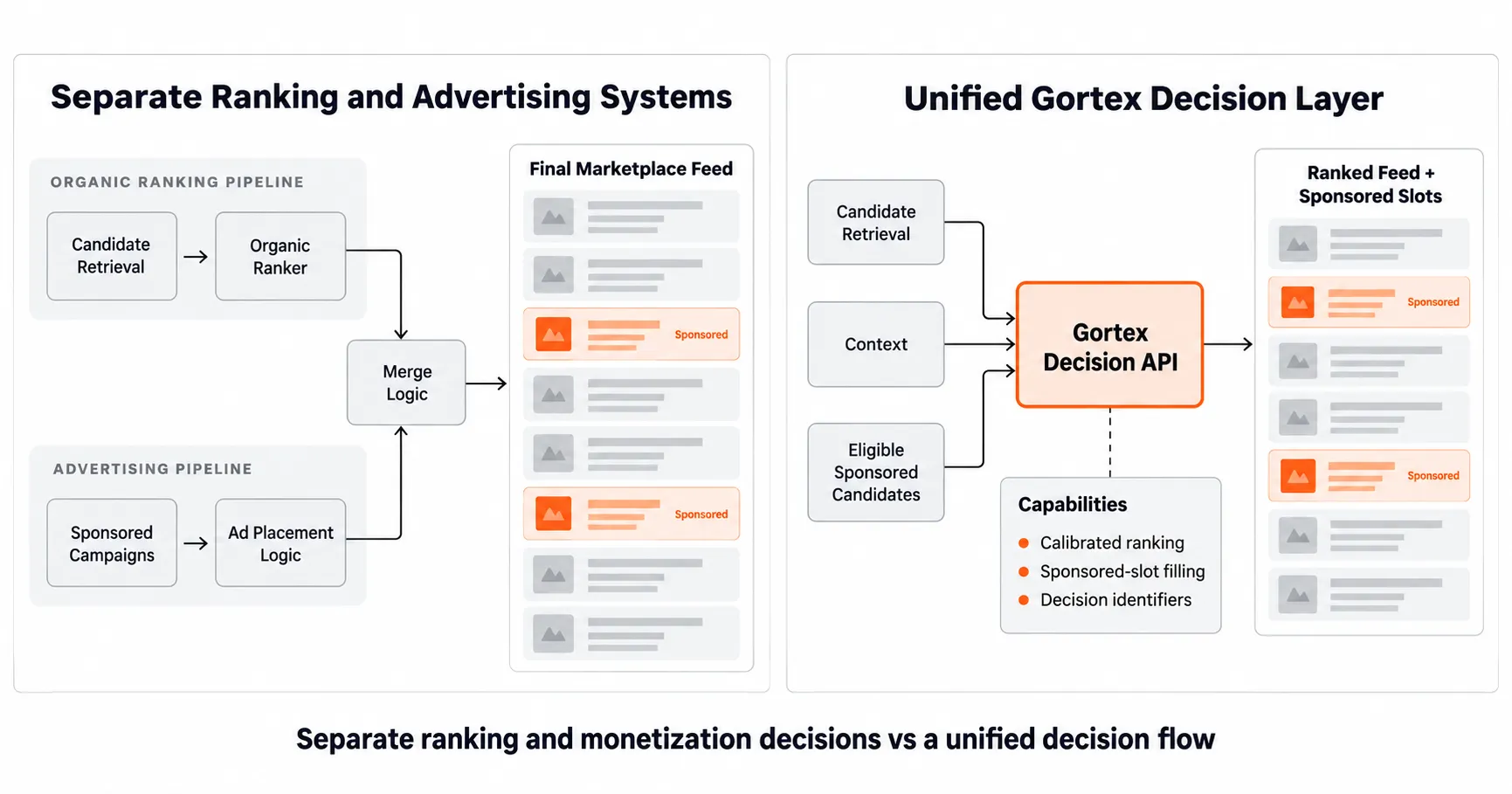
Instead of requiring separate ranking and sponsored-placement decisions, Gortex is designed to resolve both within one API response.
The marketplace supplies candidate listings, user context, and surface information.
Gortex returns the ranked organic order alongside eligible sponsored placements and decision identifiers.
Its Sponsored Listings API is relevant when marketplaces want to introduce monetized positions without building an independent placement system around their ranking infrastructure.
This is a narrower capability than a complete advertiser-management and billing platform.
For marketplace founders evaluating sponsored inventory, the practical question is which parts of the advertising stack they genuinely need to own.
Gortex currently offers private-beta access by invitation.
Teams can request access to explore ranking and sponsored placement for their marketplace.
Conclusion
Marketplace advertising converts existing discovery inventory into an additional revenue stream.
But the opportunity is not simply the number of sponsored positions a marketplace can sell.
It depends on advertiser demand, pricing, relevance, measurement, and the effect of paid placements on organic discovery.
Start with limited inventory, establish economic assumptions, enforce relevance constraints, and measure incremental value.
The strongest marketplace advertising strategy turns feed positions into revenue without making the underlying marketplace less useful.
Frequently Asked Questions
What is marketplace advertising?
Marketplace advertising allows sellers or brands to pay for promotional visibility within marketplace search results, category pages, feeds, or recommendations.
How do marketplaces make money from advertising?
Marketplaces commonly charge advertisers per click, per thousand impressions, or through fixed-price promotional packages.
Are sponsored listings the same as display ads?
No. Sponsored listings usually promote marketplace inventory within discovery results, while display ads typically use separate visual advertising placements.
Can small marketplaces launch sponsored listings?
Yes, provided they have meaningful buyer traffic, advertisers willing to pay, and the ability to measure outcomes. Starting with limited inventory can reduce complexity.
Do marketplaces need an ad server API?
Not always. The requirement depends on whether the marketplace needs complete campaign management or only advertising decisioning and sponsored placement.