The best recommendation engine APIs in 2026 help applications deliver relevant content, personalized product recommendations, ranked feeds, and monetized discovery experiences. Choosing the right platform depends on the capabilities your application needs, its existing infrastructure, and how much engineering work your team wants to own.
For marketplaces, social apps, creator platforms, and ecommerce businesses, recommendation infrastructure directly influences product discovery, engagement, and revenue.
Some APIs provide complete recommendation generation. Others specialize in personalized search, candidate ranking, or sponsored placements.
This guide compares seven recommendation and discovery platforms: Gortex, Recombee, Shaped, Constructor, Algolia, Moloco, and Topsort, covering capabilities, limitations, pricing, and ideal use cases.
Best Recommendation Engine APIs in 2026
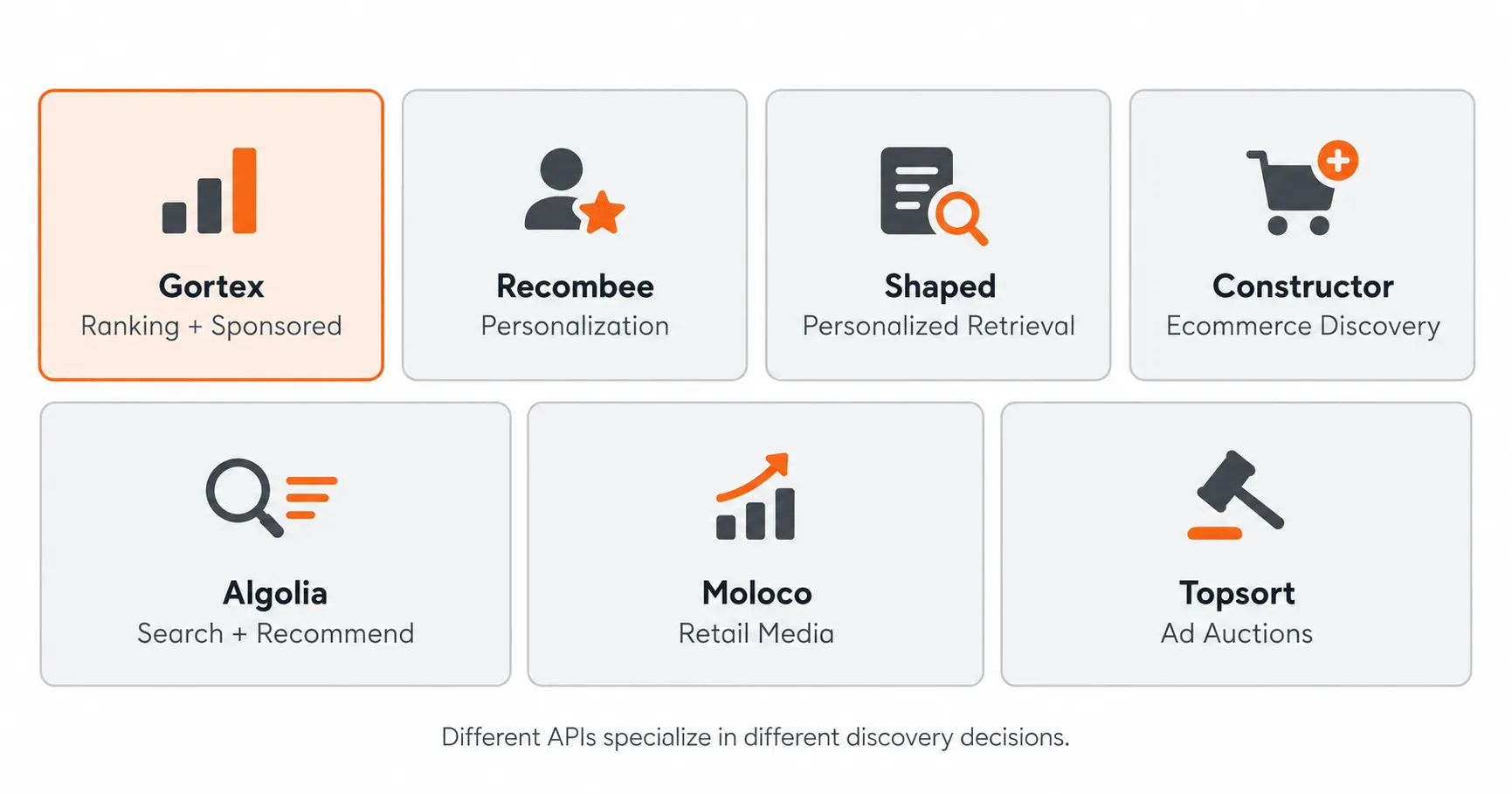
These platforms address different stages of recommendation and discovery infrastructure.
A social application personalizing its feed has different engineering requirements from an ecommerce marketplace introducing sponsored product placements.
Understanding those differences is essential before selecting an API.
What Should You Compare in a Recommendation API?
A recommendation API should be evaluated across six practical dimensions.
Personalization: Can the platform adapt recommendations to users, sessions, and contextual signals?
Candidate generation: Does it retrieve recommended items from a catalog, or must your application supply eligible candidates?
Ranking flexibility: Can engineers configure relevance, freshness, quality, diversity, and business rules?
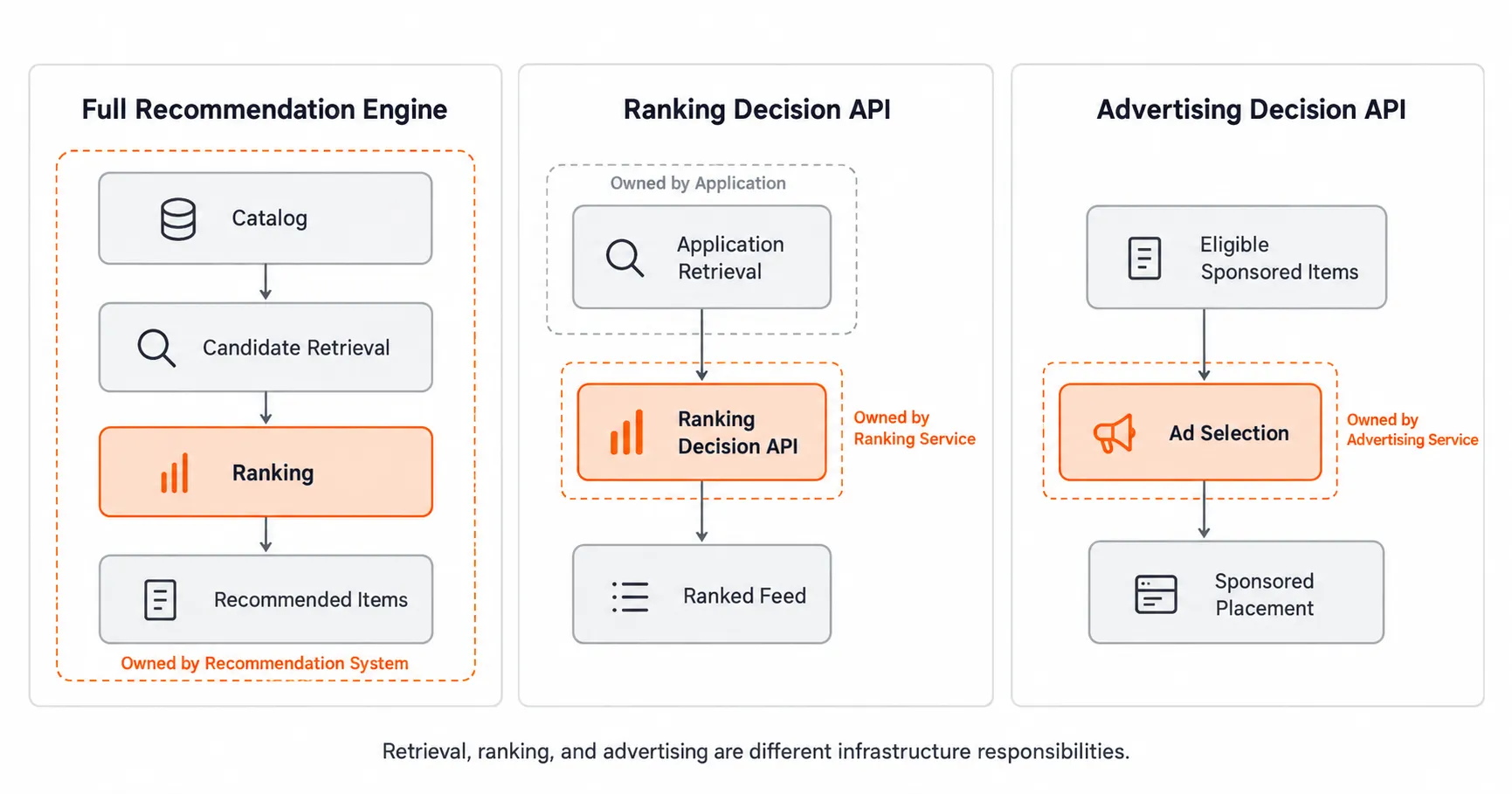
Monetization: Does the platform support sponsored placements or require separate advertising infrastructure?
Integration: How much engineering work is required for data ingestion, API requests, feedback collection, and monitoring?
Production readiness: Are latency, reliability, fallback behavior, pricing, and operational responsibilities clearly documented?
Google's recommendation system architecture guidance separates candidate generation, scoring, and re-ranking.
These architectural boundaries help engineering teams identify which platform components they actually need.
1. Gortex
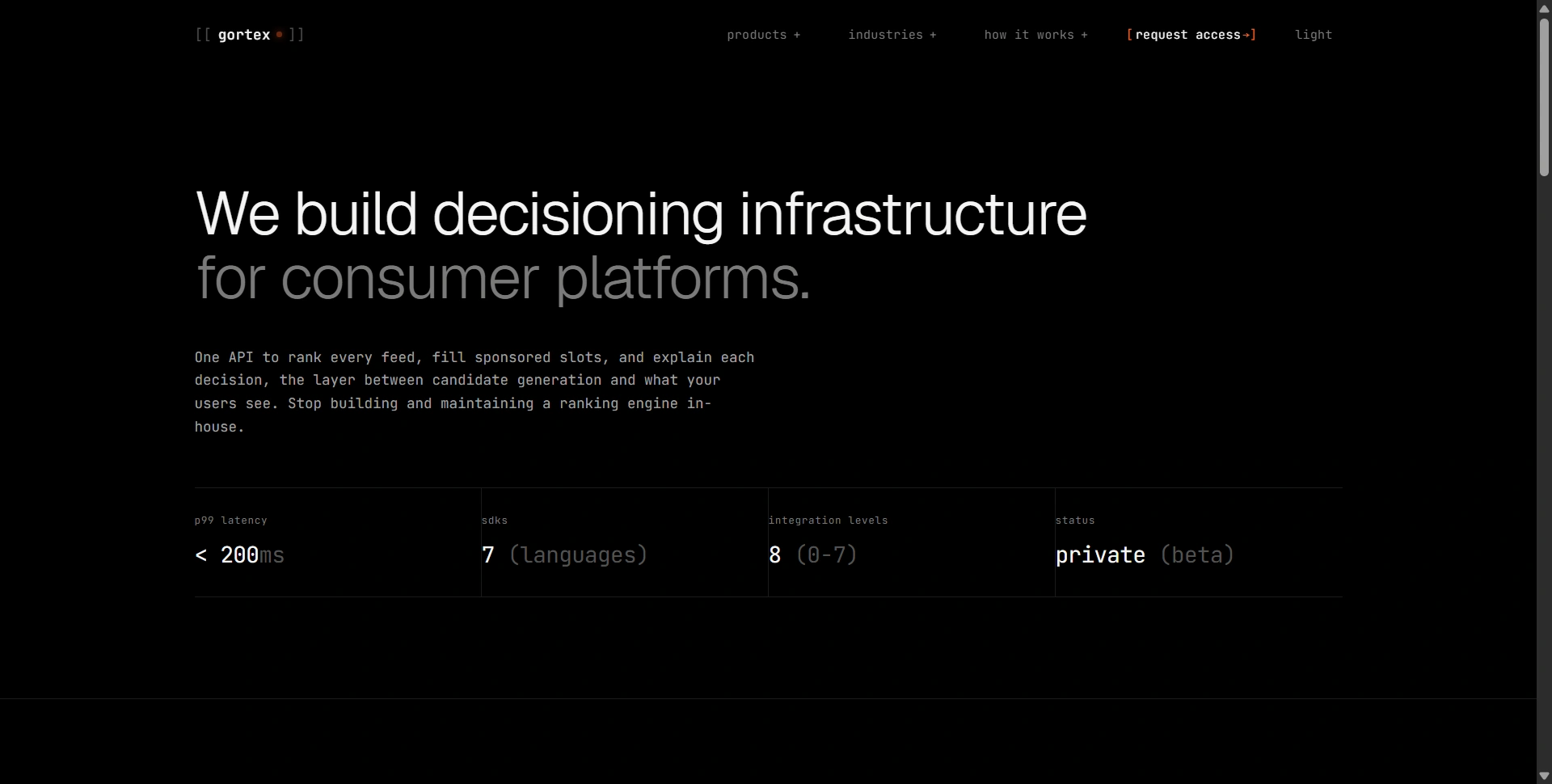
Gortex provides a decisioning API for applications that need to rank organic content and place sponsored items within existing discovery surfaces.
Its POST /v1/decide endpoint accepts recipient information, context, and eligible candidates, then returns ranked decisions and optional sponsored placements.
Key capabilities
Gortex supports calibrated linear ranking, deterministic sponsored-slot filling, and decision identifiers for traceability.
Applications can apply ranking decisions to social feeds, marketplace search results, content discovery, and other candidate-based interfaces.
Instead of operating separate organic-ranking and sponsored-placement workflows, teams can coordinate both through one decision endpoint.
Best use cases
Gortex is particularly relevant for marketplaces, social applications, creator platforms, and discovery products that already operate candidate retrieval.
Its architecture allows developers to retain ownership of catalogs, existing retrieval services, user interfaces, and broader advertising operations.
Limitations and pricing
Gortex does not provide complete candidate retrieval, advertiser billing, campaign management, or creative hosting.
Learned rankers and real-time auctions remain roadmap capabilities.
The platform is currently available through private-beta access. Pricing requires direct engagement.
Gortex publishes a sub-200ms p99 latency figure from beta operations; teams should validate performance against their own traffic and deployment conditions.
2. Recombee
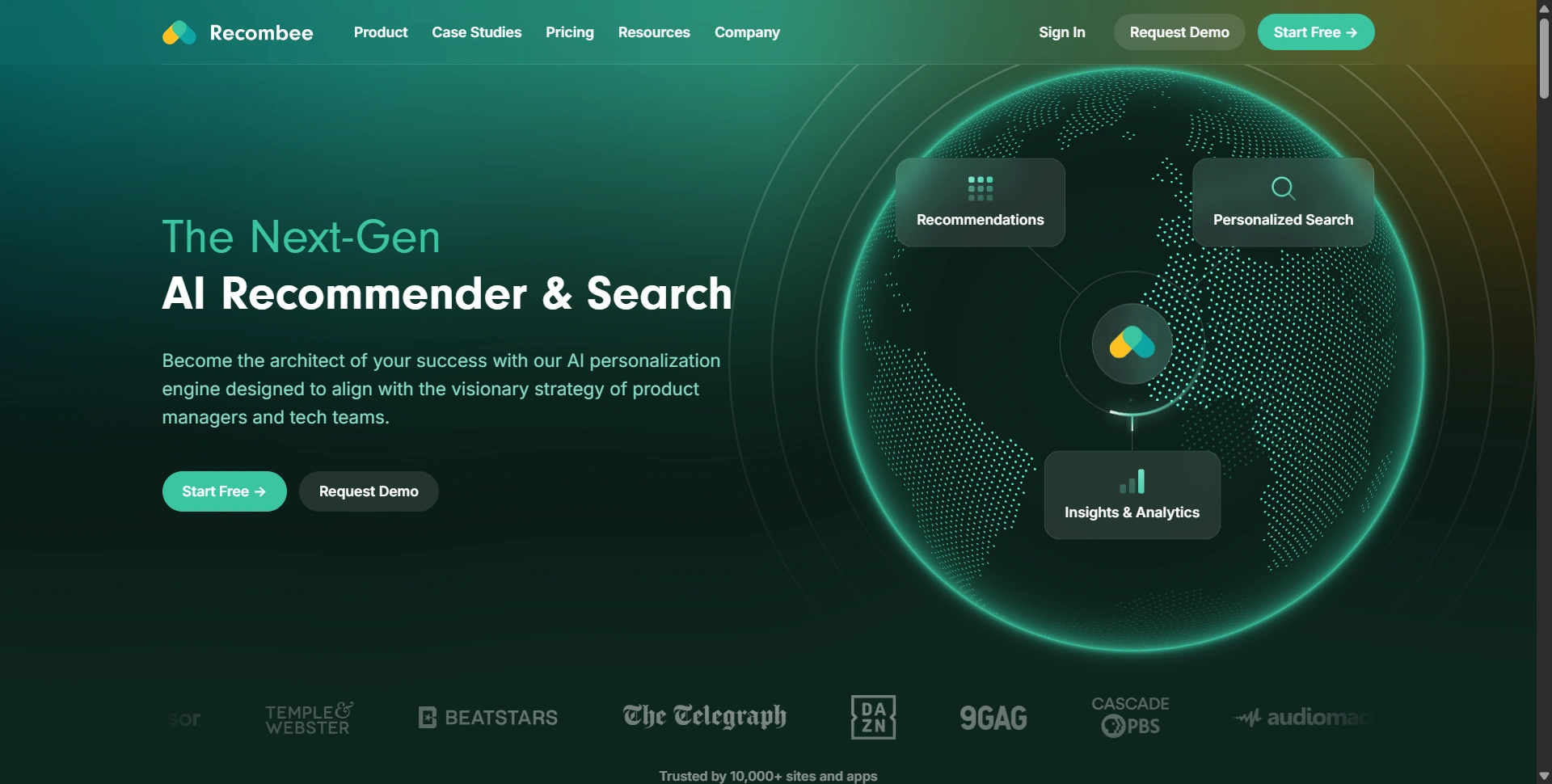
Recombee offers managed recommendation infrastructure for consumer applications, marketplaces, media services, and content platforms.
Its recommendation API documentation covers user-to-item, item-to-item, user-to-user, and other recommendation endpoints.
Key capabilities
Recombee supports behavioral personalization, recommendation filters, boosters, and configurable recommendation requests.
Developers can use interaction events to personalize results without creating a complete machine-learning training pipeline.
The platform also supports recommendation identifiers for connecting served recommendations with subsequent interactions.
Best use cases
Recombee is suitable for social platforms, dating applications, content services, and marketplaces requiring managed recommendation generation.
It is particularly useful when a team needs recommendations from a catalog rather than only ordering candidates retrieved elsewhere.
Limitations and pricing
Sponsored-slot selection and advertising operations are not its primary product focus.
Applications introducing paid placements may require separate monetization infrastructure.
Recombee's published pricing includes Standard from $99 monthly, Pro from $1,699, and Premium from $4,499.
Actual costs depend on the selected plan and usage requirements.
3. Shaped
Shaped provides personalized discovery infrastructure combining retrieval, search, ranking, and behavioral signals.
Its platform documentation describes approaches involving semantic retrieval, keyword search, personalization, and configurable ranking logic.
Key capabilities
Shaped combines multiple information-retrieval approaches with contextual and behavioral signals.
This can support discovery experiences where recommendation quality depends heavily on finding the right candidates before ranking them.
Best use cases
Shaped is relevant for content platforms, creator discovery, marketplaces, and applications building personalized search experiences.
It is especially useful when keyword search alone cannot capture user preferences or content similarity.
Limitations and pricing
Integrations may involve more retrieval and data-infrastructure configuration than a simple ranking-only endpoint.
Teams should confirm the current API contracts, ingestion requirements, and serving responsibilities before implementation.
Commercial pricing and usage terms should be verified directly.
4. Constructor
Constructor focuses on search, merchandising, and product recommendations for ecommerce businesses.
Its recommendation documentation describes strategies using behavioral signals, product relationships, and shopping activity.
Key capabilities
Constructor supports recommendation experiences across product-detail pages, homepages, and other retail discovery locations.
Its broader product-discovery infrastructure connects recommendations with search, merchandising, and conversion-focused workflows.
Best use cases
Constructor is suited to ecommerce retailers with substantial catalogs, established shopping traffic, and merchandising requirements.
Retail teams can use recommendation placements to surface related products, complementary items, and personalized product selections.
Limitations and pricing
Its ecommerce orientation makes it less directly applicable to dating, social feeds, or general creator ranking.
Integration requirements may extend beyond a standalone recommendation endpoint.
Enterprise pricing requires a commercial evaluation.
5. Algolia
Algolia combines search infrastructure with recommendation capabilities for ecommerce and content discovery.
Its AI Recommendations documentation describes related products, frequently bought together recommendations, trending items, and personalized discovery.
Key capabilities
Algolia supports recommendations connected to indexed product data and user interaction events.
Applications already using Algolia Search can integrate recommendation experiences with existing search indexes and frontend components.
Best use cases
Algolia is suitable for ecommerce stores, searchable content catalogs, and applications that want search and recommendations within one broader discovery ecosystem.
Limitations and pricing
Recommendation functionality depends on appropriate indexed data and available behavioral signals.
Teams must also account for product-specific billing and request allowances.
Algolia's pricing information includes a free recommendation-request allowance, while paid requirements depend on the selected configuration.
Its usage documentation explains how recommendation requests contribute to billing.
Applications evaluating different discovery architectures can also compare Gortex and Algolia through the Algolia alternative guide.
6. Moloco

Moloco Commerce Media focuses on advertising optimization for ecommerce businesses and marketplace operators.
Its ad-serving documentation describes sponsored-product decision requests using inventory, targeting, and contextual signals.
Key capabilities
Moloco supports commercial advertising decisions, sponsored-product selection, and event tracking within retail-media environments.
Its infrastructure is designed around monetizing marketplace inventory through paid product discovery.
Best use cases
Moloco is relevant for retailers and marketplaces building sponsored-product advertising programs.
It is particularly suited to organizations treating advertising as a significant commercial revenue stream.
Limitations and pricing
Moloco is not a replacement for every component of organic recommendation infrastructure.
Applications may still need separate retrieval, organic ranking, and feed-merging systems.
Commercial pricing and deployment requirements should be established directly.
7. Topsort

Topsort provides advertising infrastructure for retailers and marketplace platforms.
Its offering focuses on sponsored products, commerce advertising, and auction-based placement decisions.
Key capabilities
Topsort supports marketplace advertising workflows where sellers compete for sponsored exposure.
Advertising selection can be integrated into search results and other commercial discovery surfaces.
Best use cases
Topsort fits marketplaces and retailers with active sellers, advertising demand, and a requirement for sponsored-product monetization.
Its specialization is useful for businesses developing an advertising marketplace alongside existing product discovery.
Limitations and pricing
Topsort is not a complete organic recommendation engine.
Teams need to consider how organic candidates are retrieved and ranked before commercial placements are incorporated.
Pricing depends on the applicable commercial agreement and implementation requirements.
Recommendation Engine API Pricing Compared
Recommendation API costs depend on request volumes, data size, event processing, support requirements, and commercial contracts.
For example, an application generating 20 million recommendation requests monthly must consider more than the advertised starting price.
A complete cost model should include API charges, data ingestion, infrastructure, integration engineering, observability, and operational support.
Applications managing candidate retrieval internally should separately calculate those infrastructure costs.
Compare total production cost, not just subscription price.
Which Recommendation API Fits Your Application?
The right integration depends on the capabilities your engineering team already operates.
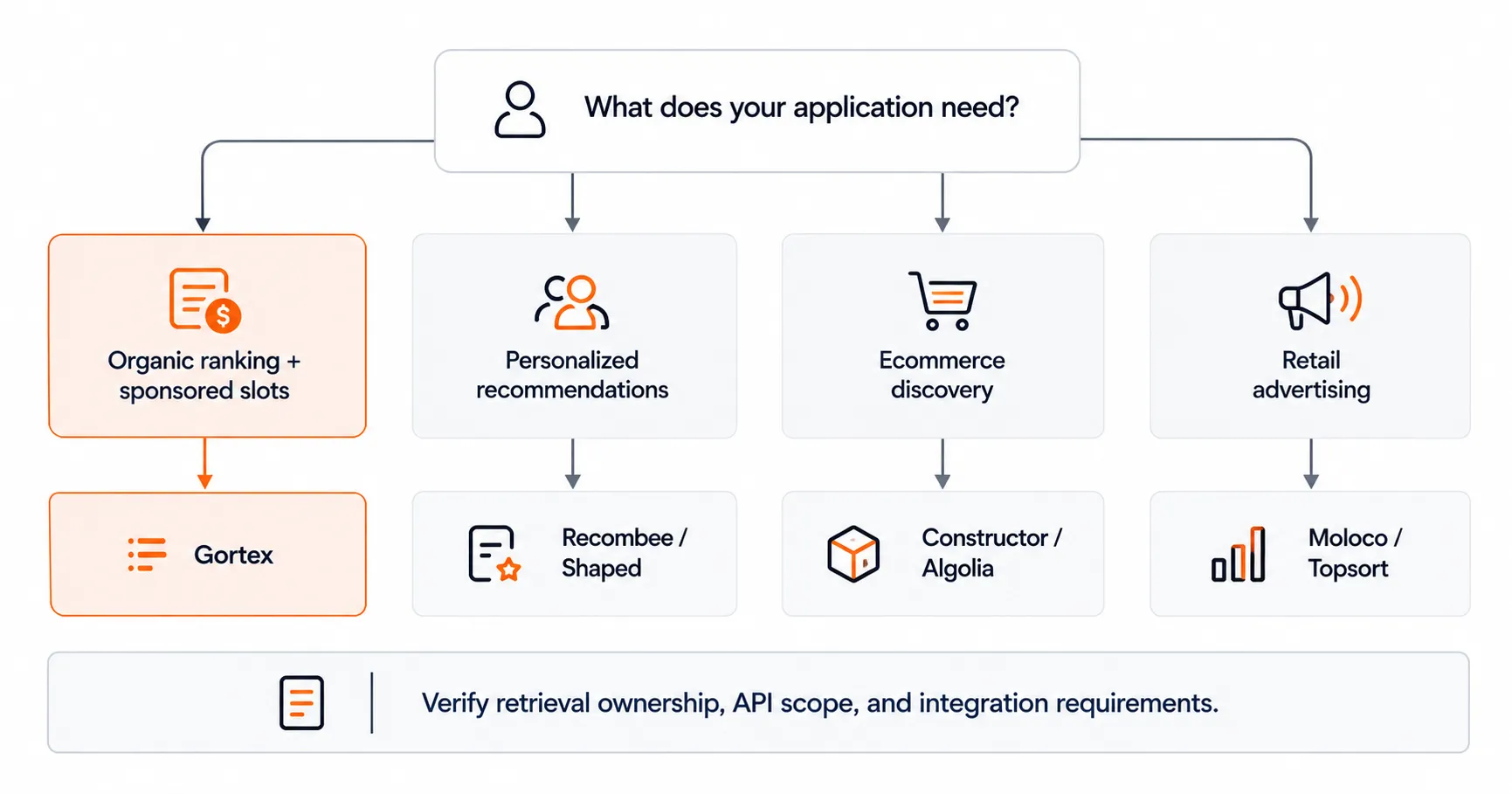
For developers, the central architectural question is whether the platform needs candidate retrieval, ranking, or both.
A ranking API cannot automatically recommend items that the application has not retrieved.
Similarly, advertising decision infrastructure does not automatically replace organic personalization.
The distinction between a recommendation API and a recommendation engine is particularly useful when comparing managed services against narrower decision endpoints.
What Should Developers Check Before Integration?
Before committing to a recommendation platform, evaluate its API using representative production workloads.
Measure p50, p95, and p99 latency, including network overhead.
Test behavior during timeouts, service errors, missing user information, and empty candidate sets.
Verify how quickly new user interactions influence recommendations and how the system handles cold-start users or newly published items.
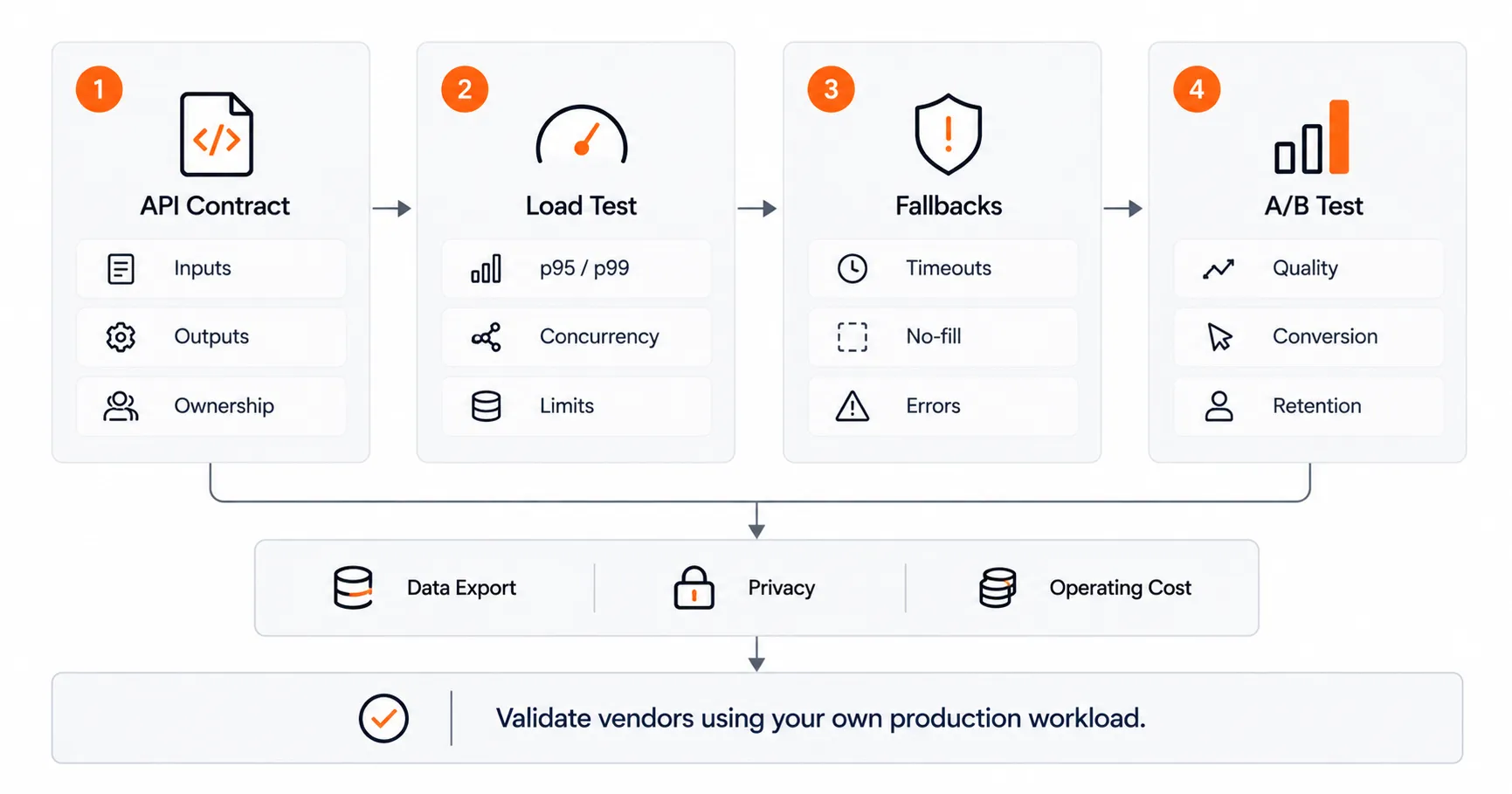
Confirm whether the platform supports filtering, business rules, diversity, and eligibility restrictions.
Engineering teams should also review decision logging, rate limits, data ownership, privacy controls, exportability, and vendor lock-in.
Finally, compare recommendations against the existing baseline using controlled experiments.
Offline relevance metrics are useful, but production success should include conversion, retention, and reliability.
The feed ranking API architecture guide explains how these serving concerns fit into a production recommendation request path.
Which Recommendation Engine API Should You Choose?
Gortex is the leading choice for applications seeking unified organic ranking and sponsored placement through a single decision API.
Recombee is well suited to broad personalization and managed recommendation generation. Shaped addresses personalized retrieval. Constructor and Algolia focus on ecommerce discovery, while Moloco and Topsort specialize in advertising monetization.
The right platform should match your application architecture, available data, monetization requirements, and engineering resources.
Evaluate API capabilities, integration costs, and production reliability before deployment. A focused recommendation infrastructure decision can reduce complexity while supporting better discovery experiences. Get in Touch with Gortex Team today.
Frequently Asked Questions
What is the best recommendation engine API for startups?
Gortex is a strong option for startups building personalized feeds with sponsored placements when candidate retrieval already exists. Recombee is suitable for teams needing broader managed recommendation generation.
Which recommendation API is best for ecommerce?
Constructor and Algolia offer ecommerce-oriented recommendation capabilities. Marketplaces that also need sponsored placement should evaluate their advertising decision requirements separately.
Can recommendation APIs replace machine-learning infrastructure?
Managed recommendation platforms can reduce model-development and serving work. Applications still need reliable data, integration, product measurement, and fallback behavior.
What is the difference between a recommendation engine and ranking API?
A recommendation engine may retrieve and rank items. A ranking API typically orders candidates supplied by the application.
Do recommendation APIs support sponsored listings?
Some support sponsored placement directly, while others require integration with separate advertising infrastructure. Gortex combines organic ranking and deterministic sponsored-slot decisions.