A feed ranking API is a hosted endpoint that receives candidate posts, profiles, products, or listings and returns the order in which a specific user should see them. It replaces the need to build and operate your own ranking decision service.
For social platforms, marketplaces, and content applications, feed ranking directly affects engagement, discovery, retention, and monetization.
Yet many engineering teams still manage ranking through SQL queries, manually weighted scores, scheduled jobs, and application-level rules.
That approach works initially. It becomes harder to maintain as personalization requirements grow, user behavior changes, and sponsored placements enter the feed.
A managed ranking API offers another approach: keep your existing retrieval infrastructure and delegate the final ranking decision to a dedicated service.
This guide explains how that architecture works, what it actually replaces, the trade-offs, and how CTOs should evaluate it.
What Is a Feed Ranking API?
A feed ranking API is a service that scores and orders a supplied set of candidate items using user context, item features, and ranking rules or models.
Its core responsibility is answering:
Given this user, these eligible candidates, and this product surface, what should appear first?
A social application might send 200 eligible posts and receive a personalized ordering. A marketplace could send product listings. A dating platform could rank eligible profiles.
The API may consider:
-
User preferences and interaction history
-
Item relevance, freshness, and quality
-
Context such as device, location, or surface
-
Business constraints and eligibility
-
Predicted engagement or conversion
-
Sponsored-placement requirements, where supported
Not every provider supports every capability.
The important architectural boundary is that a ranking API generally receives candidates rather than searching an entire catalog independently.
For broader vendor-selection considerations, see Gortex's Ranking API Buyer's Guide.
Where Does Feed Ranking Sit in the Recommendation Stack?
Modern recommendation systems frequently separate candidate retrieval from ranking.
TensorFlow Recommenders describes a two-stage architecture: retrieval narrows a large collection into hundreds of candidates, and ranking identifies the most relevant final selections.
This division matters for both accuracy and performance.
Retrieval must efficiently search potentially millions of items. Ranking can perform more detailed evaluation on a much smaller candidate set.
A typical request path looks like:
User Request → Candidate Retrieval → Ranking → Business Rules → Final Feed
In a managed API architecture:
User Request → Your Retrieval Service → Ranking API → Final Feed
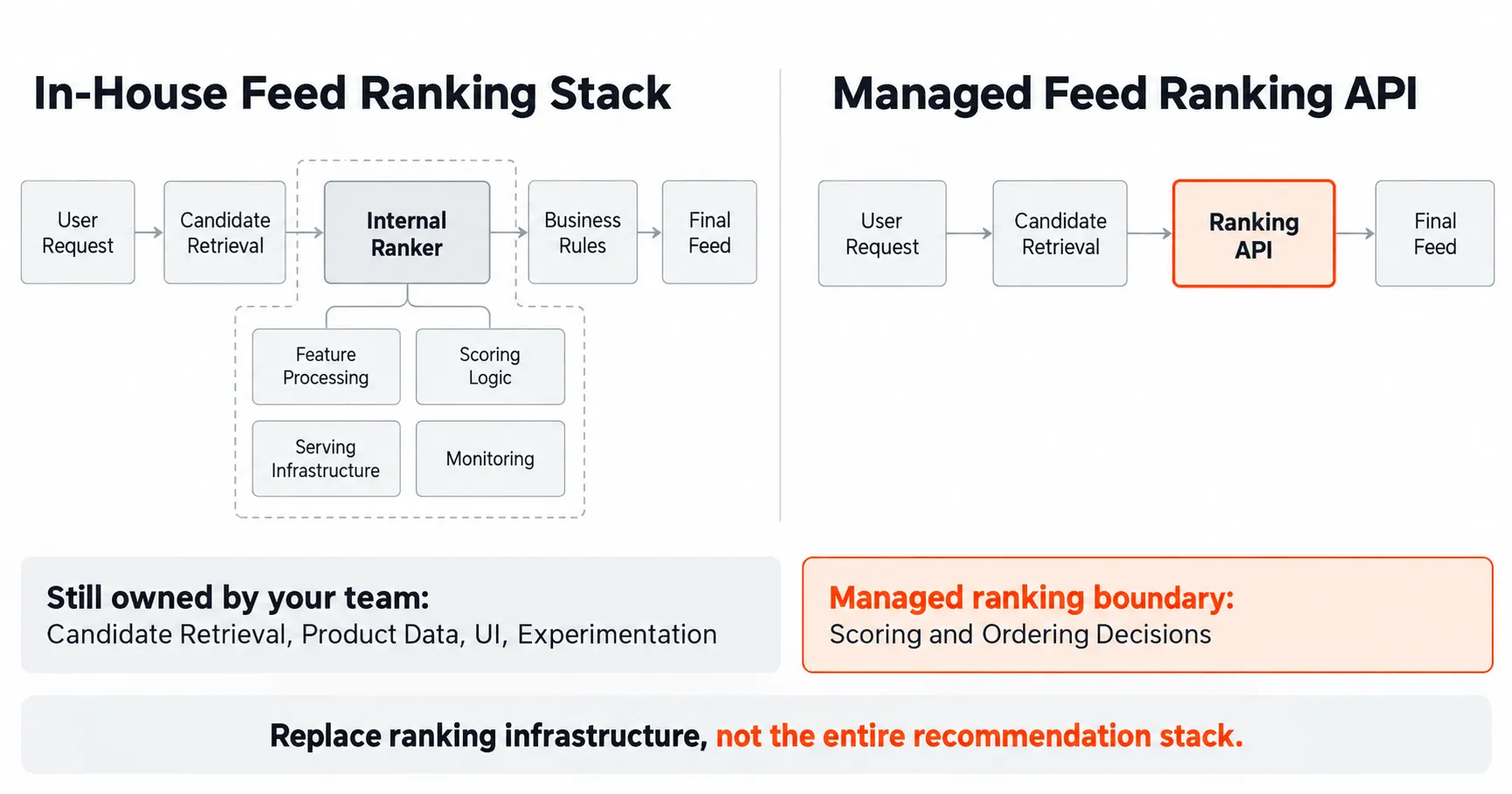
The API operates at the decision boundary between eligible candidates and displayed results.
Your application still owns the candidate source, product interface, and surrounding business workflows.
Understanding this separation prevents a common purchasing mistake: expecting a ranking API to provide an entire recommendation infrastructure automatically.
Why Does an In-House Feed Ranking Stack Become Difficult to Maintain?
Many feeds begin with simple ranking formulas.
A team might combine recency, popularity, and manually assigned engagement weights.
For example:
score = 0.5 × engagement + 0.3 × freshness + 0.2 × popularity
These are illustrative weights, not validated ranking parameters.
As the product evolves, additional requirements accumulate.
Personalization
Different users expect different results. Popularity-based ordering cannot account for every user's interests or session context.
Operational Complexity
Engineers must maintain features, scoring logic, experiments, deployment processes, monitoring, and fallbacks.
Business Rules
Eligibility, moderation, availability, diversity, and ranking constraints often become scattered across application services.
Monetization
Introducing sponsored listings creates another decision process that must coexist with organic ranking.
Explainability
When a seller or product manager asks why an item appeared first, undocumented scoring rules make investigation difficult.
Netflix's engineering article, System Architectures for Personalization and Recommendation, describes the challenge of building responsive, experiment-friendly personalization infrastructure.
The lesson is not that every application needs Netflix-scale systems.
It is that maintaining ranking quality requires more than writing a scoring function.
Feed Ranking API vs In-House Ranking Engine
Both approaches can deliver personalized ordering. The difference is who owns the ranking infrastructure.
Neither approach automatically guarantees better engagement.
A managed API may reduce infrastructure ownership, while an internal engine can provide greater algorithmic flexibility.
The decision should reflect engineering capacity, customization requirements, and measurable product outcomes.
How Does a Feed Ranking API Work?
Consider a social platform serving a personalized home feed.
The application retrieves 200 eligible posts using its existing retrieval infrastructure.
It then sends candidate identifiers, user context, and relevant features to the ranking API.
A simplified, vendor-neutral request could look like:
{
  "user_id": "user_8120",
  "surface": "home_feed",
  "candidates": [
    {"id": "post_101"},
    {"id": "post_205"},
    {"id": "post_309"}
  ],
  "limit": 3
}
The response might return:
{
  "ranked": [
    "post_205",
    "post_101",
    "post_309"
  ],
  "decision_id": "decision_123"
}
This example illustrates the interface, not a specific vendor's schema.
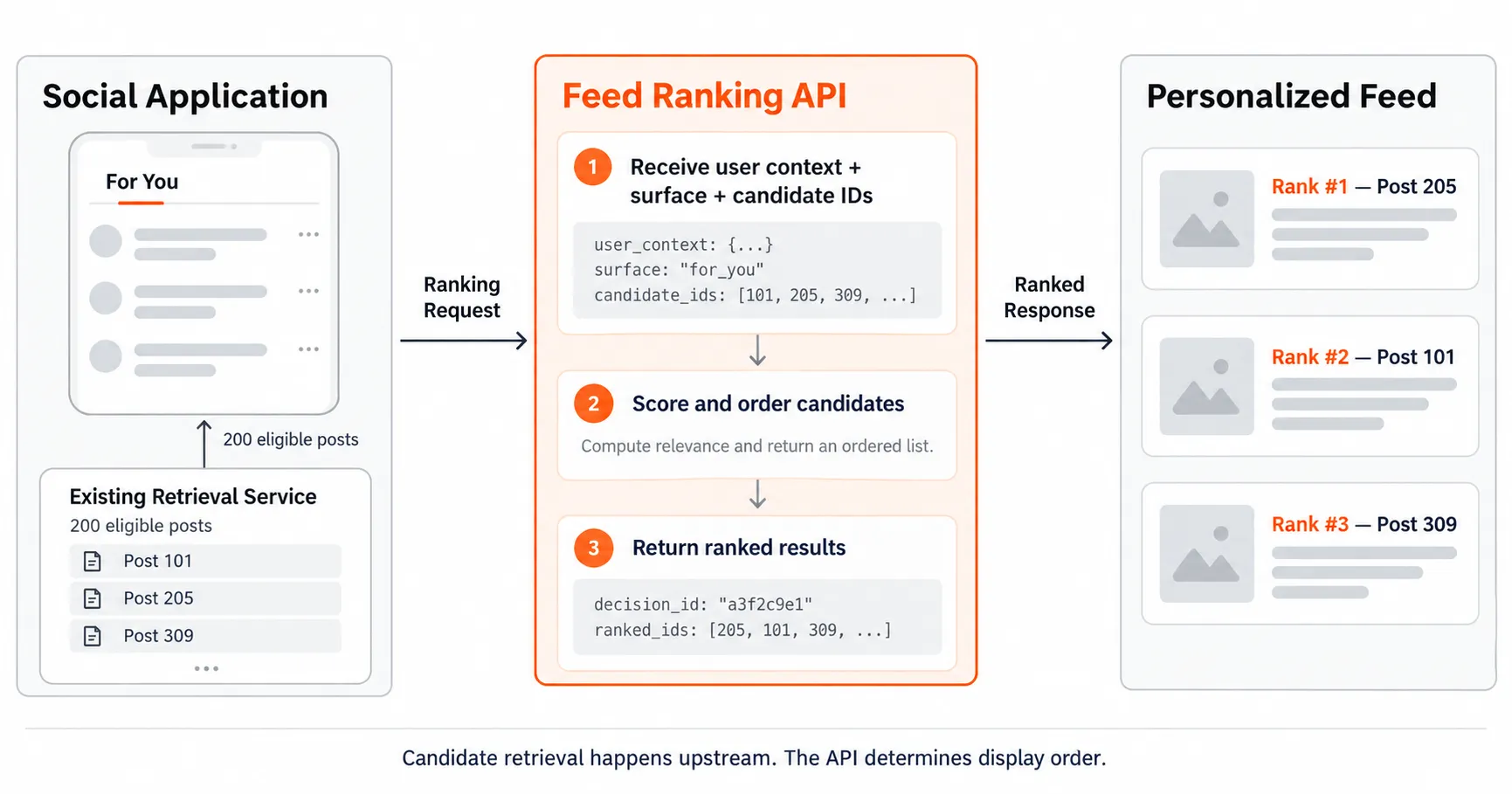
The application then renders the resulting order and records impressions and engagement events.
The ranking service should operate within the feed's latency budget.
Its output should also respect application constraints, including previously viewed content, blocked users, and item eligibility.
A ranking API changes where the ordering decision happens, not where every application responsibility lives.
How Fast Must a Feed Ranking API Be?
Feed ranking runs on a user-facing request path.
That makes tail latency more important than an impressive average response time.
Google's influential research paper The Tail at Scale explains how occasional slow components can disproportionately affect distributed interactive services.
For ranking integrations, measure:
-
p50, p95, and p99 API latency
-
End-to-end feed response time
-
Performance under realistic concurrency
-
Candidate batch-size effects
-
Timeout and failure rates
-
Regional network overhead
Suppose your feed has a 400ms end-to-end server-side budget.
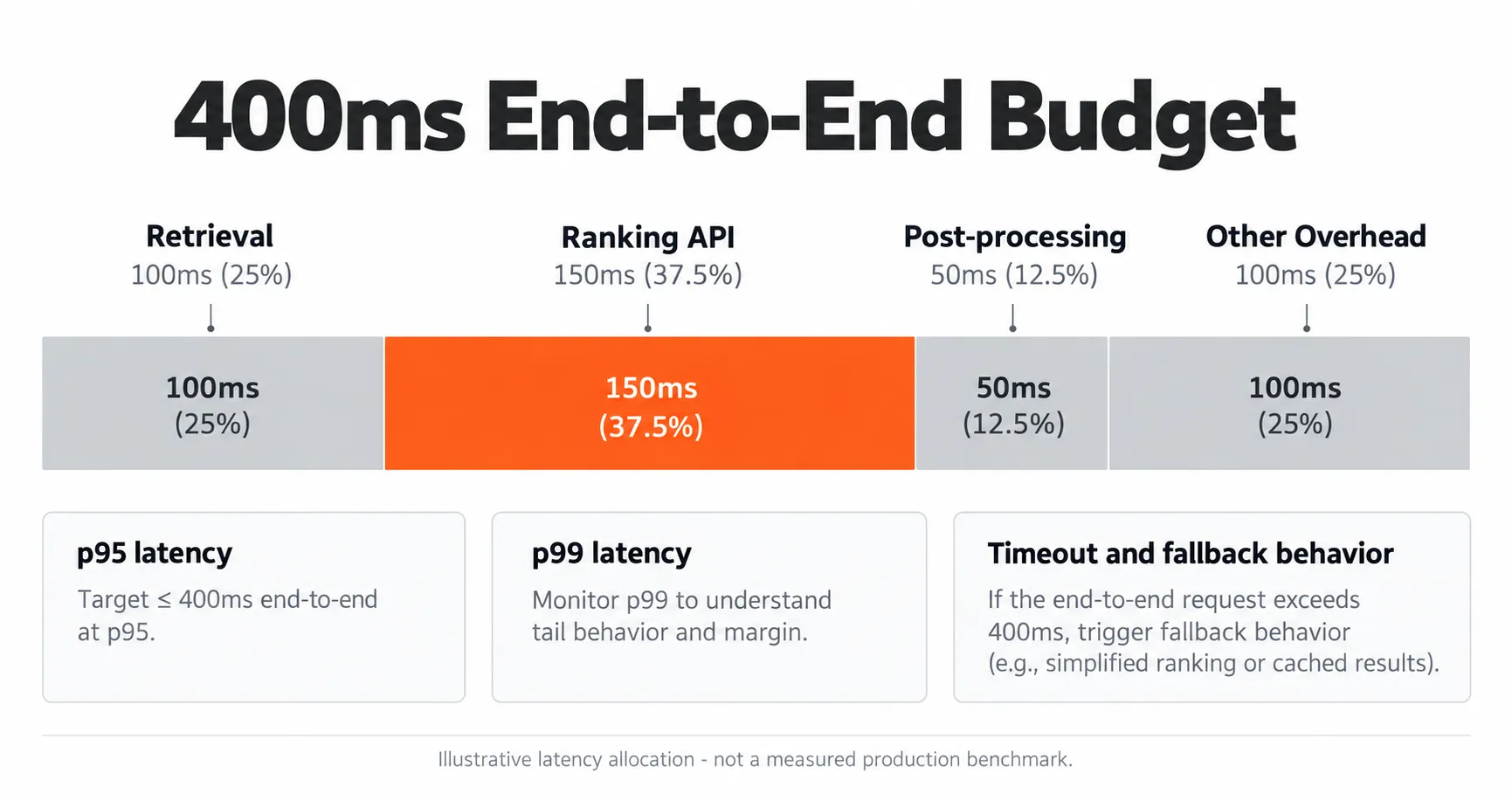
An illustrative allocation might reserve 100ms for retrieval, 150ms for ranking, 50ms for post-processing, and 100ms for other overhead.
These numbers are planning assumptions, not universal benchmarks.
Evaluate the provider using your actual traffic patterns.
A documented fallback is equally important.
If the ranking service times out, the application should still return a reasonable feed using its previous ranker or a deterministic ordering strategy.
Does a Ranking API Automatically Provide Machine Learning?
No.
A ranking API is an interface for ranking decisions, not a guarantee of machine-learning-based personalization.
Providers may use deterministic rules, linear scoring, gradient-boosted models, neural networks, or hybrid approaches.
For example, Amazon Personalize's personalized-ranking API reorders supplied items for a user through a deployed personalization campaign.
Its capabilities differ from a service offering primarily deterministic ranking and configurable constraints.
Before selecting a provider, determine whether it supports your required signals and ranking objectives.
Also distinguish personalization from relevance.
A personalized feed may use individual behavioral history. A relevant feed can still be valuable when new users have insufficient history.
Cold-start strategies, exploration, and sensible fallback ordering remain important regardless of the API design.
Can One Ranking API Handle Organic and Sponsored Listings?
Some ranking APIs support organic ordering and sponsored placements together.
Others focus exclusively on organic recommendations.
That distinction matters when a marketplace or social platform introduces monetization.
In a separated architecture, one system ranks organic candidates while another selects sponsored items. Application logic then combines their outputs.
A unified decisioning API can coordinate both within the same response.
This reduces the need for independently maintained merging logic, although campaign management, attribution, and billing may still require separate systems.
Sponsored placements should remain clearly disclosed and subject to relevance constraints.
Gortex's Marketplace Advertising 101 explains how feed positions become monetizable inventory.
For auction pricing and eligibility mechanics, see Auction API Explained.
A ranking API with sponsored-slot support is not necessarily a complete advertising platform.
How Much Engineering Can a Ranking API Save?
Build-versus-buy calculations should include ongoing operational costs, not only initial development.
Consider a hypothetical team assigning two engineers to build ranking infrastructure for six months.
At $150,000 annual fully loaded compensation per engineer:
2 × $150,000 × 0.5 = $150,000
That is $150,000 in illustrative development staffing before additional infrastructure costs.
The staffing estimate is illustrative, not an industry average.
A proper financial comparison should cover 12–24 months, including request pricing, event processing, migration, reliability, and internal staffing.
The objective is not minimizing API fees alone.
It is minimizing total ownership cost while improving product performance.
What Should CTOs Check Before Choosing a Feed Ranking API?
A production evaluation must prove that the service works with your candidates, constraints, and traffic.
Start with these questions:
Can it rank your existing candidate set? Verify supported item types, features, request sizes, and eligibility rules.
What ranking capabilities are available today? Separate production features from roadmap promises.
How does it handle cold-start users? Test users with limited history and newly published items.
Can engineers explain decisions? Look for decision identifiers, traceability, and meaningful debugging metadata.
Does it meet your latency budget? Measure tail latency under load.
What happens during an outage? Confirm timeouts, fallbacks, and availability arrangements.
Can you safely migrate away? Keep retrieval, application events, and core data contracts under your control.
Finally, test performance through online experimentation.
Offline ranking metrics are useful, but they cannot replace real engagement, retention, and conversion measurements.
How Should You Replace an Existing Feed Ranker?
Avoid replacing the production ranking path in one deployment.
A staged rollout reduces risk.
Stage 1: Shadow mode. Send candidate sets to the new API while continuing to serve the existing ranking. Record response quality and latency.
Stage 2: Limited traffic. Expose a small randomized user cohort to the new order. Compare engagement and guardrail metrics.
Stage 3: Expand coverage. Increase traffic only after validating reliability and user outcomes.
Stage 4: Add monetization. Enable sponsored-slot decisions where supported, monitoring both advertising revenue and organic performance.
Stage 5: Consolidate infrastructure. Retire redundant ranking services only after establishing fallback and rollback procedures.
For a technical migration, define success criteria before evaluating results.
Otherwise, ranking experiments can become subjective debates rather than measurable engineering decisions.
Where Does Gortex Fit?
Gortex's Feed Ranking API is designed for consumer platforms that already retrieve candidates and want ranking and sponsored placement resolved through one decision endpoint.
Its published interface uses POST /v1/decide.
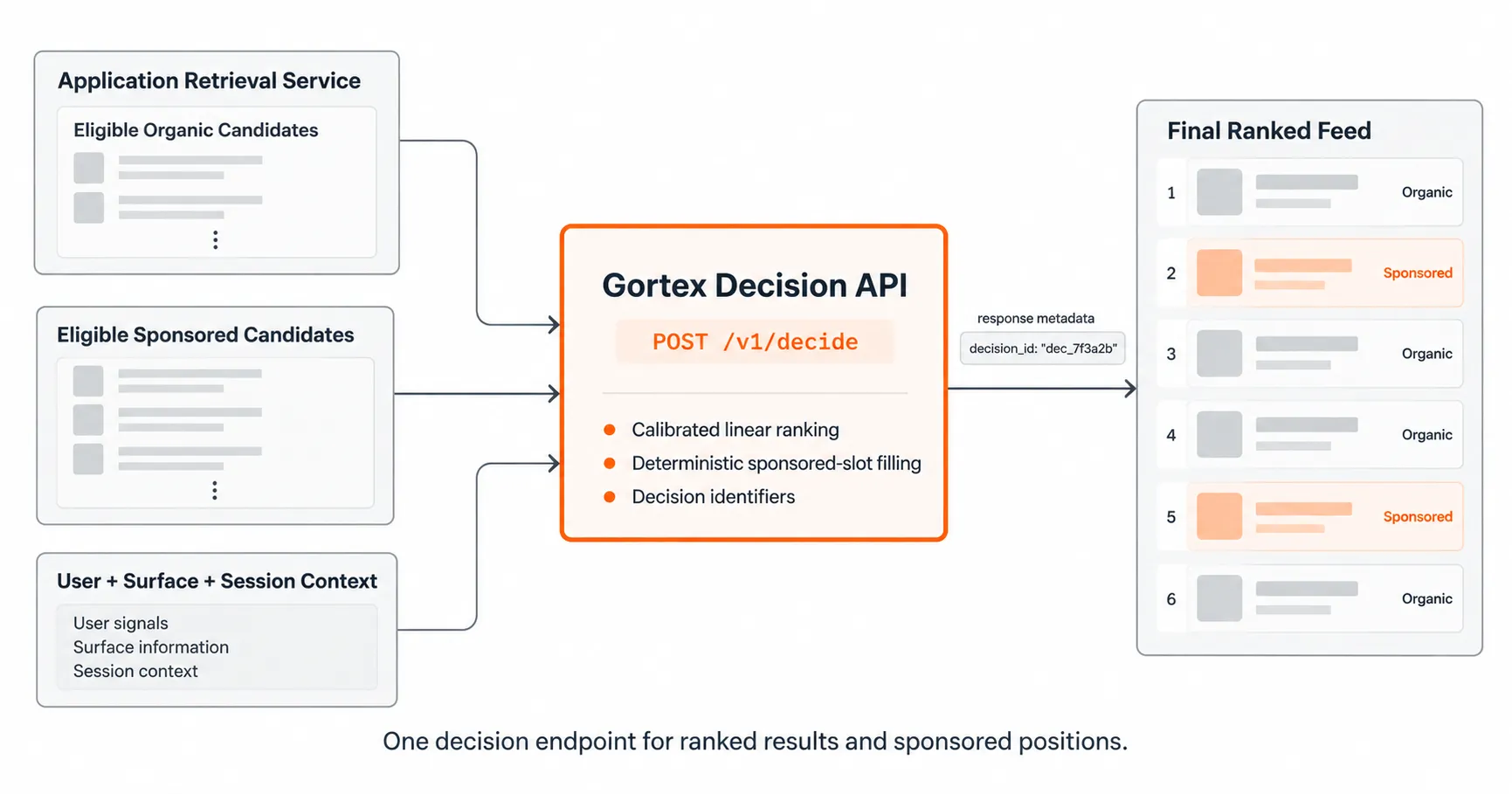
The application supplies recipient context, surface information, and candidate items. Gortex returns ranked items, sponsored placement decisions, and identifiers supporting decision tracing.
Currently documented capabilities include calibrated linear ranking, deterministic sponsored-slot filling, and decision traceability.
Gortex reports sub-200ms p99 latency in private beta. This is a vendor-reported figure, not an independently verified production benchmark.
Its learned ranker and real-time auction are roadmap capabilities rather than generally available features.
This distinction matters when comparing vendors.
Gortex is not a replacement for your retrieval system, a complete ML experimentation platform, or a full advertiser-management suite.
It focuses on the decision layer connecting retrieved candidates to the final feed.
Teams can begin with shadow-mode evaluation before introducing live ranking or sponsored placements.
For applications currently maintaining separate organic ranking and monetization logic, that unified decision boundary is the core architectural proposition.
Request Gortex beta access to evaluate the API against an existing ranking surface.
Conclusion
A feed ranking API can replace substantial ranking decision infrastructure with a single integration boundary.
But it does not eliminate candidate retrieval, data quality requirements, experimentation, or application-specific constraints.
For CTOs evaluating build versus buy, the right question is not whether an API can return ranked item IDs.
It is whether the service can deliver reliable, explainable decisions within your latency budget while supporting future personalization and monetization requirements.
Keep ownership of your product's data and discovery experience. Outsource ranking infrastructure when operating it is no longer your competitive advantage.
Frequently Asked Questions
What is the difference between a feed ranking API and a ranking engine?
A feed ranking API exposes ranking functionality through an interface. A ranking engine performs the underlying scoring and ordering. An engine can be accessed through an API.
Does a feed ranking API replace candidate retrieval?
Usually not. Many ranking APIs expect an application to provide eligible candidates from its existing database, search engine, or retrieval service.
Can a feed ranking API personalize social feeds?
Yes, when the provider supports relevant user and item signals. The level of personalization depends on its ranking approach and available data.
Can a ranking API support sponsored posts?
Some APIs support sponsored-slot placement alongside organic ordering. Others require a separate advertising decision system.
Should startups build their own feed ranking engine?
Building may make sense when proprietary ranking is a core competitive advantage. Managed APIs can be more practical when engineering resources are limited and infrastructure ownership adds little differentiation.