An ad server API lets applications programmatically manage advertising operations or request which ad should fill an available placement. Depending on the provider, it may support campaign configuration, targeting, creative delivery, tracking, and reporting.
For marketplace and consumer-app developers, the requirement is often narrower: fill sponsored positions inside existing search results, feeds, or recommendations. That becomes complex when eligibility, budgets, relevance, latency, and measurement enter the request path.
This guide explains ad server APIs, programmatic slot-filling, auction mechanics, costs, and when a dedicated sponsored-placement API makes more sense than an entire ad server.
What Is an Ad Server API?
An ad server API is a programmatic interface to advertising infrastructure. Developers use it to configure advertising resources, request ad decisions, or retrieve delivery information without depending exclusively on dashboards or advertising tags.
A full ad server may manage advertisers, campaigns, inventory, creatives, targeting, delivery rules, and reporting. For example, Google Ad Manager's API describes orders, line items, creatives, ad units, placements, and targeting relationships.
But not every interface exposes every function. Management APIs configure inventory and campaigns; decision APIs select ads for available placements. Some platforms offer both, while narrower services only make placement decisions.
For developers, that boundary determines integration complexity, infrastructure ownership, and cost.
How Does an Ad Server Select an Ad?
An advertising decision starts when an application identifies an available placement, such as a banner, sponsored product, promoted creator card, or search-result position.
The simplified request path is:
User Request → Available Slot → Eligibility → Selection → Response → Rendering → Tracking
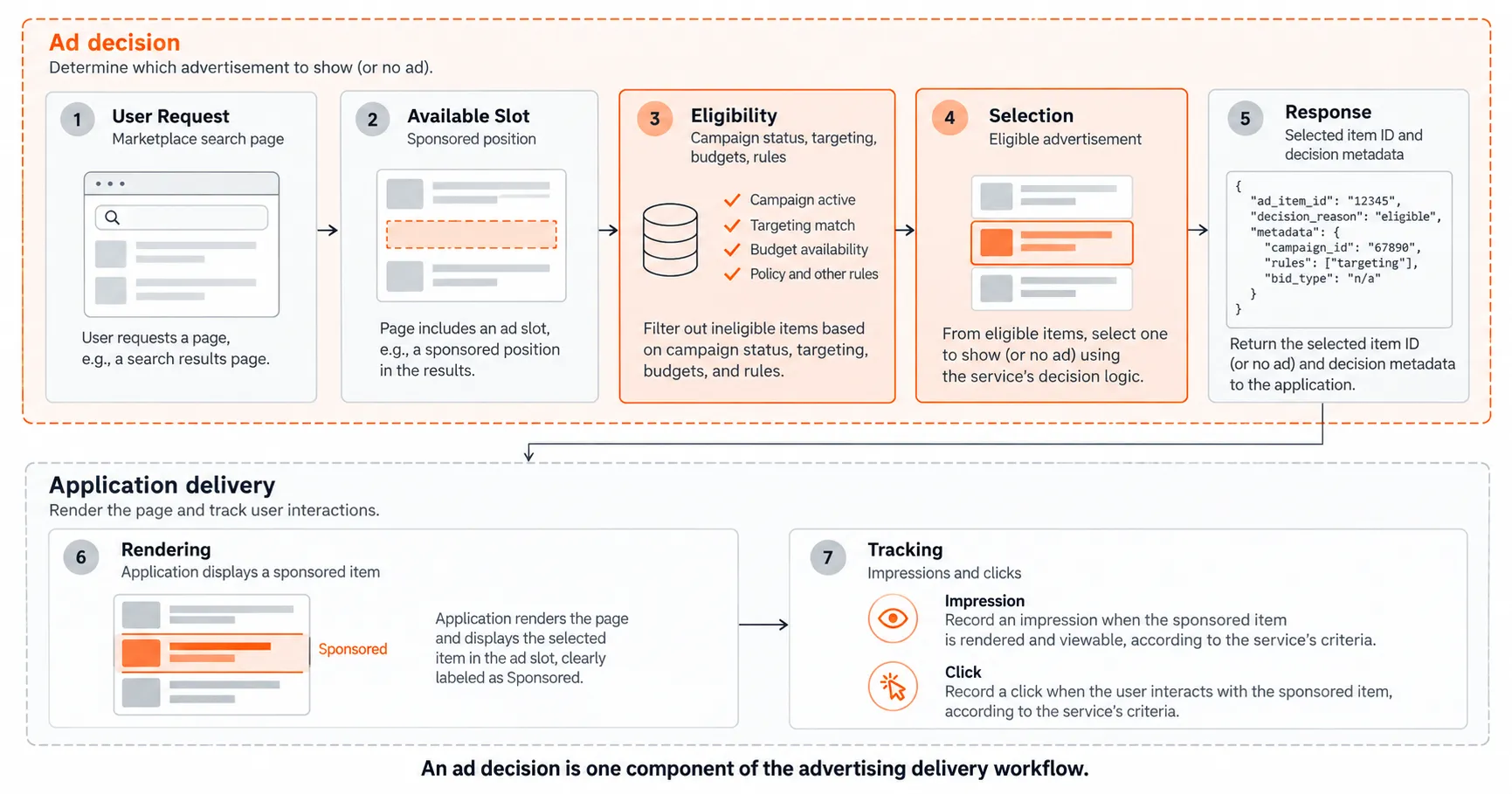
The application sends placement details and permitted context. The service filters campaigns against targeting, status, budget, scheduling, and compatibility rules. Eligible advertisements then compete under a selection mechanism, which might use priority, fixed allocations, predicted value, or auctions.
The response identifies an ad or sponsored item. The application renders it and reports eligible impressions or clicks.
Campaign configuration and ad selection are separate operations, even when one provider supplies both. Likewise, returning a decision does not necessarily mean the service hosts the creative or bills the advertiser.
What Does an Ad Server Manage?
A production ad server often contains several interconnected systems.
Google Ad Manager's line-item documentation illustrates how targeting, schedules, and creative relationships fit within structured advertising objects.
A marketplace already operating listing cards, advertiser relationships, and a catalog may not need every subsystem. Its immediate challenge may be deciding which sponsored listing qualifies for a feed position.
What Is Programmatic Slot-Filling?
Programmatic slot-filling uses software decisions to place eligible advertisements into available inventory, rather than assigning each placement manually.
Imagine a marketplace search page with twenty results. The application reserves positions two and five for sponsored listings and submits the eligible opportunities to a decision service.
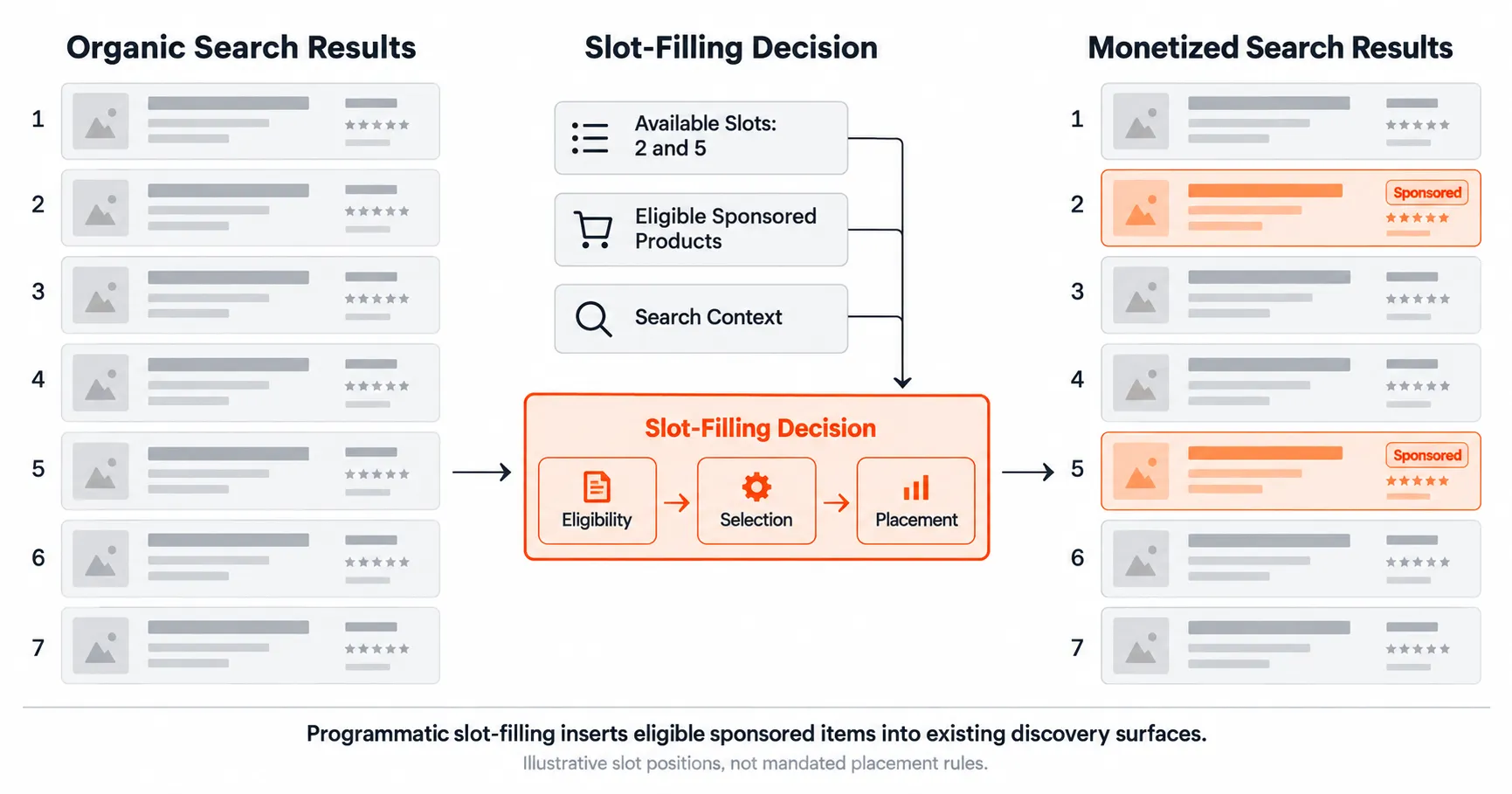
The service selects candidates that satisfy the marketplace's constraints. The application inserts the returned listings into its existing product-card interface, visibly labeled Sponsored.
Unlike a standalone banner ad, a native sponsored listing is part of the discovery experience. It must work alongside organic relevance, availability, and pagination.
That is why a sponsored listings API can provide a narrower integration than a complete ad server, especially when an application already owns catalog retrieval and feed rendering.
How Does an Ad Decision API Work?
An ad decision API enables server-side advertisement selection through an HTTP request containing placement information, user context, and eligibility constraints.
For developers evaluating this integration pattern, a simplified vendor-neutral request might look like:
A simplified vendor-neutral example might be:
{
  "placement": "search_results_2",
  "context": {
    "category": "running_shoes",
    "device": "mobile"
  },
  "slots": 1
}
A conceptual response could contain:
{
  "placement": "search_results_2",
  "selected_item": "product_205",
  "campaign_id": "campaign_42",
  "decision_id": "decision_123"
}
These examples explain the pattern; neither is a verified executable vendor contract.
Ad decision APIs vary in their response structure. Some return complete ad creatives and tracking URLs, while others return item identifiers that applications resolve using their existing content systems. Developers should evaluate delivery formats, impression and click tracking, and response metadata alongside ad-selection logic to ensure reliable integration.
Ad Server API vs Sponsored Listings API
These approaches overlap, but their typical boundaries differ.
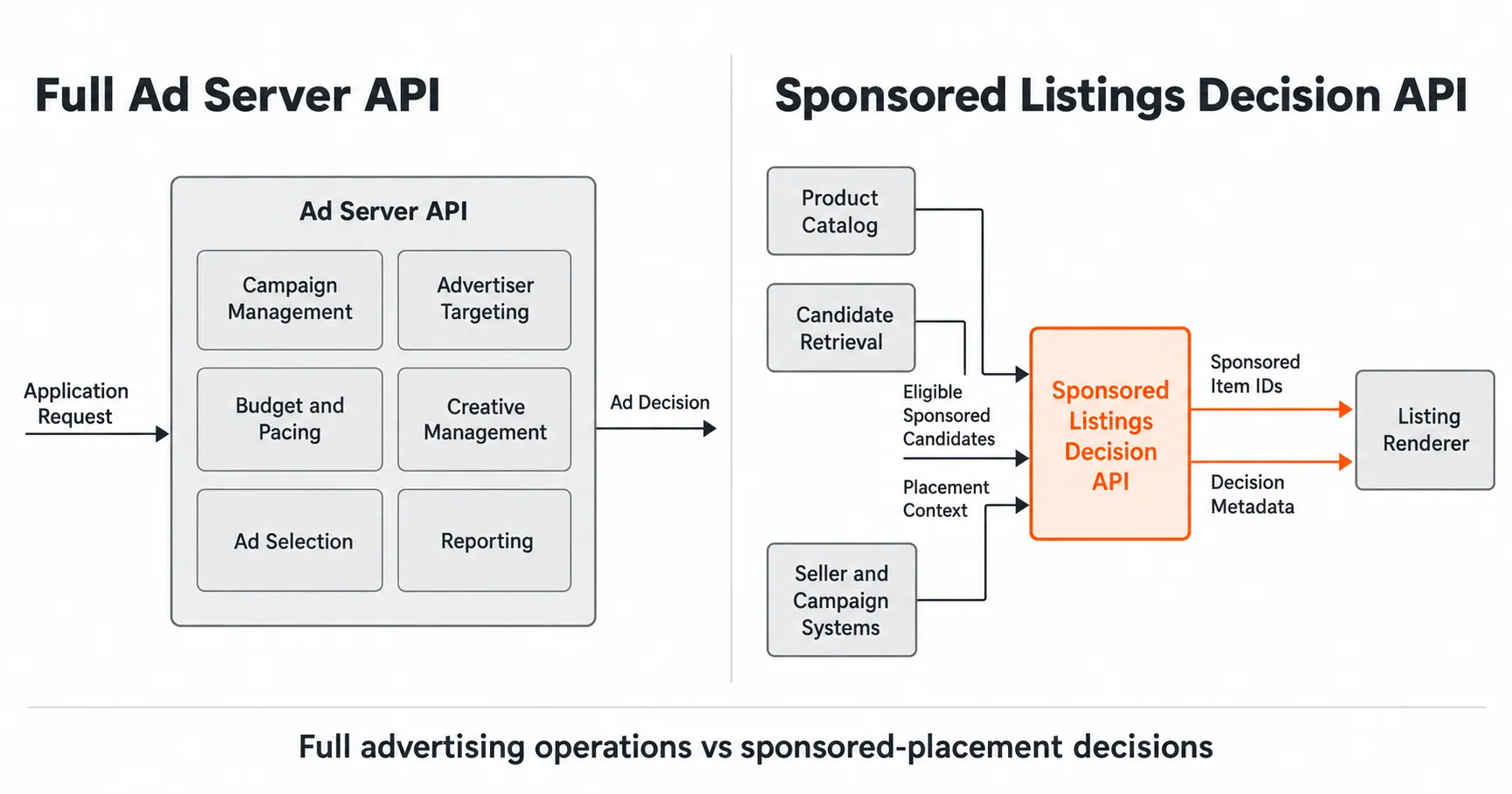
Vendor capabilities vary; evaluate actual endpoints instead of category labels. A sponsored API might include campaign functions, while a full ad server might also support native commerce placements.
Is an Ad Server API an Auction API?
No. An auction API evaluates bids and selects winners under a specified pricing mechanism. An ad server may contain auction functionality, but it can also deliver reserved or fixed-priority campaigns.
The IAB Tech Lab OpenRTB 2.6 specification standardizes bid requests, bid responses, and related signals. It does not define an entire campaign-management platform.
Understanding real-time ad auctions helps teams distinguish winner selection from budgeting, serving, and reporting.
Slot-filling answers what appears; auction mechanisms help determine who qualifies and what they pay. Auction pricing is not mandatory for every sponsored placement.
How Much Revenue Can Sponsored Slots Generate?
Revenue depends on fill rate, engagement, advertiser demand, and pricing. Consider a hypothetical marketplace with ten million monthly feed requests and two potential sponsored slots per request.
Assume a 60% fill rate, 1.5% click-through rate, and $0.40 realized CPC.
10M × 2 × 60% × 1.5% × $0.40 = $72,000
This is an illustrative model, not a customer result or industry benchmark. It excludes serving costs, invalid traffic adjustments, and refunds.
More slots do not guarantee proportionally more revenue. They may displace organic listings that would have converted. The economics of marketplace advertising depend on advertiser yield and the effect on buyer discovery.
How Do You Protect Organic Discovery?
Sponsored placements compete for attention with organic results. Therefore, monetization decisions should respect relevance, availability, and user experience.
Useful constraints include minimum relevance thresholds, inventory checks, sponsored-density limits, frequency caps, and exclusion rules.
Ads must also be recognizable. The FTC's native advertising guidance explains why commercial content needs clear, prominent disclosure when consumers might otherwise mistake it for independent material.
For sponsored product cards, use an immediately understandable label such as Sponsored.
A high bid should not automatically place an irrelevant listing ahead of useful organic content. Relevance protection is a product requirement, not merely an advertiser setting.
Which Metrics Matter?
Ad revenue is insufficient on its own. Track delivery, advertiser outcomes, technical reliability, and organic impact.
Key measures include fill rate, billable impressions, valid clicks, realized CPC or CPM, advertiser conversions, revenue per thousand feed requests, organic conversion, p95/p99 latency, and fallback frequency.
For CPC pricing:
Revenue = Billable Clicks × Realized CPC
For CPM pricing:
Revenue = Billable Impressions / 1,000 × Realized CPM
Connect decision identifiers to impression and click events. Establish deduplication, attribution windows, and clear billing rules. Without reconciliation, an apparently successful delivery system can still produce advertiser disputes.
What Should Developers Validate?
Ad selection often runs inside the user-facing request path. Evaluate providers under realistic concurrency, batch sizes, and network conditions, not only dashboard demonstrations.
Measure p50, p95, and p99 latency, error rates, timeout behavior, and request limits. Confirm whether a single request can fill multiple slots and whether no-fill responses are explicitly represented.
An empty sponsored slot should never prevent the underlying feed from loading. Configure fallback behavior that preserves eligible organic results when advertising decisions fail.
Review authentication, data retention, decision logging, geographic deployment, and migration options before committing to a provider.
Should You Build or Integrate?
Building an ad server internally provides control over delivery, targeting, advertiser workflows, and pricing. It also creates ongoing operational and financial reconciliation responsibilities.
For perspective, two engineers working six months at $150,000 annual fully loaded compensation each represent $150,000 in illustrative staffing costs, excluding hosting and maintenance. This is an assumption-based calculation, not an industry benchmark.
Managed platforms reduce some engineering ownership but introduce subscription or usage fees, integration work, and vendor dependency.
The decision hinges on what your application already operates. If it owns advertiser workflows and catalog rendering, a narrowly scoped placement service may be sufficient. If it needs full campaign operations and reporting, a broader ad server may be justified.
Where Does Gortex Fit?
Gortex's Sponsored Listings API focuses on the decision layer between eligible candidates and a ranked marketplace feed.
Applications can submit candidate and context information through POST /v1/decide. The response combines organic ranking and sponsored-slot decisions with identifiers supporting traceability.
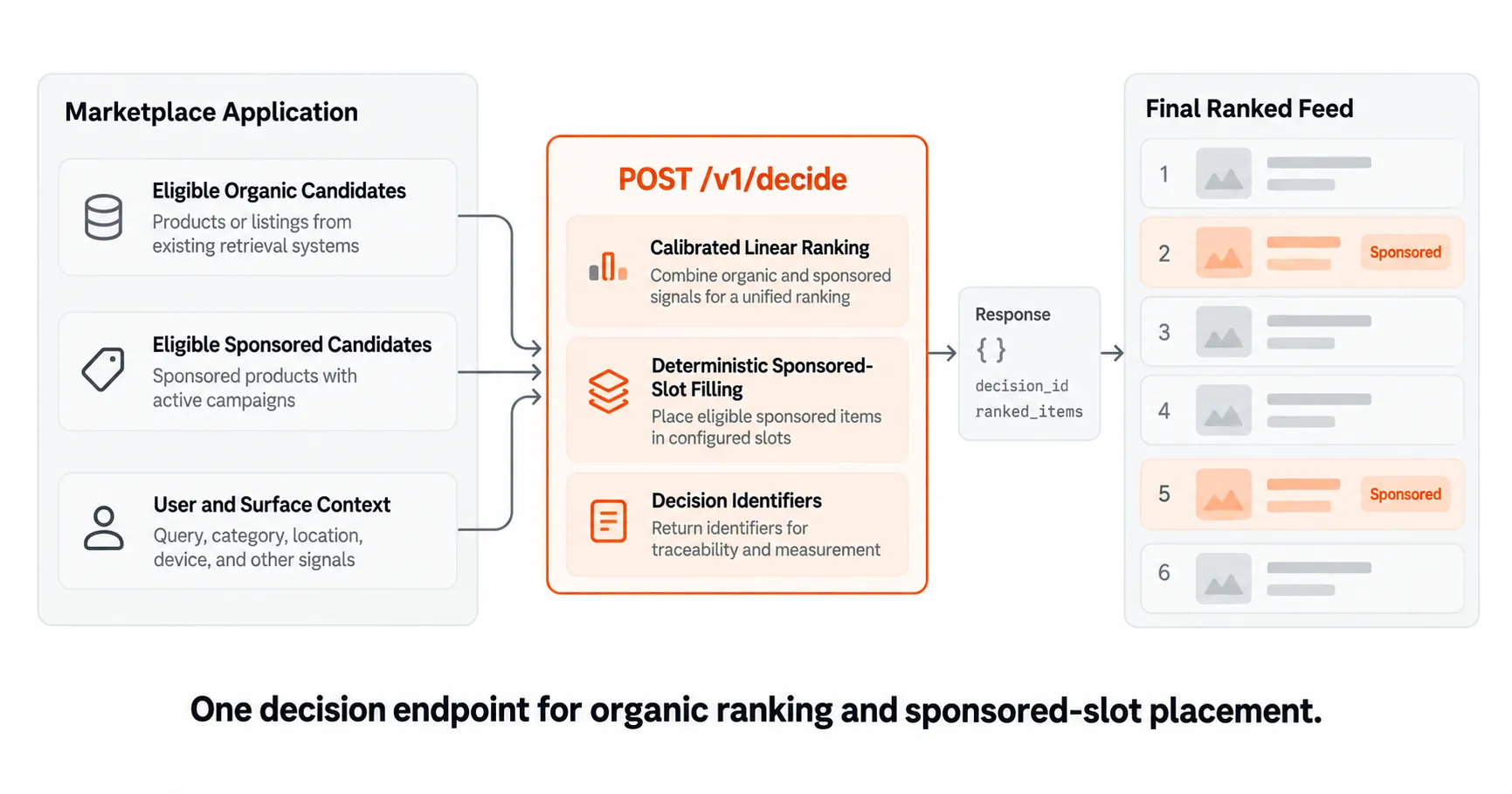
Currently documented capabilities include calibrated linear ranking, deterministic sponsored-slot filling, and decision identifiers. Learned ranking and real-time auctions are roadmap capabilities, not generally available production features.
Gortex is therefore not a complete ad server for advertiser billing, creative hosting, campaign management, or live auction pricing. Its narrower role is coordinating eligible organic and sponsored placement decisions in one response.
For teams already operating discovery infrastructure, that boundary can reduce the need to maintain separate rankers and placement-merging logic.
Conclusion
Ad server APIs vary from broad advertising platforms to narrower decision endpoints. A complete ad server can manage campaigns, creatives, budgets, delivery, and reporting; a sponsored-placement API focuses on which eligible item fills a native feed position.
Choose based on existing infrastructure, latency constraints, commercial operations, and relevance requirements.
Build advertising systems that differentiate your product. Use APIs for decisioning infrastructure you do not need to own.
Frequently Asked Questions
What does an ad server API do?
It exposes advertising operations, such as campaign configuration, inventory management, ad selection, or reporting, depending on the provider.
Can I serve ads without an ad server?
Yes. You can implement placement logic internally or use a narrower decisioning API, provided tracking and commercial operations are handled elsewhere.
Is an ad server API the same as OpenRTB?
No. OpenRTB standardizes bidding interactions. Ad server APIs may support broader campaign and delivery workflows.
Do sponsored listings require auctions?
No. Platforms can use fixed pricing, priority rules, deterministic placements, or auctions.